

References
Alarcon, J. V., Van Heemst, J., & de Jong, N. (1997). The social accounting matrix extended with
social and environmental indicators-an application to Bolivia. Working Paper No. 256,
Institute of Social Studies.
CSO (2006). Statistical Abstract of Indian Economy: Central Statistical Organization, India.
Gallardo, A., Mardones, C. (2013). Environmentally extended social accounting matrix for chile.
Environment, Development and Sustainability, Springer 15(4), 1099–1127 August.
Harris, J. R., and Todaro, M. P. (1970). Migration, unemployment and development: A two-sector
analysis. American Economic Review 60, 126–142.
INCCA (2010). India: Greenhouse Gas Emissions 2007, Indian Network for Climate Change
Assessment, Ministry of Environment and Forests (MoEF), Govt. of India.
IPCC (2006). IPCC Guidelines for National Greenhouse Gas Inventories, Intergovernmental
Panel on Climate Change (IPCC), Energy, Vol. 2.
Keuning, S. J., (1992). National Accounts and Environment: The case for a system’s approach.
National Accounts Occasional Paper, Nr. NA-53, Netherlands Central Bureau of Statistics,
Voorburg.
LAEI (2003). London Atmospheric Emissions Inventory database, http://data.london.gov.uk/
dataset
Markandya, A., & Murty, M. N. (2000). Cost–benefit analysis of cleaning the Ganges: Some
emerging environment and development issues. Environment and Development Economics,
9(1), 61–81.
Murty, M. N., & Gulati, S. C. (2004). A generalized method of hedonic prices: Measuring benefits
from reduced urban air pollution. Institute of Economic Growth Working Paper E/254/2005,
New Delhi.
Murty, M. N., Gulati, S. C., & Banerjee, A. (2004): Measuring benefits from reduced air pollution
in the cities of Delhi and Kolkata in India using hedonic property prices model. Institute of
Economic Growth Working Paper 249, New Delhi.
Murty, M. N., Gulati, S. C. (2005) A Generalized Method of Hedonic Prices: Measuring Benefits
from Reduced Urban Air Pollution. Institute of Economic Growth Working Paper E/254/2005,
New Delhi.
National Sample Survey Organisation (NSSO). (2000–01). Household consumption expenditure
and employment. Government of India.
Pal, B. D., Pohit, S., Roy, J. (2012). Social Accounting Matrix For India. Economic Systems
Research, 24(1), 77–99.
Pal, B. D., Pohit, S. (2014). Environmentally Extended Social Accounting Matrix for Climate
Change Policy Analysis in India. Journal of Regional Development and Planning 3(1), 61–76.
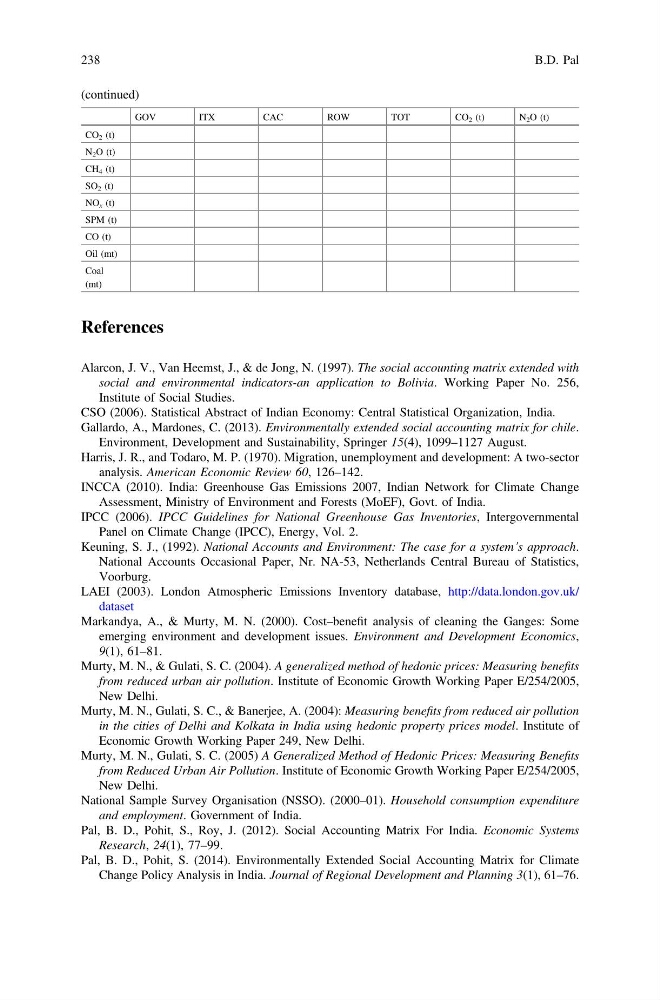
(continued)
GOV
ITX
CAC
ROW
TOT
CO 2 (t)
N 2 O (t)
CO 2 (t)
N 2 O (t)
CH 4 (t)
SO 2 (t)
NO x (t)
SPM (t)
CO (t)
Oil (mt)
Coal
(mt)
238
B.D. Pal
Alarcon, J. V., Van Heemst, J., & de Jong, N. (1997). The social accounting matrix extended with
social and environmental indicators-an application to Bolivia. Working Paper No. 256,
Institute of Social Studies.
CSO (2006). Statistical Abstract of Indian Economy: Central Statistical Organization, India.
Gallardo, A., Mardones, C. (2013). Environmentally extended social accounting matrix for chile.
Environment, Development and Sustainability, Springer 15(4), 1099–1127 August.
Harris, J. R., and Todaro, M. P. (1970). Migration, unemployment and development: A two-sector
analysis. American Economic Review 60, 126–142.
INCCA (2010). India: Greenhouse Gas Emissions 2007, Indian Network for Climate Change
Assessment, Ministry of Environment and Forests (MoEF), Govt. of India.
IPCC (2006). IPCC Guidelines for National Greenhouse Gas Inventories, Intergovernmental
Panel on Climate Change (IPCC), Energy, Vol. 2.
Keuning, S. J., (1992). National Accounts and Environment: The case for a system’s approach.
National Accounts Occasional Paper, Nr. NA-53, Netherlands Central Bureau of Statistics,
Voorburg.
LAEI (2003). London Atmospheric Emissions Inventory database, http://data.london.gov.uk/
dataset
Markandya, A., & Murty, M. N. (2000). Cost–benefit analysis of cleaning the Ganges: Some
emerging environment and development issues. Environment and Development Economics,
9(1), 61–81.
Murty, M. N., & Gulati, S. C. (2004). A generalized method of hedonic prices: Measuring benefits
from reduced urban air pollution. Institute of Economic Growth Working Paper E/254/2005,
New Delhi.
Murty, M. N., Gulati, S. C., & Banerjee, A. (2004): Measuring benefits from reduced air pollution
in the cities of Delhi and Kolkata in India using hedonic property prices model. Institute of
Economic Growth Working Paper 249, New Delhi.
Murty, M. N., Gulati, S. C. (2005) A Generalized Method of Hedonic Prices: Measuring Benefits
from Reduced Urban Air Pollution. Institute of Economic Growth Working Paper E/254/2005,
New Delhi.
National Sample Survey Organisation (NSSO). (2000–01). Household consumption expenditure
and employment. Government of India.
Pal, B. D., Pohit, S., Roy, J. (2012). Social Accounting Matrix For India. Economic Systems
Research, 24(1), 77–99.
Pal, B. D., Pohit, S. (2014). Environmentally Extended Social Accounting Matrix for Climate
Change Policy Analysis in India. Journal of Regional Development and Planning 3(1), 61–76.
(continued)
GOV
ITX
CAC
ROW
TOT
CO 2 (t)
N 2 O (t)
CO 2 (t)
N 2 O (t)
CH 4 (t)
SO 2 (t)
NO x (t)
SPM (t)
CO (t)
Oil (mt)
Coal
(mt)
238
B.D. Pal