

settlements humans began to actively shape the land surface of the Earth in order to
produce biomass for food, materials and energy conversion. First evidence of the
existence of villages in India can be dated back to the seventh millennium B.C.
(Misra 2001). In the following millennia, advancements of technologies, medicine
and the access to biotic and mineral resources led to continuous increase of the world
population and consequential transformations to natural land-cover. After the
Industrial Revolution in the eighteenth century, human impacts on nature have
reached an unprecedented level of magnitude. In this light some scientists are
speaking of a new geologic era, the Anthropocene where humanity alters actively the
functioning of the whole Earth System (e.g. Crutzen 2006).
The interactivity between humans and ecosystems can be understood through the
concept of ecosystem services. This presumes that ecosystems provide essential
goods and services to society, and that as humanity uses these services they may be
depleted and hence their sustainability requires mechanisms for their management.
This includes resources such as food, energy and space for living, but also processes such as climate regulation and water retention to avoid flooding (Millennium
Ecosystem Assessment 2005). The portfolio of goods and services provided by a
particular ecosystem depends on its structure and how it is managed by humans.
A scientific framework to describe and to better understand interactions between
human societies and ecosystems is the concept of human-environment systems (e.g.
Turner et al. 2007). These are composed of a human sub-system and an environment
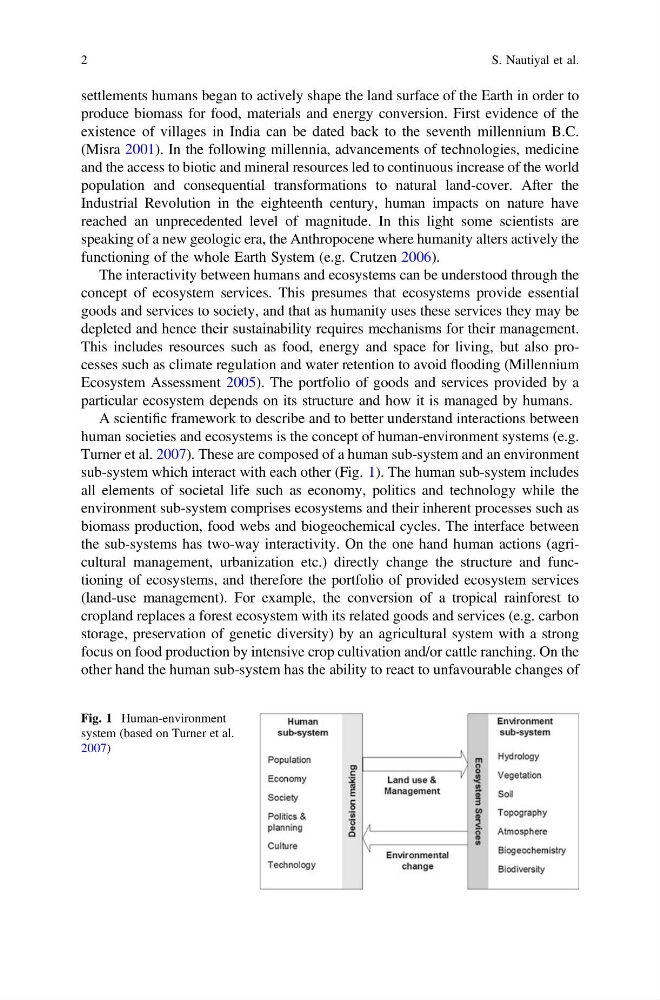
sub-system which interact with each other (Fig. 1). The human sub-system includes
all elements of societal life such as economy, politics and technology while the
environment sub-system comprises ecosystems and their inherent processes such as
biomass production, food webs and biogeochemical cycles. The interface between
the sub-systems has two-way interactivity. On the one hand human actions (agricultural management, urbanization etc.) directly change the structure and functioning of ecosystems, and therefore the portfolio of provided ecosystem services
(land-use management). For example, the conversion of a tropical rainforest to
cropland replaces a forest ecosystem with its related goods and services (e.g. carbon
storage, preservation of genetic diversity) by an agricultural system with a strong
focus on food production by intensive crop cultivation and/or cattle ranching. On the
other hand the human sub-system has the ability to react to unfavourable changes of
Fig. 1 Human-environment
system (based on Turner et al.
2007)
2
S. Nautiyal et al.
produce biomass for food, materials and energy conversion. First evidence of the
existence of villages in India can be dated back to the seventh millennium B.C.
(Misra 2001). In the following millennia, advancements of technologies, medicine
and the access to biotic and mineral resources led to continuous increase of the world
population and consequential transformations to natural land-cover. After the
Industrial Revolution in the eighteenth century, human impacts on nature have
reached an unprecedented level of magnitude. In this light some scientists are
speaking of a new geologic era, the Anthropocene where humanity alters actively the
functioning of the whole Earth System (e.g. Crutzen 2006).
The interactivity between humans and ecosystems can be understood through the
concept of ecosystem services. This presumes that ecosystems provide essential
goods and services to society, and that as humanity uses these services they may be
depleted and hence their sustainability requires mechanisms for their management.
This includes resources such as food, energy and space for living, but also processes such as climate regulation and water retention to avoid flooding (Millennium
Ecosystem Assessment 2005). The portfolio of goods and services provided by a
particular ecosystem depends on its structure and how it is managed by humans.
A scientific framework to describe and to better understand interactions between
human societies and ecosystems is the concept of human-environment systems (e.g.
Turner et al. 2007). These are composed of a human sub-system and an environment
sub-system which interact with each other (Fig. 1). The human sub-system includes
all elements of societal life such as economy, politics and technology while the
environment sub-system comprises ecosystems and their inherent processes such as
biomass production, food webs and biogeochemical cycles. The interface between
the sub-systems has two-way interactivity. On the one hand human actions (agricultural management, urbanization etc.) directly change the structure and functioning of ecosystems, and therefore the portfolio of provided ecosystem services
(land-use management). For example, the conversion of a tropical rainforest to
cropland replaces a forest ecosystem with its related goods and services (e.g. carbon
storage, preservation of genetic diversity) by an agricultural system with a strong
focus on food production by intensive crop cultivation and/or cattle ranching. On the
other hand the human sub-system has the ability to react to unfavourable changes of
Fig. 1 Human-environment
system (based on Turner et al.
2007)
2
S. Nautiyal et al.