

5 The Effects of Urbanization
Generally the urban population growth in India was slow during pre-independence;
however, there was a gradual increase of urban population during the liberalization
period. And as per the latest census of 2011, about 31 % of population in the total is
urban. Interestingly this population is mostly accumulating in class I cities. And the
class three tier cities are losing the ground. However, during the post-liberalization
period, India has witnessed a rural influx into urban areas. This has put tremendous
pressure on fertile land and resulted in resource depletion and environmental pollution. The most striking feature of India’s urbanization is that it is ‘large-city
oriented’ and almost 70 % of India’s urban population is now concentrated in class
I cities (Lakshmana 2008). The poor quality of India’s urban centers and the
consequent haphazard kind of urbanization has been worsened by the burden of this
rural influx. The magnitude of environmental degradation in such urban sprawls is
alarming. However, increased urban population over the past 30 years is of greater
significance in the western region compared with other regions in India. Besides,
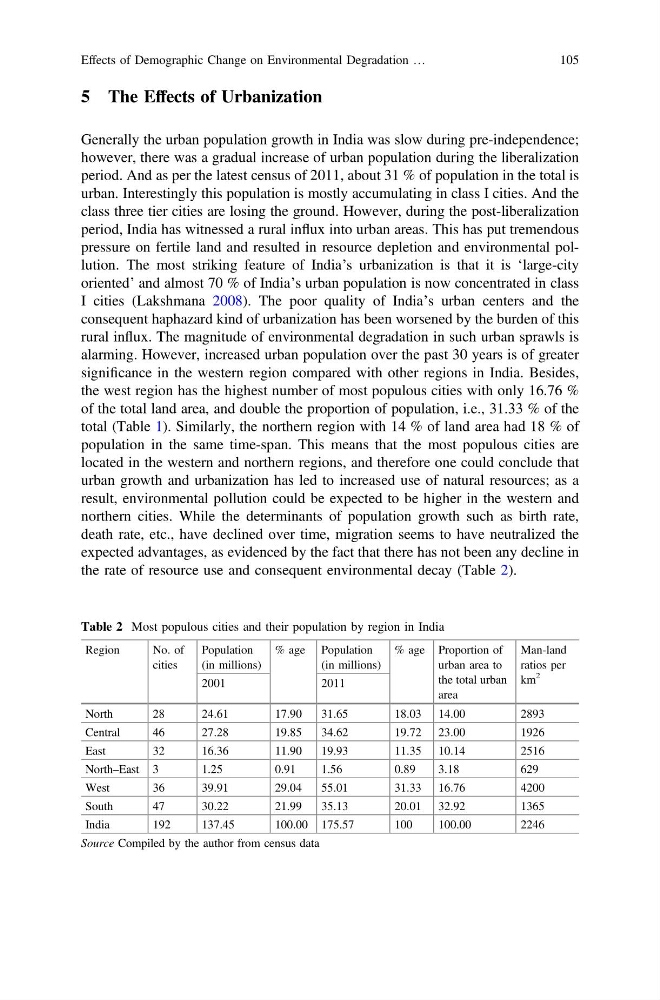
the west region has the highest number of most populous cities with only 16.76 %
of the total land area, and double the proportion of population, i.e., 31.33 % of the
total (Table 1). Similarly, the northern region with 14 % of land area had 18 % of
population in the same time-span. This means that the most populous cities are
located in the western and northern regions, and therefore one could conclude that
urban growth and urbanization has led to increased use of natural resources; as a
result, environmental pollution could be expected to be higher in the western and
northern cities. While the determinants of population growth such as birth rate,
death rate, etc., have declined over time, migration seems to have neutralized the
expected advantages, as evidenced by the fact that there has not been any decline in
the rate of resource use and consequent environmental decay (Table 2).
Table 2 Most populous cities and their population by region in India
Region
No. of
cities
Population
(in millions)
% age Population
(in millions)
% age Proportion of
urban area to
the total urban
area
Man-land
ratios per
km
2
2001
2011
North
28
24.61
17.90
31.65
18.03 14.00
2893
Central
46
27.28
19.85
34.62
19.72 23.00
1926
East
32
16.36
11.90
19.93
11.35 10.14
2516
North–East 3
1.25
0.91
1.56
0.89
3.18
629
West
36
39.91
29.04
55.01
31.33 16.76
4200
South
47
30.22
21.99
35.13
20.01 32.92
1365
India
192
137.45
100.00 175.57
100
100.00
2246
Source Compiled by the author from census data
Effects of Demographic Change on Environmental Degradation …
105
Generally the urban population growth in India was slow during pre-independence;
however, there was a gradual increase of urban population during the liberalization
period. And as per the latest census of 2011, about 31 % of population in the total is
urban. Interestingly this population is mostly accumulating in class I cities. And the
class three tier cities are losing the ground. However, during the post-liberalization
period, India has witnessed a rural influx into urban areas. This has put tremendous
pressure on fertile land and resulted in resource depletion and environmental pollution. The most striking feature of India’s urbanization is that it is ‘large-city
oriented’ and almost 70 % of India’s urban population is now concentrated in class
I cities (Lakshmana 2008). The poor quality of India’s urban centers and the
consequent haphazard kind of urbanization has been worsened by the burden of this
rural influx. The magnitude of environmental degradation in such urban sprawls is
alarming. However, increased urban population over the past 30 years is of greater
significance in the western region compared with other regions in India. Besides,
the west region has the highest number of most populous cities with only 16.76 %
of the total land area, and double the proportion of population, i.e., 31.33 % of the
total (Table 1). Similarly, the northern region with 14 % of land area had 18 % of
population in the same time-span. This means that the most populous cities are
located in the western and northern regions, and therefore one could conclude that
urban growth and urbanization has led to increased use of natural resources; as a
result, environmental pollution could be expected to be higher in the western and
northern cities. While the determinants of population growth such as birth rate,
death rate, etc., have declined over time, migration seems to have neutralized the
expected advantages, as evidenced by the fact that there has not been any decline in
the rate of resource use and consequent environmental decay (Table 2).
Table 2 Most populous cities and their population by region in India
Region
No. of
cities
Population
(in millions)
% age Population
(in millions)
% age Proportion of
urban area to
the total urban
area
Man-land
ratios per
km
2
2001
2011
North
28
24.61
17.90
31.65
18.03 14.00
2893
Central
46
27.28
19.85
34.62
19.72 23.00
1926
East
32
16.36
11.90
19.93
11.35 10.14
2516
North–East 3
1.25
0.91
1.56
0.89
3.18
629
West
36
39.91
29.04
55.01
31.33 16.76
4200
South
47
30.22
21.99
35.13
20.01 32.92
1365
India
192
137.45
100.00 175.57
100
100.00
2246
Source Compiled by the author from census data
Effects of Demographic Change on Environmental Degradation …
105