

62
H.-J. Bolle
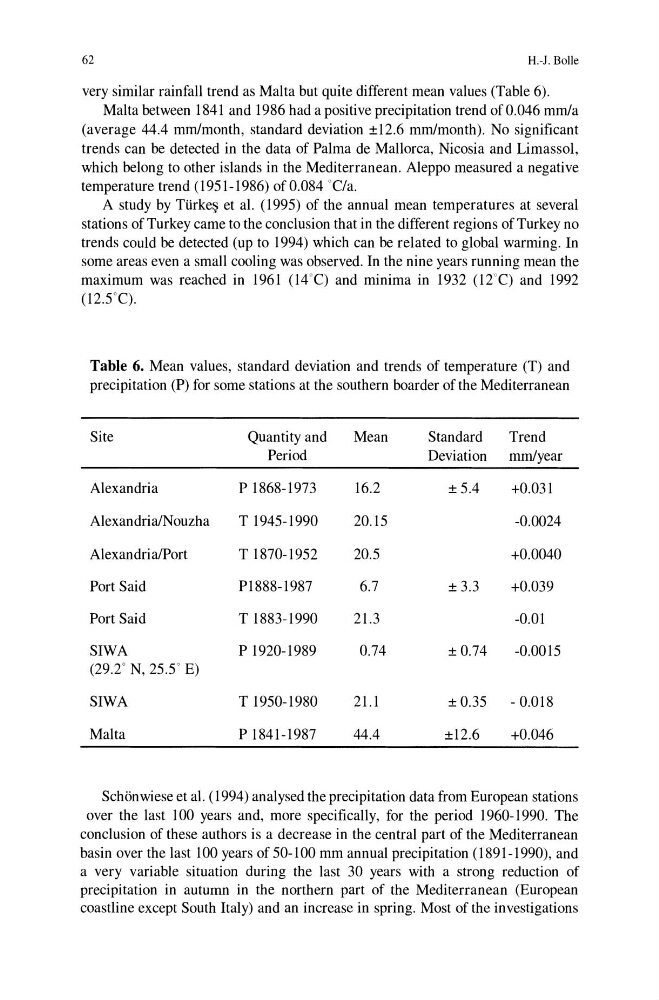
very similar rainfall trend as Malta but quite different mean values (Table 6).
Malta between 1841 and 1986 had a positive precipitation trend of 0.046 mm/a
(average 44.4 mm/month, standard deviation ±12.6 mm/month). No significant
trends can be detected in the data of Palma de Mallorca, Nicosia and Limassol,
which belong to other islands in the Mediterranean. Aleppo measured a negative
temperature trend (1951-1986) of 0.084 'Cia.
A study by Tiirke~ et al. (1995) of the annual mean temperatures at several
stations of Turkey came to the conclusion that in the different regions of Turkey no
trends could be detected (up to 1994) which can be related to global warming. In
some areas even a small cooling was observed. In the nine years running mean the
maximum was reached in 1961 (14'C) and minima in 1932 (12'C) and 1992
(12SC).
Table 6. Mean values, standard deviation and trends of temperature (T) and
precipitation (P) for some stations at the southern boarder of the Mediterranean
Site
Quantity and
Mean
Standard
Trend
Period
Deviation
mm/year
Alexandria
P 1868-1973
16.2
±5.4
+0.031
A1exandria/Nouzha
T 1945-1990
20.15
-0.0024
Alexandria/Port
T 1870-1952
20.5
+0.0040
Port Said
P1888-1987
6.7
± 3.3
+0.039
Port Said
T 1883-1990
21.3
-0.01
SIWA
P 1920-1989
0.74
±0.74
-0.0015
(29.2' N, 25.5' E)
SIWA
T 1950-1980
21.1
±0.35
- 0.018
Malta
P 1841-1987
44.4
±12.6
+0.046
SchOn wiese et al. (L 994) analysed the precipitation data from European stations
over the last 100 years and, more specifically, for the period 1960-1990. The
conclusion of these authors is a decrease in the central part of the Mediterranean
basin over the last 100 years of 50-100 mm annual precipitation (1891-1990), and
a very variable situation during the last 30 years with a strong reduction of
precipitation in autumn in the northern part of the Mediterranean (European
coastline except South Italy) and an increase in spring. Most of the investigations
H.-J. Bolle
very similar rainfall trend as Malta but quite different mean values (Table 6).
Malta between 1841 and 1986 had a positive precipitation trend of 0.046 mm/a
(average 44.4 mm/month, standard deviation ±12.6 mm/month). No significant
trends can be detected in the data of Palma de Mallorca, Nicosia and Limassol,
which belong to other islands in the Mediterranean. Aleppo measured a negative
temperature trend (1951-1986) of 0.084 'Cia.
A study by Tiirke~ et al. (1995) of the annual mean temperatures at several
stations of Turkey came to the conclusion that in the different regions of Turkey no
trends could be detected (up to 1994) which can be related to global warming. In
some areas even a small cooling was observed. In the nine years running mean the
maximum was reached in 1961 (14'C) and minima in 1932 (12'C) and 1992
(12SC).
Table 6. Mean values, standard deviation and trends of temperature (T) and
precipitation (P) for some stations at the southern boarder of the Mediterranean
Site
Quantity and
Mean
Standard
Trend
Period
Deviation
mm/year
Alexandria
P 1868-1973
16.2
±5.4
+0.031
A1exandria/Nouzha
T 1945-1990
20.15
-0.0024
Alexandria/Port
T 1870-1952
20.5
+0.0040
Port Said
P1888-1987
6.7
± 3.3
+0.039
Port Said
T 1883-1990
21.3
-0.01
SIWA
P 1920-1989
0.74
±0.74
-0.0015
(29.2' N, 25.5' E)
SIWA
T 1950-1980
21.1
±0.35
- 0.018
Malta
P 1841-1987
44.4
±12.6
+0.046
SchOn wiese et al. (L 994) analysed the precipitation data from European stations
over the last 100 years and, more specifically, for the period 1960-1990. The
conclusion of these authors is a decrease in the central part of the Mediterranean
basin over the last 100 years of 50-100 mm annual precipitation (1891-1990), and
a very variable situation during the last 30 years with a strong reduction of
precipitation in autumn in the northern part of the Mediterranean (European
coastline except South Italy) and an increase in spring. Most of the investigations