

60
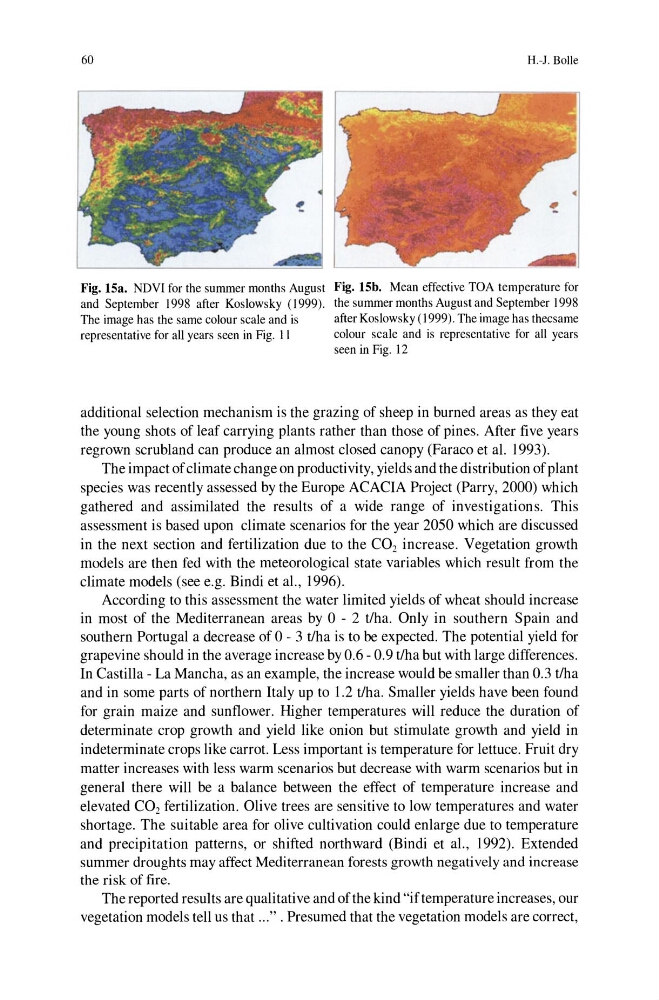
Fig. ISa. NOVI for the summer months August
and September 1998 after Koslowsky (1999).
The image has the same colour scale and is
representative for all years seen in Fig. II
H.-J. Bolle
Fig. ISb. Mean effective TOA temperature for
the summer months August and September 1998
after Koslowsky (1999). The image has thecsame
colour scale and is representative for all years
seen in Fig. 12
additional selection mechanism is the grazing of sheep in burned areas as they eat
the young shots of leaf carrying plants rather than those of pines. After five years
regrown scrubland can produce an almost closed canopy (Faraco et ai. 1993).
The impact of climate change on productivity, yields and the distribution of plant
species was recently assessed by the Europe ACACIA Project (Parry, 2000) which
gathered and assimilated the results of a wide range of investigations. This
assessment is based upon climate scenarios for the year 2050 which are discussed
in the next section and fertilization due to the CO 2 increase. Vegetation growth
models are then fed with the meteorological state variables which result from the
climate models (see e.g. Bindi et aI., 1996).
According to this assessment the water limited yields of wheat should increase
in most of the Mediterranean areas by 0 - 2 t/ha. Only in southern Spain and
southern Portugal a decrease of 0 - 3 Uha is to be expected. The potential yield for
grapevine should in the average increase by 0.6 - 0.9 tlha but with large differences.
In Castilla - La Mancha, as an example, the increase would be smaller than 0.3 Uha
and in some parts of northern Italy up to 1.2 t/ha. Smaller yields have been found
for grain maize and sunflower. Higher temperatures will reduce the duration of
determinate crop growth and yield like onion but stimulate growth and yield in
indeterminate crops like carrot. Less important is temperature for lettuce. Fruit dry
matter increases with less warm scenarios but decrease with warm scenarios but in
general there will be a balance between the effect of temperature increase and
elevated CO 2 fertilization. Olive trees are sensitive to low temperatures and water
shortage. The suitable area for olive cultivation could enlarge due to temperature
and precipitation patterns, or shifted northward (Bindi et aI., 1992). Extended
summer droughts may affect Mediterranean forests growth negatively and increase
the risk of fire.
The reported results are qualitati ve and of the kind "if temperature increases, our
vegetation models tell us that ... " . Presumed that the vegetation models are correct,
Fig. ISa. NOVI for the summer months August
and September 1998 after Koslowsky (1999).
The image has the same colour scale and is
representative for all years seen in Fig. II
H.-J. Bolle
Fig. ISb. Mean effective TOA temperature for
the summer months August and September 1998
after Koslowsky (1999). The image has thecsame
colour scale and is representative for all years
seen in Fig. 12
additional selection mechanism is the grazing of sheep in burned areas as they eat
the young shots of leaf carrying plants rather than those of pines. After five years
regrown scrubland can produce an almost closed canopy (Faraco et ai. 1993).
The impact of climate change on productivity, yields and the distribution of plant
species was recently assessed by the Europe ACACIA Project (Parry, 2000) which
gathered and assimilated the results of a wide range of investigations. This
assessment is based upon climate scenarios for the year 2050 which are discussed
in the next section and fertilization due to the CO 2 increase. Vegetation growth
models are then fed with the meteorological state variables which result from the
climate models (see e.g. Bindi et aI., 1996).
According to this assessment the water limited yields of wheat should increase
in most of the Mediterranean areas by 0 - 2 t/ha. Only in southern Spain and
southern Portugal a decrease of 0 - 3 Uha is to be expected. The potential yield for
grapevine should in the average increase by 0.6 - 0.9 tlha but with large differences.
In Castilla - La Mancha, as an example, the increase would be smaller than 0.3 Uha
and in some parts of northern Italy up to 1.2 t/ha. Smaller yields have been found
for grain maize and sunflower. Higher temperatures will reduce the duration of
determinate crop growth and yield like onion but stimulate growth and yield in
indeterminate crops like carrot. Less important is temperature for lettuce. Fruit dry
matter increases with less warm scenarios but decrease with warm scenarios but in
general there will be a balance between the effect of temperature increase and
elevated CO 2 fertilization. Olive trees are sensitive to low temperatures and water
shortage. The suitable area for olive cultivation could enlarge due to temperature
and precipitation patterns, or shifted northward (Bindi et aI., 1992). Extended
summer droughts may affect Mediterranean forests growth negatively and increase
the risk of fire.
The reported results are qualitati ve and of the kind "if temperature increases, our
vegetation models tell us that ... " . Presumed that the vegetation models are correct,