

Towards a Mediterranean GEWEX
353
In order to establish a GEWEX one will draw in a number of existing
programmes and projects such as the MED-HYCOS network which can be looked
at as a backbone of the hydrological branch of a GEWEX in the Mediterranean area
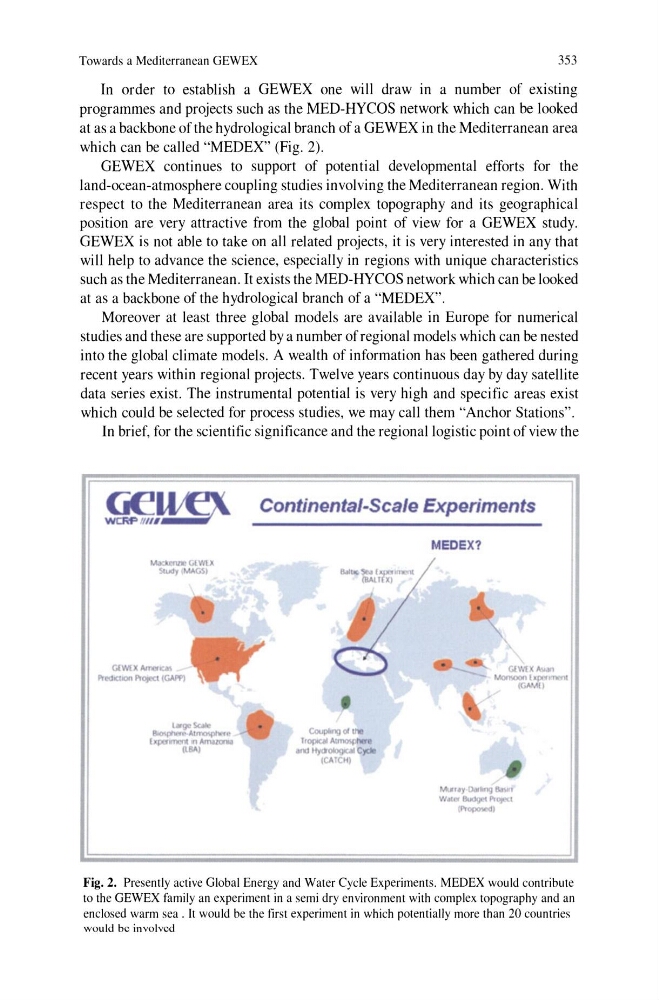
which can be called "MEDEX" (Fig. 2).
GEWEX continues to support of potential developmental efforts for the
land-ocean-atmosphere coupling studies involving the Mediterranean region. With
respect to the Mediterranean area its complex topography and its geographical
position are very attractive from the global point of view for a GEWEX study.
GEWEX is not able to take on all related projects, it is very interested in any that
will help to advance the science, especially in regions with unique characteristics
such as the Mediterranean. It exists the MED-HYCOS network which can be looked
at as a backbone of the hydrological branch of a "MEDEX".
Moreover at least three global models are available in Europe for numerical
studies and these are supported by a number of regional models which can be nested
into the global climate models. A wealth of information has been gathered during
recent years within regional projects. Twelve years continuous day by day satellite
data series exist. The instrumental potential is very high and specific areas exist
which could be selected for process studies, we may call them "Anchor Stations".
In brief, for the scientific significance and the regional logistic point of view the
Moo: """,,"lWL'
I"', ,MAGS)
Continental-Scale Experiments
MEDEX?
Fig. 2. Presently active Global Energy and Water Cycle Experiments. MEDEX would contribute
to the GEWEX family an experiment in a semi dry environment with complex topography and an
enclosed warm sea. It would be the first experiment in which potentially more than 20 countries
would bc involvcd
353
In order to establish a GEWEX one will draw in a number of existing
programmes and projects such as the MED-HYCOS network which can be looked
at as a backbone of the hydrological branch of a GEWEX in the Mediterranean area
which can be called "MEDEX" (Fig. 2).
GEWEX continues to support of potential developmental efforts for the
land-ocean-atmosphere coupling studies involving the Mediterranean region. With
respect to the Mediterranean area its complex topography and its geographical
position are very attractive from the global point of view for a GEWEX study.
GEWEX is not able to take on all related projects, it is very interested in any that
will help to advance the science, especially in regions with unique characteristics
such as the Mediterranean. It exists the MED-HYCOS network which can be looked
at as a backbone of the hydrological branch of a "MEDEX".
Moreover at least three global models are available in Europe for numerical
studies and these are supported by a number of regional models which can be nested
into the global climate models. A wealth of information has been gathered during
recent years within regional projects. Twelve years continuous day by day satellite
data series exist. The instrumental potential is very high and specific areas exist
which could be selected for process studies, we may call them "Anchor Stations".
In brief, for the scientific significance and the regional logistic point of view the
Moo: """,,"lWL'
I"', ,MAGS)
Continental-Scale Experiments
MEDEX?
Fig. 2. Presently active Global Energy and Water Cycle Experiments. MEDEX would contribute
to the GEWEX family an experiment in a semi dry environment with complex topography and an
enclosed warm sea. It would be the first experiment in which potentially more than 20 countries
would bc involvcd