

280
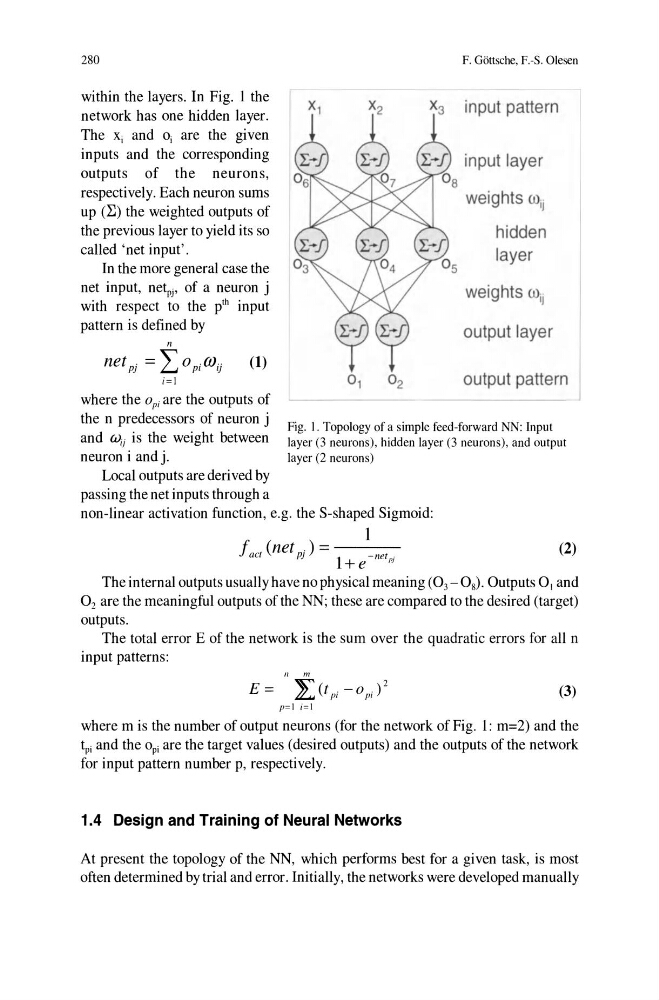
within the layers. In Fig. 1 the
network has one hidden layer.
The Xi and 0i are the given
inputs and the corresponding
outputs of the neurons,
respectively. Each neuron sums
up O~) the weighted outputs of
the previous layer to yield its so
called 'net input'.
In the more general case the
net input, net pi ' of a neuron j
with respect to the pth input
pattern is defined by
n
net pj = I 0 piWij
i=!
(1)
where the 0pi are the outputs of
the n predecessors of neuron j
and wij is the weight between
neuron i and j.
Local outputs are derived by
passing the net inputs through a
F. Gottsche. F.-S. Olesen
X3
input pattern
weights w 1j
hidden
layer
weights w ij
output layer
output pattern
Fig. 1. Topology of a simple feed-forward NN: Input
layer (3 neurons), hidden layer (3 neurons). and output
layer (2 neurons)
non-linear activation function, e.g. the S-shaped Sigmoid:
1
fact (net pj ) = 1 -net
+ e Pi
(2)
The internal outputs usually have no physical meaning (0 3 - Os). Outputs 0 1 and
O 2 are the meaningful outputs of the NN; these are compared to the desired (target)
outputs.
The total error E of the network is the sum over the quadratic errors for all n
input patterns:
II
m
E = ~ (t pi - 0 pi ) 2
(3)
p=1 i=1
where m is the number of output neurons (for the network of Fig. 1: m=2) and the
tpi and the 0pi are the target values (desired outputs) and the outputs of the network
for input pattern number p, respectively.
1.4 Design and Training of Neural Networks
At present the topology of the NN, which performs best for a given task, is most
often determined by trial and error. Initially, the networks were developed manually
within the layers. In Fig. 1 the
network has one hidden layer.
The Xi and 0i are the given
inputs and the corresponding
outputs of the neurons,
respectively. Each neuron sums
up O~) the weighted outputs of
the previous layer to yield its so
called 'net input'.
In the more general case the
net input, net pi ' of a neuron j
with respect to the pth input
pattern is defined by
n
net pj = I 0 piWij
i=!
(1)
where the 0pi are the outputs of
the n predecessors of neuron j
and wij is the weight between
neuron i and j.
Local outputs are derived by
passing the net inputs through a
F. Gottsche. F.-S. Olesen
X3
input pattern
weights w 1j
hidden
layer
weights w ij
output layer
output pattern
Fig. 1. Topology of a simple feed-forward NN: Input
layer (3 neurons), hidden layer (3 neurons). and output
layer (2 neurons)
non-linear activation function, e.g. the S-shaped Sigmoid:
1
fact (net pj ) = 1 -net
+ e Pi
(2)
The internal outputs usually have no physical meaning (0 3 - Os). Outputs 0 1 and
O 2 are the meaningful outputs of the NN; these are compared to the desired (target)
outputs.
The total error E of the network is the sum over the quadratic errors for all n
input patterns:
II
m
E = ~ (t pi - 0 pi ) 2
(3)
p=1 i=1
where m is the number of output neurons (for the network of Fig. 1: m=2) and the
tpi and the 0pi are the target values (desired outputs) and the outputs of the network
for input pattern number p, respectively.
1.4 Design and Training of Neural Networks
At present the topology of the NN, which performs best for a given task, is most
often determined by trial and error. Initially, the networks were developed manually