

224
P. Maheras and C. Anagnostopoulou
4 The Automated Circulation Classification Scheme
4.1 Principle
The automated scheme is based on standardised 500hPa geopotential height data
(NCEP reanalysis data; Kalnay et ai., 1996, at OOh, 06h, 12h and 18h) with a spatial
resolution of 2.5" x 2.5" for the region 200N - 65°N and 200W - 50 0 E for the period
1958-1997. The data were standardised on a monthly basis using the formula:
Zi is the standardised value at grid point i,
X i is the observed value at grid point i,
Xi is the mean monthly value at grid point i, and
a is the standard deviation at grid point i.
(8)
The first step is to determine whether the hourly (12h) anomalies over Greece
(calculated as the mean for 8 grid points, 2.5° x 2.5°) are positive or negative. The
second step is to look for the
centre of the positive or negative
the region of the absolute highest
positive or negative anomaly in the
Ane
examined area. For an anticyclonic
centre, the value of the anomalies
at the centre must be greater or
equal to the corresponding
neighbouring grid points, while for
a cyclonic centre it must be lower
or equal. The next step is to check
whether there is a continuous
decrease or increase of the
anomalies from the centre of the
system towards Greece, for
posltlve or negative centres
respectively. The following step is
to look for other regional or local
centres. If one or more positive or
negative centres are found with
similar characteristics, the centre
located closest to Greece is
defined as the centre of the
anomaly system.
The final step is the
classification of the anticyclonic
and cyclonic circulation types.
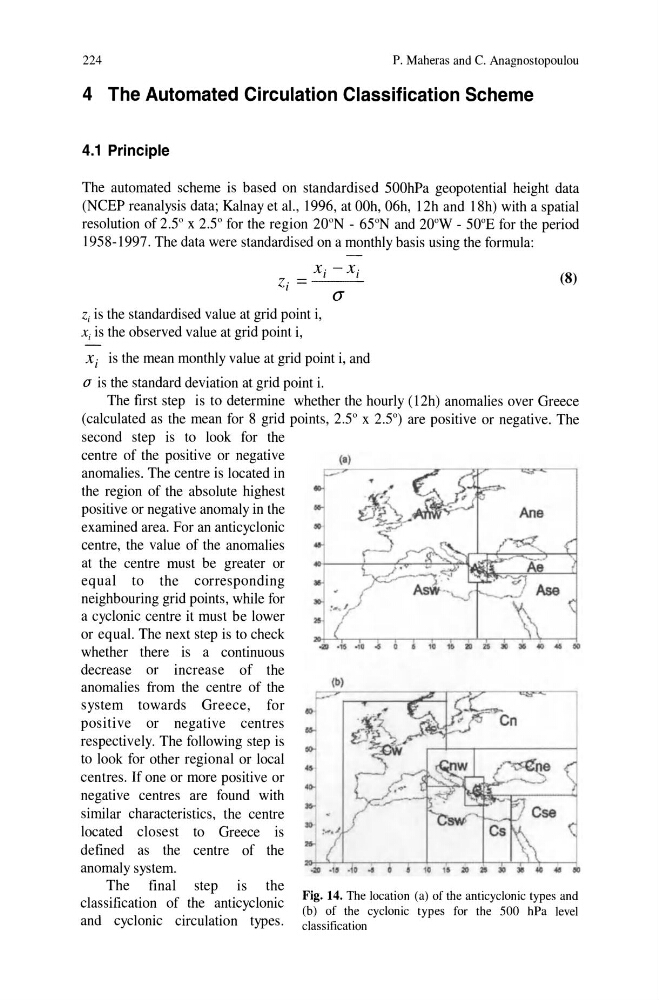
Fig. 14. The location (a) of the anticyclon ic types and
(b) of the cyclonic types for the 500 hPa level
classification
P. Maheras and C. Anagnostopoulou
4 The Automated Circulation Classification Scheme
4.1 Principle
The automated scheme is based on standardised 500hPa geopotential height data
(NCEP reanalysis data; Kalnay et ai., 1996, at OOh, 06h, 12h and 18h) with a spatial
resolution of 2.5" x 2.5" for the region 200N - 65°N and 200W - 50 0 E for the period
1958-1997. The data were standardised on a monthly basis using the formula:
Zi is the standardised value at grid point i,
X i is the observed value at grid point i,
Xi is the mean monthly value at grid point i, and
a is the standard deviation at grid point i.
(8)
The first step is to determine whether the hourly (12h) anomalies over Greece
(calculated as the mean for 8 grid points, 2.5° x 2.5°) are positive or negative. The
second step is to look for the
centre of the positive or negative
the region of the absolute highest
positive or negative anomaly in the
Ane
examined area. For an anticyclonic
centre, the value of the anomalies
at the centre must be greater or
equal to the corresponding
neighbouring grid points, while for
a cyclonic centre it must be lower
or equal. The next step is to check
whether there is a continuous
decrease or increase of the
anomalies from the centre of the
system towards Greece, for
posltlve or negative centres
respectively. The following step is
to look for other regional or local
centres. If one or more positive or
negative centres are found with
similar characteristics, the centre
located closest to Greece is
defined as the centre of the
anomaly system.
The final step is the
classification of the anticyclonic
and cyclonic circulation types.
Fig. 14. The location (a) of the anticyclon ic types and
(b) of the cyclonic types for the 500 hPa level
classification