

222
P. Maheras and C. Anagnostopoulou
3.2 Trends of Precipitation
Linear regression is the most commonly used technique for assessing relationships
between two variables (De Luis et aI., 2000), however, trends in precipitation series
are rarely linear. Moreover, linear regression assumes normality and homogeneity of
variance throughout the series (Clark and Hosking, 1986) and may be adversely
affected by outliers (De Luis et aI., 2000).
Linear regression was chosen to study the trends of annual and seasonal for both
precipitation totals and rain days. In addition Spearman's rank correlation test
(Sneyers, 1992) was chosen to detect significant trends at a 95% significance level.
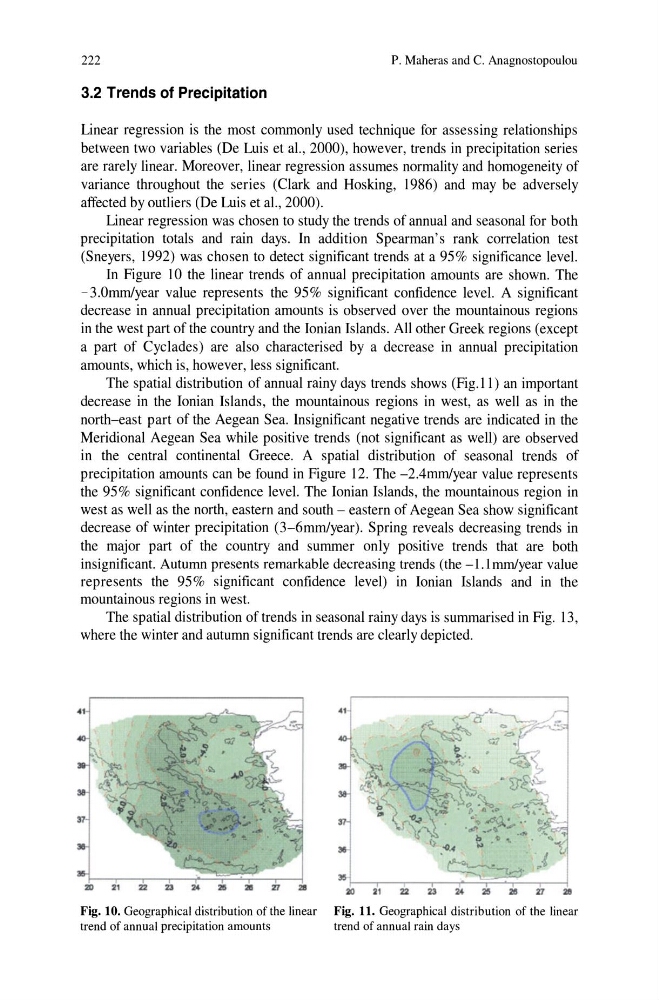
In Figure 10 the linear trends of annual precipitation amounts are shown. The
- 3.0mm/year value represents the 95% significant confidence level. A significant
decrease in annual precipitation amounts is observed over the mountainous regions
in the west part of the country and the Ionian Islands. All other Greek regions (except
a part of Cyclades) are also characterised by a decrease in annual precipitation
amounts, which is, however, less significant.
The spatial distribution of annual rainy days trends shows (Fig. 1 1 ) an important
decrease in the Ionian Islands, the mountainous regions in west, as well as in the
north-east part of the Aegean Sea. Insignificant negative trends are indicated in the
Meridional Aegean Sea while positive trends (not significant as well) are observed
in the central continental Greece. A spatial distribution of seasonal trends of
precipitation amounts can be found in Figure 12. The -2.4mm/year value represents
the 95% significant confidence level. The Ionian Islands, the mountainous region in
west as well as the north, eastern and south - eastern of Aegean Sea show significant
decrease of winter precipitation (3-6mmJyear). Spring reveals decreasing trends in
the major part of the country and summer only positive trends that are both
insignificant. Autumn presents remarkable decreasing trends (the -1.1 mm/year value
represents the 95% significant confidence level) in Ionian Islands and in the
mountainous regions in west.
The spatial distribution of trends in seasonal rainy days is summarised in Fig. 13,
where the winter and autumn significant trends are clearly depicted.
Fig. 10. Geographical distribution of the linear
trend of annual precipitation amounts
:lO
2t
ZI
23
24
25
211
%7
211
Fig. 11. Geographical distribution of the linear
trend of annual rain days
P. Maheras and C. Anagnostopoulou
3.2 Trends of Precipitation
Linear regression is the most commonly used technique for assessing relationships
between two variables (De Luis et aI., 2000), however, trends in precipitation series
are rarely linear. Moreover, linear regression assumes normality and homogeneity of
variance throughout the series (Clark and Hosking, 1986) and may be adversely
affected by outliers (De Luis et aI., 2000).
Linear regression was chosen to study the trends of annual and seasonal for both
precipitation totals and rain days. In addition Spearman's rank correlation test
(Sneyers, 1992) was chosen to detect significant trends at a 95% significance level.
In Figure 10 the linear trends of annual precipitation amounts are shown. The
- 3.0mm/year value represents the 95% significant confidence level. A significant
decrease in annual precipitation amounts is observed over the mountainous regions
in the west part of the country and the Ionian Islands. All other Greek regions (except
a part of Cyclades) are also characterised by a decrease in annual precipitation
amounts, which is, however, less significant.
The spatial distribution of annual rainy days trends shows (Fig. 1 1 ) an important
decrease in the Ionian Islands, the mountainous regions in west, as well as in the
north-east part of the Aegean Sea. Insignificant negative trends are indicated in the
Meridional Aegean Sea while positive trends (not significant as well) are observed
in the central continental Greece. A spatial distribution of seasonal trends of
precipitation amounts can be found in Figure 12. The -2.4mm/year value represents
the 95% significant confidence level. The Ionian Islands, the mountainous region in
west as well as the north, eastern and south - eastern of Aegean Sea show significant
decrease of winter precipitation (3-6mmJyear). Spring reveals decreasing trends in
the major part of the country and summer only positive trends that are both
insignificant. Autumn presents remarkable decreasing trends (the -1.1 mm/year value
represents the 95% significant confidence level) in Ionian Islands and in the
mountainous regions in west.
The spatial distribution of trends in seasonal rainy days is summarised in Fig. 13,
where the winter and autumn significant trends are clearly depicted.
Fig. 10. Geographical distribution of the linear
trend of annual precipitation amounts
:lO
2t
ZI
23
24
25
211
%7
211
Fig. 11. Geographical distribution of the linear
trend of annual rain days