

220
P. Maheras and C. Anagnostopoulou
3 Variability and Trends of Precipitation
3.1 Variability of precipitation
The interannual variability of annual and seasonal precipitation as well as of rainy
days over Greece is examined by examining the coefficient of variability (CV) for 20
stations.
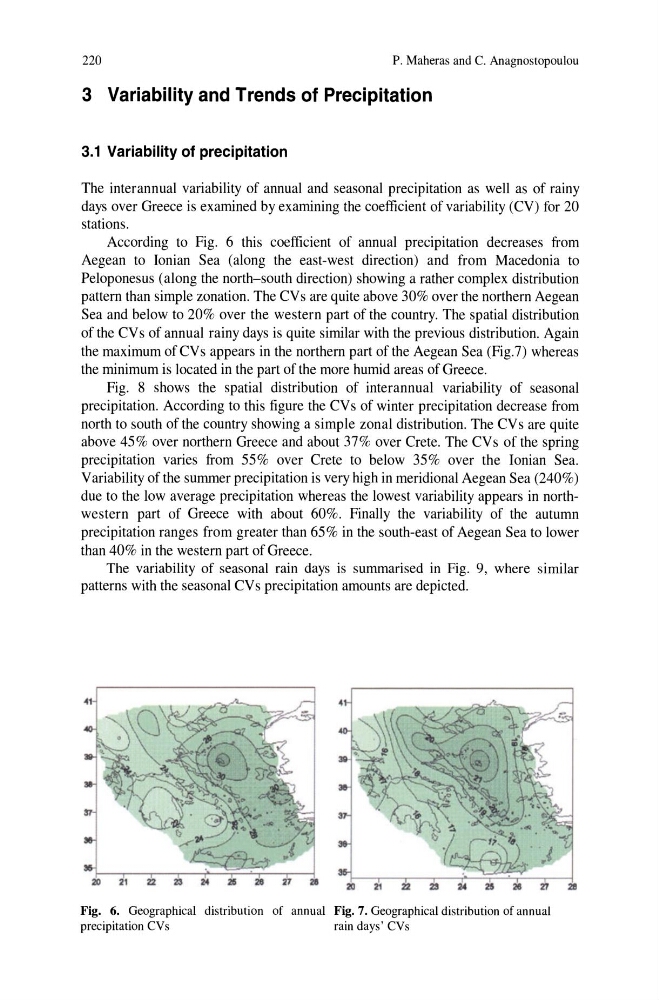
According to Fig. 6 this coefficient of annual precipitation decreases from
Aegean to Ionian Sea (along the east-west direction) and from Macedonia to
Peloponesus (along the north-south direction) showing a rather complex distribution
pattern than simple zonation. The CVs are quite above 30% over the northern Aegean
Sea and below to 20% over the western part of the country. The spatial distribution
of the CV s of annual rainy days is quite similar with the previous distribution. Again
the maximum of CV s appears in the northern part of the Aegean Sea (Fig.7) whereas
the minimum is located in the part of the more humid areas of Greece.
Fig. 8 shows the spatial distribution of interannual variability of seasonal
precipitation. According to this figure the CV s of winter precipitation decrease from
north to south of the country showing a simple zonal distribution. The CV s are quite
above 45% over northern Greece and about 37% over Crete. The CVs of the spring
precipitation varies from 55% over Crete to below 35% over the Ionian Sea.
Variability of the summer precipitation is very high in meridional Aegean Sea (240%)
due to the low average precipitation whereas the lowest variability appears in northwestern part of Greece with about 60%. Finally the variability of the autumn
precipitation ranges from greater than 65% in the south-east of Aegean Sea to lower
than 40% in the western part of Greece.
The variability of seasonal rain days is summarised in Fig. 9, where similar
patterns with the seasonal CV s precipitation amounts are depicted.
Fig. 6. Geographical distribution of annual Fig. 7. Geographical distribution of annual
precipitation CV s
rain days ' CV s
P. Maheras and C. Anagnostopoulou
3 Variability and Trends of Precipitation
3.1 Variability of precipitation
The interannual variability of annual and seasonal precipitation as well as of rainy
days over Greece is examined by examining the coefficient of variability (CV) for 20
stations.
According to Fig. 6 this coefficient of annual precipitation decreases from
Aegean to Ionian Sea (along the east-west direction) and from Macedonia to
Peloponesus (along the north-south direction) showing a rather complex distribution
pattern than simple zonation. The CVs are quite above 30% over the northern Aegean
Sea and below to 20% over the western part of the country. The spatial distribution
of the CV s of annual rainy days is quite similar with the previous distribution. Again
the maximum of CV s appears in the northern part of the Aegean Sea (Fig.7) whereas
the minimum is located in the part of the more humid areas of Greece.
Fig. 8 shows the spatial distribution of interannual variability of seasonal
precipitation. According to this figure the CV s of winter precipitation decrease from
north to south of the country showing a simple zonal distribution. The CV s are quite
above 45% over northern Greece and about 37% over Crete. The CVs of the spring
precipitation varies from 55% over Crete to below 35% over the Ionian Sea.
Variability of the summer precipitation is very high in meridional Aegean Sea (240%)
due to the low average precipitation whereas the lowest variability appears in northwestern part of Greece with about 60%. Finally the variability of the autumn
precipitation ranges from greater than 65% in the south-east of Aegean Sea to lower
than 40% in the western part of Greece.
The variability of seasonal rain days is summarised in Fig. 9, where similar
patterns with the seasonal CV s precipitation amounts are depicted.
Fig. 6. Geographical distribution of annual Fig. 7. Geographical distribution of annual
precipitation CV s
rain days ' CV s