

216
P. Maheras and C. Anagnostopoulou
1 Introduction
Greece is located in the Eastern Mediterranean basin in the south Balkans. Its climate
is highly diverse because of the complex terrain, together with the strong continental
and maritime influences (Xoplaki et aI., 2000) contributing to difficulties in weather
forecasting, especially precipitation. The precipitation pattern over the Greek area
shows a sharp gradient between the western part, where precipitation is 2 to 3 times
higher than other regions. The higher precipitation totals in the west are related to the
atmospheric circulation in association to the Mediterranean Sea surface temperature
distribution and the complex topography of the region. More specifically, as air
masses move towards the east passing over the sea, they pick up moisture in their
lower layers and become unstable. Condensation of the water vapour occurs as a
result of topographic forcing by the land and the mountains, such as the Pindus in
NW and centre Greece, Olympus and the mountains of Crete, leads to heavy rainfall
on the windward side.
Although the global circulation and regional climate factors can explain the
spatial distribution of rainfall, as well as seasonal variability, they could not account
for its interannual variability since it has different origin. Different techniques have
been used to relate Greek monthly precipitation and atmospheric circulation indices,
namely correlation coefficients analysis (Kozuchowski et aI., 1992), zonal and
meridional indices analysis (Kutiel et aI., 1996a; 1996b) and Canonical Correlation
analysis (Xoplaki et aI., 2000). Despite the strong association identified between the
monthly or seasonal circulation indices and monthly or seasonal precipitation in
Greece, it would be, however unreasonable to expect the daily precipitation regime
in Greece to be totally controlled by one or two modes of the atmospheric circulation
variability. In our
OpInIOn, only an
exhaustive study
focusing on a large
number of years and
at the same time
includes an individual
study of types
circulation will allow
to make progress in
the understanding of
the mechanisms that
govern the rainfall
regime over Greece.
The main aim of
this paper IS to
present an automatic
classification scheme
of circulation types
over Greece (Maheras
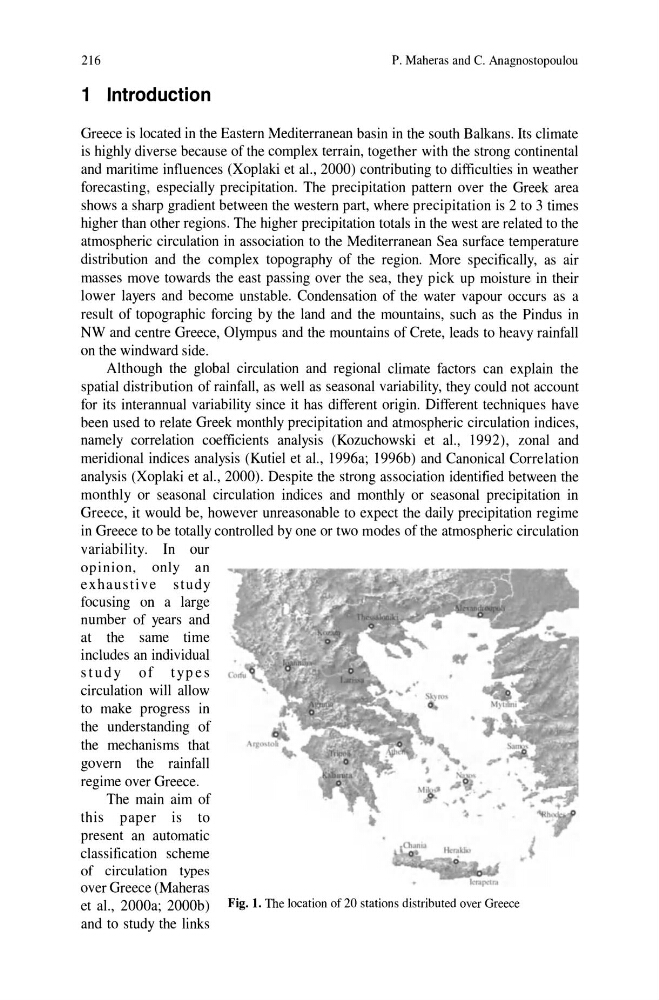
et aI., 2000a; 2000b) Fig. 1. The location of 20 stations distributed over Greece
and to study the links
P. Maheras and C. Anagnostopoulou
1 Introduction
Greece is located in the Eastern Mediterranean basin in the south Balkans. Its climate
is highly diverse because of the complex terrain, together with the strong continental
and maritime influences (Xoplaki et aI., 2000) contributing to difficulties in weather
forecasting, especially precipitation. The precipitation pattern over the Greek area
shows a sharp gradient between the western part, where precipitation is 2 to 3 times
higher than other regions. The higher precipitation totals in the west are related to the
atmospheric circulation in association to the Mediterranean Sea surface temperature
distribution and the complex topography of the region. More specifically, as air
masses move towards the east passing over the sea, they pick up moisture in their
lower layers and become unstable. Condensation of the water vapour occurs as a
result of topographic forcing by the land and the mountains, such as the Pindus in
NW and centre Greece, Olympus and the mountains of Crete, leads to heavy rainfall
on the windward side.
Although the global circulation and regional climate factors can explain the
spatial distribution of rainfall, as well as seasonal variability, they could not account
for its interannual variability since it has different origin. Different techniques have
been used to relate Greek monthly precipitation and atmospheric circulation indices,
namely correlation coefficients analysis (Kozuchowski et aI., 1992), zonal and
meridional indices analysis (Kutiel et aI., 1996a; 1996b) and Canonical Correlation
analysis (Xoplaki et aI., 2000). Despite the strong association identified between the
monthly or seasonal circulation indices and monthly or seasonal precipitation in
Greece, it would be, however unreasonable to expect the daily precipitation regime
in Greece to be totally controlled by one or two modes of the atmospheric circulation
variability. In our
OpInIOn, only an
exhaustive study
focusing on a large
number of years and
at the same time
includes an individual
study of types
circulation will allow
to make progress in
the understanding of
the mechanisms that
govern the rainfall
regime over Greece.
The main aim of
this paper IS to
present an automatic
classification scheme
of circulation types
over Greece (Maheras
et aI., 2000a; 2000b) Fig. 1. The location of 20 stations distributed over Greece
and to study the links