

SOO-year Winter Temperature and Precipitation Variability over the Mediterranean Area
149
showed that coral records from the Northern Red Sea provides evidence that
interactions between tropical and extratropical modes of the global climate system
had an important control on Middle East climate variability on interannual and
longer timescales since at least AD 1750. They found that colder periods are
accompanied by more arid conditions in the northern Red Sea but increased
precipitation in the southeastern Mediterranean region, whereas warm periods are
accompanied by decreased rainfall in the latter and less arid conditions in the
northern Red Sea.
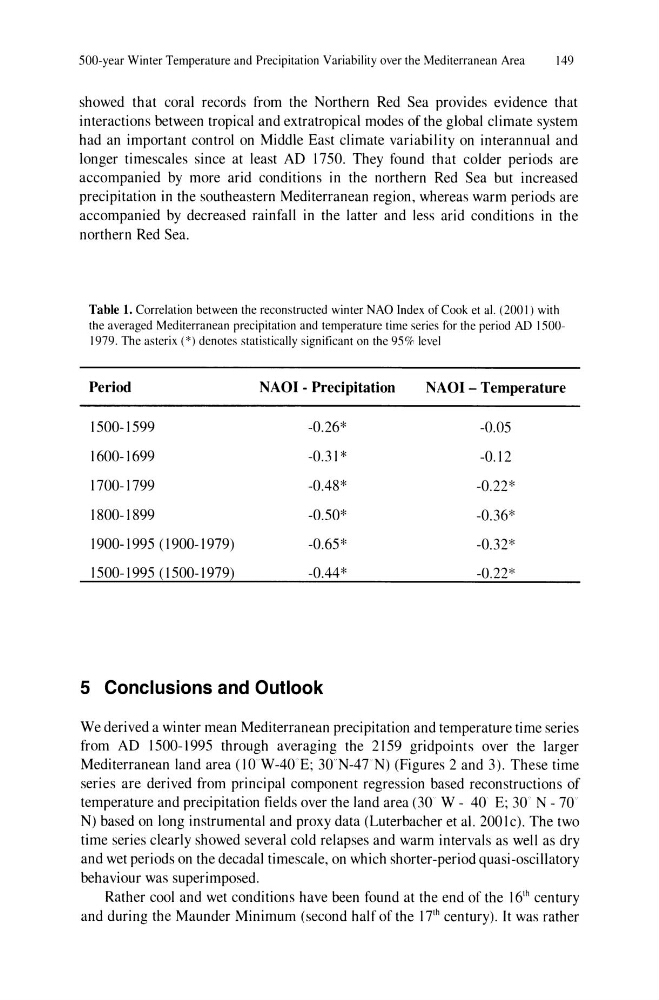
Table 1. Correlation between the reconstructed winter NAO Index of Cook et al. (200 I) with
the averaged Mediterranean precipitation and temperature time series for the period AD 15001979. The asterix (*) denotes statistically significant on the 9S% level
Period
NAOI - Precipitation
NAOI - Temperature
1500-1599
-0.26*
-0.05
1600-1699
-0.31 *
-0.12
1700-1799
-0.48*
-0.22*
1800-1899
-0.50*
-0.36*
1900-1995 (1900-1979)
-0.65*
-0.32*
1500-1995 (1500-1979)
-0.44*
-0.22*
5 Conclusions and Outlook
We derived a winter mean Mediterranean precipitation and temperature time series
from AD 1500-1995 through averaging the 2159 gridpoints over the larger
Mediterranean land area (IOW-40E; 30N-4TN) (Figures 2 and 3). These time
series are derived from principal component regression based reconstructions of
temperature and precipitation fields over the land area (30 W - 40 E; 30 N - 70
N) based on long instrumental and proxy data (Luterbacher et al. 200Ic). The two
time series clearly showed several cold relapses and warm intervals as well as dry
and wet periods on the dec ada I timescale, on which shorter-period quasi-oscillatory
behaviour was superimposed.
Rather cool and wet conditions have been found at the end of the 16 th century
and during the Maunder Minimum (second half of the 17th century). It was rather
149
showed that coral records from the Northern Red Sea provides evidence that
interactions between tropical and extratropical modes of the global climate system
had an important control on Middle East climate variability on interannual and
longer timescales since at least AD 1750. They found that colder periods are
accompanied by more arid conditions in the northern Red Sea but increased
precipitation in the southeastern Mediterranean region, whereas warm periods are
accompanied by decreased rainfall in the latter and less arid conditions in the
northern Red Sea.
Table 1. Correlation between the reconstructed winter NAO Index of Cook et al. (200 I) with
the averaged Mediterranean precipitation and temperature time series for the period AD 15001979. The asterix (*) denotes statistically significant on the 9S% level
Period
NAOI - Precipitation
NAOI - Temperature
1500-1599
-0.26*
-0.05
1600-1699
-0.31 *
-0.12
1700-1799
-0.48*
-0.22*
1800-1899
-0.50*
-0.36*
1900-1995 (1900-1979)
-0.65*
-0.32*
1500-1995 (1500-1979)
-0.44*
-0.22*
5 Conclusions and Outlook
We derived a winter mean Mediterranean precipitation and temperature time series
from AD 1500-1995 through averaging the 2159 gridpoints over the larger
Mediterranean land area (IOW-40E; 30N-4TN) (Figures 2 and 3). These time
series are derived from principal component regression based reconstructions of
temperature and precipitation fields over the land area (30 W - 40 E; 30 N - 70
N) based on long instrumental and proxy data (Luterbacher et al. 200Ic). The two
time series clearly showed several cold relapses and warm intervals as well as dry
and wet periods on the dec ada I timescale, on which shorter-period quasi-oscillatory
behaviour was superimposed.
Rather cool and wet conditions have been found at the end of the 16 th century
and during the Maunder Minimum (second half of the 17th century). It was rather