

CHAPTER 4 . Nutrients and Suspended Matter Behaviour in the Patos Lagoon Estuary (Brazil)
79
500
400
JUN89
2
AUG 89
300
200 i ~'i7666 of> 'i7
'i7'i7
~
100
'tP
6
6W
~ ..
0
500
400
. .
3
MAY 90
4
JUN90
300
200
· 1
~
100 ~6: 'i7 6 'i7,;;.w
2:
0
UJ
~ 500
u
:::;
Vi 400
S
AUG01,90
300
6
AUG 30,90
200 B,
ft: 1.
6
II
'i7~~:~
100
0
500
400
300
7
DEC 90
8
APR 91
200 (i t.£
'i7
t:f6 6 'i7 1&6.
'i7
'i7'i7
6t.£
100
~
~
0
~~gtf
-~
0
0
5
10 15 20 25 30 35
0
5
10 15 20 25 30 35
SALINITY
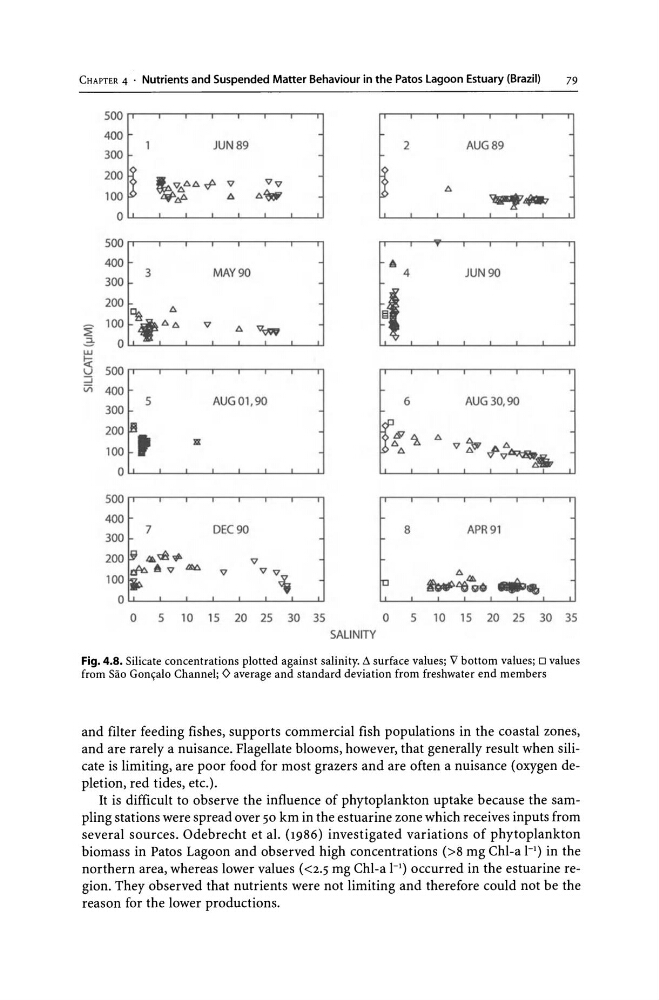
Fig. 4.8. Silicate concentrations plotted against salinity. Ll. surface values; V bottom values; 0 values
from Sao Gon~alo Channel; 0 average and standard deviation from freshwater end members
and filter feeding fishes, supports commercial fish populations in the coastal zones,
and are rarely a nuisance. Flagellate blooms, however, that generally result when silicate is limiting, are poor food for most grazers and are often a nuisance (oxygen depletion, red tides, etc.).
It is difficult to observe the influence of phytoplankton uptake because the sampling stations were spread over 50 km in the estuarine zone which receives inputs from
several sources. Odebrecht et al. (1986) investigated variations of phytoplankton
biomass in Patos Lagoon and observed high concentrations (>8 mg Chl-a I-I) in the
northern area, whereas lower values «2.5 mg Chl-a I-I) occurred in the estuarine region. They observed that nutrients were not limiting and therefore could not be the
reason for the lower productions.
79
500
400
JUN89
2
AUG 89
300
200 i ~'i7666 of> 'i7
'i7'i7
~
100
'tP
6
6W
~ ..
0
500
400
. .
3
MAY 90
4
JUN90
300
200
· 1
~
100 ~6: 'i7 6 'i7,;;.w
2:
0
UJ
~ 500
u
:::;
Vi 400
S
AUG01,90
300
6
AUG 30,90
200 B,
ft: 1.
6
II
'i7~~:~
100
0
500
400
300
7
DEC 90
8
APR 91
200 (i t.£
'i7
t:f6 6 'i7 1&6.
'i7
'i7'i7
6t.£
100
~
~
0
~~gtf
-~
0
0
5
10 15 20 25 30 35
0
5
10 15 20 25 30 35
SALINITY
Fig. 4.8. Silicate concentrations plotted against salinity. Ll. surface values; V bottom values; 0 values
from Sao Gon~alo Channel; 0 average and standard deviation from freshwater end members
and filter feeding fishes, supports commercial fish populations in the coastal zones,
and are rarely a nuisance. Flagellate blooms, however, that generally result when silicate is limiting, are poor food for most grazers and are often a nuisance (oxygen depletion, red tides, etc.).
It is difficult to observe the influence of phytoplankton uptake because the sampling stations were spread over 50 km in the estuarine zone which receives inputs from
several sources. Odebrecht et al. (1986) investigated variations of phytoplankton
biomass in Patos Lagoon and observed high concentrations (>8 mg Chl-a I-I) in the
northern area, whereas lower values «2.5 mg Chl-a I-I) occurred in the estuarine region. They observed that nutrients were not limiting and therefore could not be the
reason for the lower productions.