

Chapter 3
Coastal Lagoons of Southeastern Brazil:
Physical and Biogeochemical Characteristics
Bastiaan Knoppers . Bjorn Kjerfve
3.1
Introduction
Coastal lagoons are one of six categories of inland coastal ocean-connected systems
(Kjerfve 1994). Coastal lagoons are shallow water bodies, with depths usually less than
5 m, oriented parallel to the shoreline, separated from the ocean by a barrier, and connected to the ocean by one or more inlets (Phleger 1969). According to their geomorphology and water exchange with the coastal ocean, they are conveniently subdivided
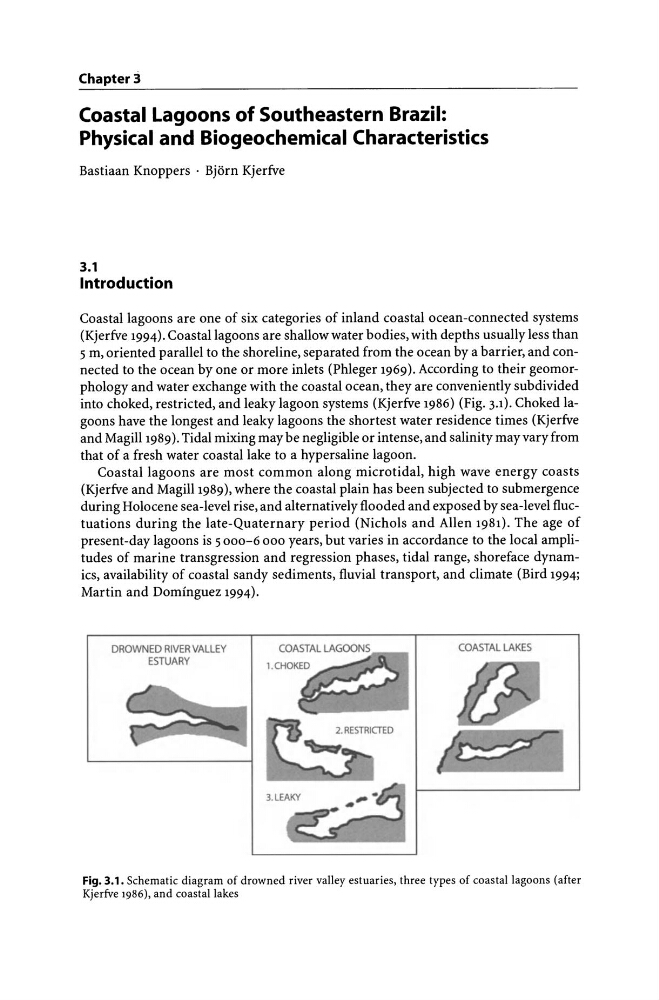
into choked, restricted, and leaky lagoon systems (Kjerfve 1986) (Fig. 3.1). Choked lagoons have the longest and leaky lagoons the shortest water residence times (Kjerfve
and Magill 1989 ). Tidal mixing may be negligible or intense, and salinity may vary from
that of a fresh water coastal lake to a hypersaline lagoon.
Coastal lagoons are most common along microtidal, high wave energy coasts
(Kjerfve and Magill 1989), where the coastal plain has been subjected to submergence
during Holocene sea-level rise, and alternatively flooded and exposed by sea-level fluctuations during the late-Quaternary period (Nichols and Allen 1981). The age of
present-day lagoons is 5000-6000 years, but varies in accordance to the local amplitudes of marine transgression and regression phases, tidal range, shoreface dynamics, availability of coastal sandy sediments, fluvial transport, and climate (Bird 1994;
Martin and Dominguez 1994).
DROWNED RIVER VALLEY
ESTUARY
COASTAL LAGOONS
COASTAL LAKES
Fig. 3.1. Schematic diagram of drowned river valley estuaries, three types of coastal lagoons (after
Kjerfve 1986), and coastal lakes
Coastal Lagoons of Southeastern Brazil:
Physical and Biogeochemical Characteristics
Bastiaan Knoppers . Bjorn Kjerfve
3.1
Introduction
Coastal lagoons are one of six categories of inland coastal ocean-connected systems
(Kjerfve 1994). Coastal lagoons are shallow water bodies, with depths usually less than
5 m, oriented parallel to the shoreline, separated from the ocean by a barrier, and connected to the ocean by one or more inlets (Phleger 1969). According to their geomorphology and water exchange with the coastal ocean, they are conveniently subdivided
into choked, restricted, and leaky lagoon systems (Kjerfve 1986) (Fig. 3.1). Choked lagoons have the longest and leaky lagoons the shortest water residence times (Kjerfve
and Magill 1989 ). Tidal mixing may be negligible or intense, and salinity may vary from
that of a fresh water coastal lake to a hypersaline lagoon.
Coastal lagoons are most common along microtidal, high wave energy coasts
(Kjerfve and Magill 1989), where the coastal plain has been subjected to submergence
during Holocene sea-level rise, and alternatively flooded and exposed by sea-level fluctuations during the late-Quaternary period (Nichols and Allen 1981). The age of
present-day lagoons is 5000-6000 years, but varies in accordance to the local amplitudes of marine transgression and regression phases, tidal range, shoreface dynamics, availability of coastal sandy sediments, fluvial transport, and climate (Bird 1994;
Martin and Dominguez 1994).
DROWNED RIVER VALLEY
ESTUARY
COASTAL LAGOONS
COASTAL LAKES
Fig. 3.1. Schematic diagram of drowned river valley estuaries, three types of coastal lagoons (after
Kjerfve 1986), and coastal lakes