

212
Gerardo M.E. Perillo . M. Cintia Piccolo
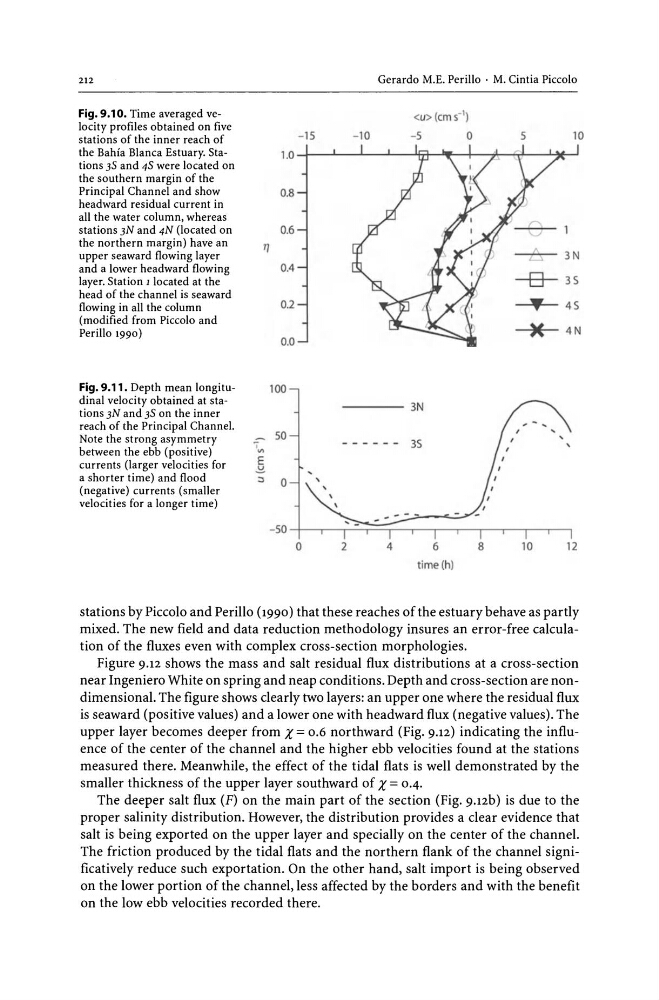
Fig. 9.1 O. Time averaged ve (em S-l )
locity profiles obtained on five
- 15
-10
- 5
0
5
10
stations of the inner reach of
the Bahia Blanca Estuary. Sta1.0
tions 35 and 45 were located on
the southern margin of the
Principal Channel and show
0.8
head ward residual current in
all the water column, whereas
stations 3N and 4N (located on
0.6
the northern margin) have an
1)
--t:rupper seaward flowing layer
3N
and a lower headward flowing
0.4
layer. Station 1 located at the
--B- 35
head of the channel is seaward
---.flowing in all the column
0.2
45
(modified from Piccolo and
Perillo 1990)
0.0
--*4N
Fig. 9.11. Depth mean longitu100
dinal velocity obtained at sta3N
tions 3N and 35 on the inner
reach of the Principal Channel.
50
Note the strong asymmetry
,
------ 35
between the ebb (positive)
'"
currents (larger velocities for
E
~
a shorter time) and flood
~
0
(negative) currents (smaller
velocities for a longer time)
-50
0
2
4
6
8
10
12
time (h)
stations by Piccolo and Perillo (1990) that these reaches of the estuary behave as partly
mixed. The new field and data reduction methodology insures an error-free calculation of the fluxes even with complex cross-section morphologies.
Figure 9.12 shows the mass and salt residual flux distributions at a cross-section
near Ingeniero White on spring and neap conditions. Depth and cross-section are nondimensional. The figure shows clearly two layers: an upper one where the residual flux
is seaward (positive values) and a lower one with headward flux (negative values). The
upper layer becomes deeper from X = 0.6 northward (Fig. 9.12) indicating the influence of the center of the channel and the higher ebb velocities found at the stations
measured there. Meanwhile, the effect of the tidal flats is well demonstrated by the
smaller thickness of the upper layer southward of X = 004The deeper salt flux (F) on the main part of the section (Fig. 9.12b) is due to the
proper salinity distribution. However, the distribution provides a clear evidence that
salt is being exported on the upper layer and specially on the center of the channel.
The friction produced by the tidal flats and the northern flank of the channel significatively reduce such exportation. On the other hand, salt import is being observed
on the lower portion of the channel, less affected by the borders and with the benefit
on the low ebb velocities recorded there.
Gerardo M.E. Perillo . M. Cintia Piccolo
Fig. 9.1 O. Time averaged ve (em S-l )
locity profiles obtained on five
- 15
-10
- 5
0
5
10
stations of the inner reach of
the Bahia Blanca Estuary. Sta1.0
tions 35 and 45 were located on
the southern margin of the
Principal Channel and show
0.8
head ward residual current in
all the water column, whereas
stations 3N and 4N (located on
0.6
the northern margin) have an
1)
--t:rupper seaward flowing layer
3N
and a lower headward flowing
0.4
layer. Station 1 located at the
--B- 35
head of the channel is seaward
---.flowing in all the column
0.2
45
(modified from Piccolo and
Perillo 1990)
0.0
--*4N
Fig. 9.11. Depth mean longitu100
dinal velocity obtained at sta3N
tions 3N and 35 on the inner
reach of the Principal Channel.
50
Note the strong asymmetry
,
------ 35
between the ebb (positive)
'"
currents (larger velocities for
E
~
a shorter time) and flood
~
0
(negative) currents (smaller
velocities for a longer time)
-50
0
2
4
6
8
10
12
time (h)
stations by Piccolo and Perillo (1990) that these reaches of the estuary behave as partly
mixed. The new field and data reduction methodology insures an error-free calculation of the fluxes even with complex cross-section morphologies.
Figure 9.12 shows the mass and salt residual flux distributions at a cross-section
near Ingeniero White on spring and neap conditions. Depth and cross-section are nondimensional. The figure shows clearly two layers: an upper one where the residual flux
is seaward (positive values) and a lower one with headward flux (negative values). The
upper layer becomes deeper from X = 0.6 northward (Fig. 9.12) indicating the influence of the center of the channel and the higher ebb velocities found at the stations
measured there. Meanwhile, the effect of the tidal flats is well demonstrated by the
smaller thickness of the upper layer southward of X = 004The deeper salt flux (F) on the main part of the section (Fig. 9.12b) is due to the
proper salinity distribution. However, the distribution provides a clear evidence that
salt is being exported on the upper layer and specially on the center of the channel.
The friction produced by the tidal flats and the northern flank of the channel significatively reduce such exportation. On the other hand, salt import is being observed
on the lower portion of the channel, less affected by the borders and with the benefit
on the low ebb velocities recorded there.