

2
Gerardo M.E. Perillo . M. Cintia Piccolo . Mario Pino-Quivira
Marine or
S
I h'
=
Fluvial or
Lower Estuary
=
easona s 1ft
~upper Estuary
~
Middle
~
~
stuary
§
Marine sediment
Ji
"
transport
/ > <::::::: '01
FlUVial / '
,---.c...r~
j ---.r sediment
--=--- transport Freshwater - only tidal
Salt-freshwater mixing
. fl
( -d I bo
)
!Xeanicdominance(brackish) zone
In uence tl a res common
mainly saltwater
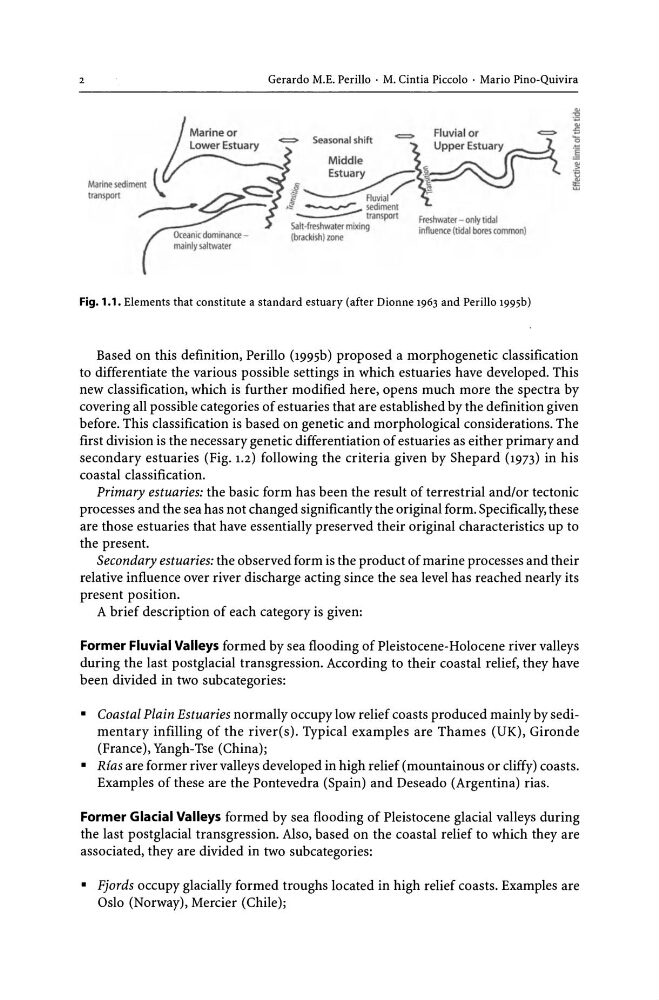
Fig.'.'. Elements that constitute a standard estuary (after Dionne 1963 and Perillo 1995b)
Based on this definition, Perillo (1995b) proposed a morphogenetic classification
to differentiate the various possible settings in which estuaries have developed. This
new classification, which is further modified here, opens much more the spectra by
covering all possible categories of estuaries that are established by the definition given
before. This classification is based on genetic and morphological considerations. The
first division is the necessary genetic differentiation of estuaries as either primary and
secondary estuaries (Fig. 1.2) following the criteria given by Shepard (1973) in his
coastal classification.
Primary estuaries: the basic form has been the result of terrestrial and/or tectonic
processes and the sea has not changed significantly the original form. Specifically, these
are those estuaries that have essentially preserved their original characteristics up to
the present.
Secondary estuaries: the observed form is the product of marine processes and their
relative influence over river discharge acting since the sea level has reached nearly its
present position.
A brief description of each category is given:
Former Fluvial Valleys formed by sea flooding of Pleistocene-Holocene river valleys
during the last postglacial transgression. According to their coastal relief, they have
been divided in two subcategories:
• Coastal Plain Estuaries normally occupy low relief coasts produced mainly by sedimentary infilling of the river(s). Typical examples are Thames (UK), Gironde
(France), Yangh-Tse (China);
• Rias are former river valleys developed in high relief (mountainous or cliffy) coasts.
Examples of these are the Pontevedra (Spain) and Deseado (Argentina) rias.
Former Glacial Valleys formed by sea flooding of Pleistocene glacial valleys during
the last postglacial transgression. Also, based on the coastal relief to which they are
associated, they are divided in two subcategories:
• Fjords occupy glacially formed troughs located in high relief coasts. Examples are
Oslo (Norway), Mercier (Chile);
Gerardo M.E. Perillo . M. Cintia Piccolo . Mario Pino-Quivira
Marine or
S
I h'
=
Fluvial or
Lower Estuary
=
easona s 1ft
~upper Estuary
~
Middle
~
~
stuary
§
Marine sediment
Ji
"
transport
/ > <::::::: '01
FlUVial / '
,---.c...r~
j ---.r sediment
--=--- transport Freshwater - only tidal
Salt-freshwater mixing
. fl
( -d I bo
)
!Xeanicdominance(brackish) zone
In uence tl a res common
mainly saltwater
Fig.'.'. Elements that constitute a standard estuary (after Dionne 1963 and Perillo 1995b)
Based on this definition, Perillo (1995b) proposed a morphogenetic classification
to differentiate the various possible settings in which estuaries have developed. This
new classification, which is further modified here, opens much more the spectra by
covering all possible categories of estuaries that are established by the definition given
before. This classification is based on genetic and morphological considerations. The
first division is the necessary genetic differentiation of estuaries as either primary and
secondary estuaries (Fig. 1.2) following the criteria given by Shepard (1973) in his
coastal classification.
Primary estuaries: the basic form has been the result of terrestrial and/or tectonic
processes and the sea has not changed significantly the original form. Specifically, these
are those estuaries that have essentially preserved their original characteristics up to
the present.
Secondary estuaries: the observed form is the product of marine processes and their
relative influence over river discharge acting since the sea level has reached nearly its
present position.
A brief description of each category is given:
Former Fluvial Valleys formed by sea flooding of Pleistocene-Holocene river valleys
during the last postglacial transgression. According to their coastal relief, they have
been divided in two subcategories:
• Coastal Plain Estuaries normally occupy low relief coasts produced mainly by sedimentary infilling of the river(s). Typical examples are Thames (UK), Gironde
(France), Yangh-Tse (China);
• Rias are former river valleys developed in high relief (mountainous or cliffy) coasts.
Examples of these are the Pontevedra (Spain) and Deseado (Argentina) rias.
Former Glacial Valleys formed by sea flooding of Pleistocene glacial valleys during
the last postglacial transgression. Also, based on the coastal relief to which they are
associated, they are divided in two subcategories:
• Fjords occupy glacially formed troughs located in high relief coasts. Examples are
Oslo (Norway), Mercier (Chile);