

CHAPTER 8 . Physical Characteristics and Processes of the Rio de la Plata Estuary
165
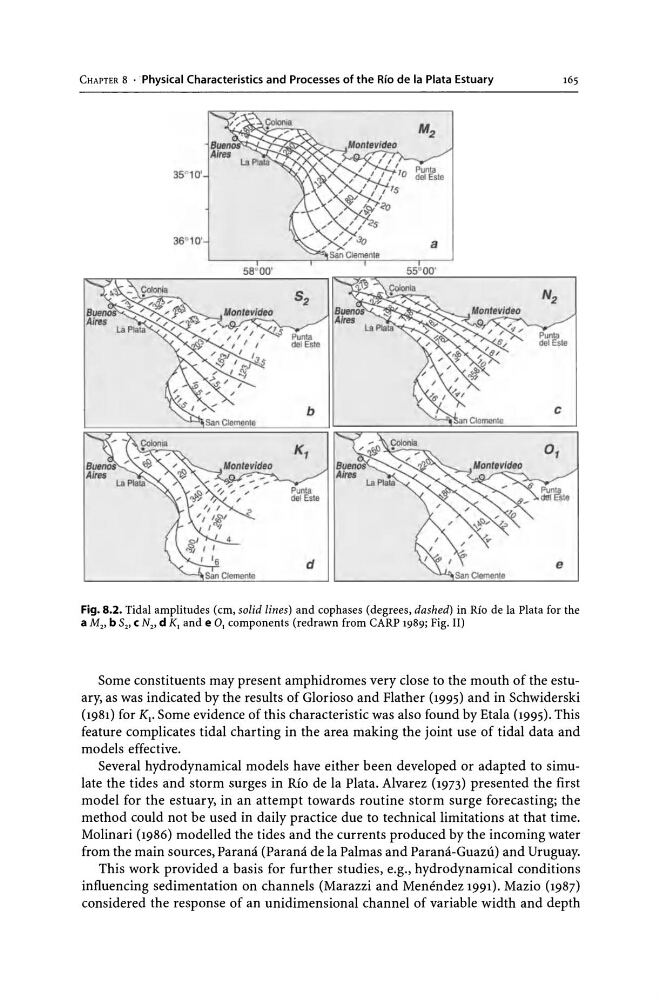
Fig. 8.2. Tidal amplitudes (em, solid lines) and cophases (degrees, dashed) in Rio de la Plata for the
a M 2 , b 52' C N2 , d K, and e 0, components (redrawn from CARP 1989; Fig. II)
Some constituents may present amphidromes very close to the mouth of the estuary, as was indicated by the results of Glorioso and Flather (1995) and in Schwiderski
(1981) for K1• Some evidence of this characteristic was also found by Etala (1995). This
feature complicates tidal charting in the area making the joint use of tidal data and
models effective.
Several hydro dynamical models have either been developed or adapted to simulate the tides and storm surges in Rio de la Plata. Alvarez (1973) presented the first
model for the estuary, in an attempt towards routine storm surge forecasting; the
method could not be used in daily practice due to technical limitations at that time.
Molinari (1986) modelled the tides and the currents produced by the incoming water
from the main sources, Parana (Parana de la Palm as and Parana-Guazu) and Uruguay.
This work provided a basis for further studies, e.g., hydro dynamical conditions
influencing sedimentation on channels (Marazzi and Menendez 1991). Mazio (1987)
considered the response of an unidimensional channel of variable width and depth
165
Fig. 8.2. Tidal amplitudes (em, solid lines) and cophases (degrees, dashed) in Rio de la Plata for the
a M 2 , b 52' C N2 , d K, and e 0, components (redrawn from CARP 1989; Fig. II)
Some constituents may present amphidromes very close to the mouth of the estuary, as was indicated by the results of Glorioso and Flather (1995) and in Schwiderski
(1981) for K1• Some evidence of this characteristic was also found by Etala (1995). This
feature complicates tidal charting in the area making the joint use of tidal data and
models effective.
Several hydro dynamical models have either been developed or adapted to simulate the tides and storm surges in Rio de la Plata. Alvarez (1973) presented the first
model for the estuary, in an attempt towards routine storm surge forecasting; the
method could not be used in daily practice due to technical limitations at that time.
Molinari (1986) modelled the tides and the currents produced by the incoming water
from the main sources, Parana (Parana de la Palm as and Parana-Guazu) and Uruguay.
This work provided a basis for further studies, e.g., hydro dynamical conditions
influencing sedimentation on channels (Marazzi and Menendez 1991). Mazio (1987)
considered the response of an unidimensional channel of variable width and depth