

156
Jorge Lopez Laborde· Gustavo J. Nagy
5a"
51'
56'
55'
33'
LEGEND
Sedimentation processes
(lill) Deposition and flocculation areas
Mecha, nicay PhY,SiCo-chemical
.:::::. (S ilty clays bottom sediments)
]4'
]4' o Graded suspension deposits
Sa lt intrusion
•
Erosion a nd transport areas
tt ~
® Salt intrus ion
3S'
3S' o Freshwater discharge
@ Coasta l degradation processes
@ Coasta l aggradation processes
PH .. Playa Honda
36
36'
BGO .. Banco Grande de Ortiz
BI
.. Barra del Ind io
PSDL .. Present sediments dispersion
limit
]7'
31'
S9"
5a"
S1'
S6'
55'
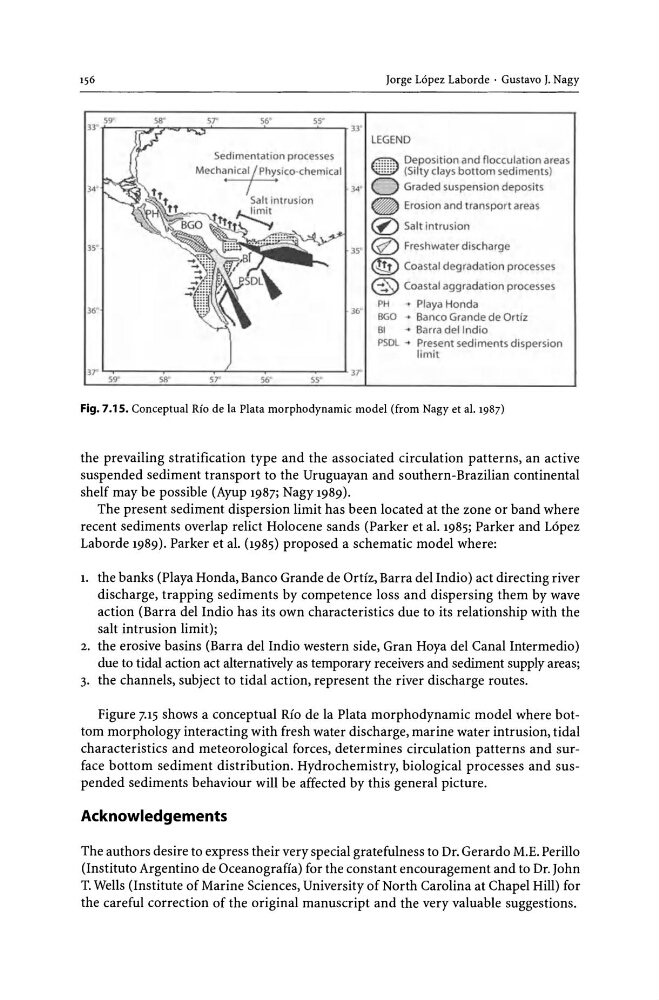
Fig. 7.1 S. Conceptual Rio de la Plata morpho dynamic model (from Nagy et al. 1987)
the prevailing stratification type and the associated circulation patterns, an active
suspended sediment transport to the Uruguayan and southern-Brazilian continental
shelf may be possible (Ayup 1987; Nagy 1989).
The present sediment dispersion limit has been located at the zone or band where
recent sediments overlap relict Holocene sands (Parker et al. 1985; Parker and Lopez
Laborde 1989). Parker et al. (1985) proposed a schematic model where:
1. the banks (Playa Honda, Banco Grande de Ortiz, Barra del Indio) act directing river
discharge, trapping sediments by competence loss and dispersing them by wave
action (Barra del Indio has its own characteristics due to its relationship with the
salt intrusion limit);
2. the erosive basins (Barra del Indio western side, Gran Hoya del Canal Intermedio)
due to tidal action act alternatively as temporary receivers and sediment supply areas;
3. the channels, subject to tidal action, represent the river discharge routes.
Figure 7.15 shows a conceptual Rio de la Plata morpho dynamic model where bottom morphology interacting with fresh water discharge, marine water intrusion, tidal
characteristics and meteorological forces, determines circulation patterns and surface bottom sediment distribution. Hydrochemistry, biological processes and suspended sediments behaviour will be affected by this general picture.
Acknowledgements
The authors desire to express their very special gratefulness to Dr. Gerardo M.E. Perillo
(Instituto Argentino de Oceanografia) for the constant encouragement and to Dr. John
T. Wells (Institute of Marine Sciences, University of North Carolina at Chapel Hill) for
the careful correction of the original manuscript and the very valuable suggestions.
Jorge Lopez Laborde· Gustavo J. Nagy
5a"
51'
56'
55'
33'
LEGEND
Sedimentation processes
(lill) Deposition and flocculation areas
Mecha, nicay PhY,SiCo-chemical
.:::::. (S ilty clays bottom sediments)
]4'
]4' o Graded suspension deposits
Sa lt intrusion
•
Erosion a nd transport areas
tt ~
® Salt intrus ion
3S'
3S' o Freshwater discharge
@ Coasta l degradation processes
@ Coasta l aggradation processes
PH .. Playa Honda
36
36'
BGO .. Banco Grande de Ortiz
BI
.. Barra del Ind io
PSDL .. Present sediments dispersion
limit
]7'
31'
S9"
5a"
S1'
S6'
55'
Fig. 7.1 S. Conceptual Rio de la Plata morpho dynamic model (from Nagy et al. 1987)
the prevailing stratification type and the associated circulation patterns, an active
suspended sediment transport to the Uruguayan and southern-Brazilian continental
shelf may be possible (Ayup 1987; Nagy 1989).
The present sediment dispersion limit has been located at the zone or band where
recent sediments overlap relict Holocene sands (Parker et al. 1985; Parker and Lopez
Laborde 1989). Parker et al. (1985) proposed a schematic model where:
1. the banks (Playa Honda, Banco Grande de Ortiz, Barra del Indio) act directing river
discharge, trapping sediments by competence loss and dispersing them by wave
action (Barra del Indio has its own characteristics due to its relationship with the
salt intrusion limit);
2. the erosive basins (Barra del Indio western side, Gran Hoya del Canal Intermedio)
due to tidal action act alternatively as temporary receivers and sediment supply areas;
3. the channels, subject to tidal action, represent the river discharge routes.
Figure 7.15 shows a conceptual Rio de la Plata morpho dynamic model where bottom morphology interacting with fresh water discharge, marine water intrusion, tidal
characteristics and meteorological forces, determines circulation patterns and surface bottom sediment distribution. Hydrochemistry, biological processes and suspended sediments behaviour will be affected by this general picture.
Acknowledgements
The authors desire to express their very special gratefulness to Dr. Gerardo M.E. Perillo
(Instituto Argentino de Oceanografia) for the constant encouragement and to Dr. John
T. Wells (Institute of Marine Sciences, University of North Carolina at Chapel Hill) for
the careful correction of the original manuscript and the very valuable suggestions.