

128
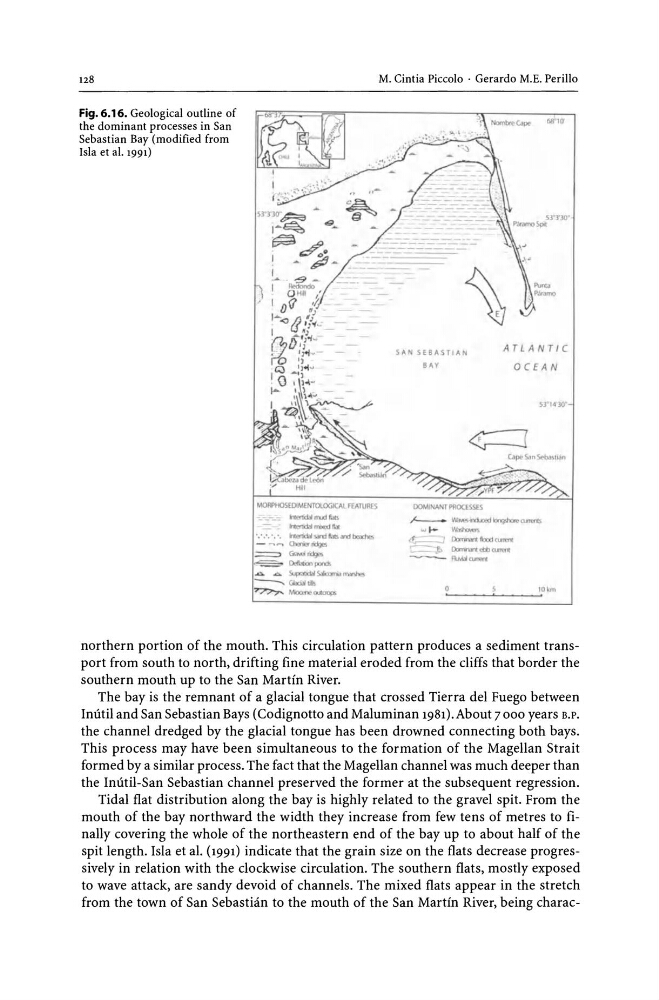
Fig. 6.16. Geological outline of
the dominant processes in San
Sebastian Bay (modified from
Isla et al. 1991)
MORPI-tOSWIMENTOI.OGICAL FEATURES
_"""lin
""""_""'
- ~~o..-.e.._
= """"'-===- ~M, Cintia Piccolo ' Gerardo M,E, Perillo
68"'0'
P.\ramo
SAN SEBASTIAN
eAY
ATLANTIC
o C fA N
53 14']0"
DOMINAIll' ""'XESSES
.-<---- ~
lt ~ DJmn.n fI:;IodC\,n'('fC
c::=.p Cbrnn etb~
----- -. .......
'0""'
northern portion of the mouth. This circulation pattern produces a sediment transport from south to north, drifting fine material eroded from the cliffs that border the
southern mouth up to the San Martin River.
The bay is the remnant of a glacial tongue that crossed Tierra del Fuego between
Inutil and San Sebastian Bays (Codignotto and Maluminan 1981). About 7 000 years B,P.
the channel dredged by the glacial tongue has been drowned connecting both bays.
This process may have been simultaneous to the formation of the Magellan Strait
formed by a similar process. The fact that the Magellan channel was much deeper than
the Inutil-San Sebastian channel preserved the former at the subsequent regression.
Tidal flat distribution along the bay is highly related to the gravel spit, From the
mouth of the bay northward the width they increase from few tens of metres to finally covering the whole of the northeastern end of the bay up to about half of the
spit length, Isla et al. (1991) indicate that the grain size on the flats decrease progressively in relation with the clockwise circulation, The southern flats, mostly exposed
to wave attack, are sandy devoid of channels. The mixed flats appear in the stretch
from the town of San Sebastian to the mouth of the San Martin River, being charac-
Fig. 6.16. Geological outline of
the dominant processes in San
Sebastian Bay (modified from
Isla et al. 1991)
MORPI-tOSWIMENTOI.OGICAL FEATURES
_"""lin
""""_""'
- ~~o..-.e.._
= """"'-===- ~M, Cintia Piccolo ' Gerardo M,E, Perillo
68"'0'
P.\ramo
SAN SEBASTIAN
eAY
ATLANTIC
o C fA N
53 14']0"
DOMINAIll' ""'XESSES
.-<---- ~
lt ~ DJmn.n fI:;IodC\,n'('fC
c::=.p Cbrnn etb~
----- -. .......
'0""'
northern portion of the mouth. This circulation pattern produces a sediment transport from south to north, drifting fine material eroded from the cliffs that border the
southern mouth up to the San Martin River.
The bay is the remnant of a glacial tongue that crossed Tierra del Fuego between
Inutil and San Sebastian Bays (Codignotto and Maluminan 1981). About 7 000 years B,P.
the channel dredged by the glacial tongue has been drowned connecting both bays.
This process may have been simultaneous to the formation of the Magellan Strait
formed by a similar process. The fact that the Magellan channel was much deeper than
the Inutil-San Sebastian channel preserved the former at the subsequent regression.
Tidal flat distribution along the bay is highly related to the gravel spit, From the
mouth of the bay northward the width they increase from few tens of metres to finally covering the whole of the northeastern end of the bay up to about half of the
spit length, Isla et al. (1991) indicate that the grain size on the flats decrease progressively in relation with the clockwise circulation, The southern flats, mostly exposed
to wave attack, are sandy devoid of channels. The mixed flats appear in the stretch
from the town of San Sebastian to the mouth of the San Martin River, being charac-