

78
2 Substituted Systems
Table 7. Seniority order of the most prominent compound classes
IUPAC
Chern. Abstr.
1. Radicals
1. Radicals
2. Anions
2. Cations
3. Cations
3. Neutral coordination compounds
4. Zwitterions
4. Anions
o
5. Carboxylic acids in the order: -COOH, -COOH, then sulfur and selenium analogues, then sulf(onic, inic)-, phosph(onic, inic)-, ars(onic; inic)-acids
6. Acid derivatives in the order: anhydrides, esters, halides, amides, hydrazides,
imides, ami dines etc.
7. Nitriles (cyanides), isocyanides etc.
8. Aldehydes, S-, Se- and Te analogues
9. Ketones, S-, Se- and Te analogues
10. Alcohols, phenols, S-, Se, and Te analogues
11. Hydroperoxides, thiohydroperoxides etc.
12. Amines, imines, hydrazines, phosphanes etc.
13. Ethers, S-, Se-, and Te analogues
14. Peroxides, disulfides, etc.
To name simple aliphatic mono acids (and their derivatives) the carbon
atom of the carboxylic group is included in the parent system, which is
expressed by changing the hydrocarbon ... ane ending to •.. anoie acid.
21
2
1
H3C-(CH2hs-CHz-COOH Henicosanoic acid
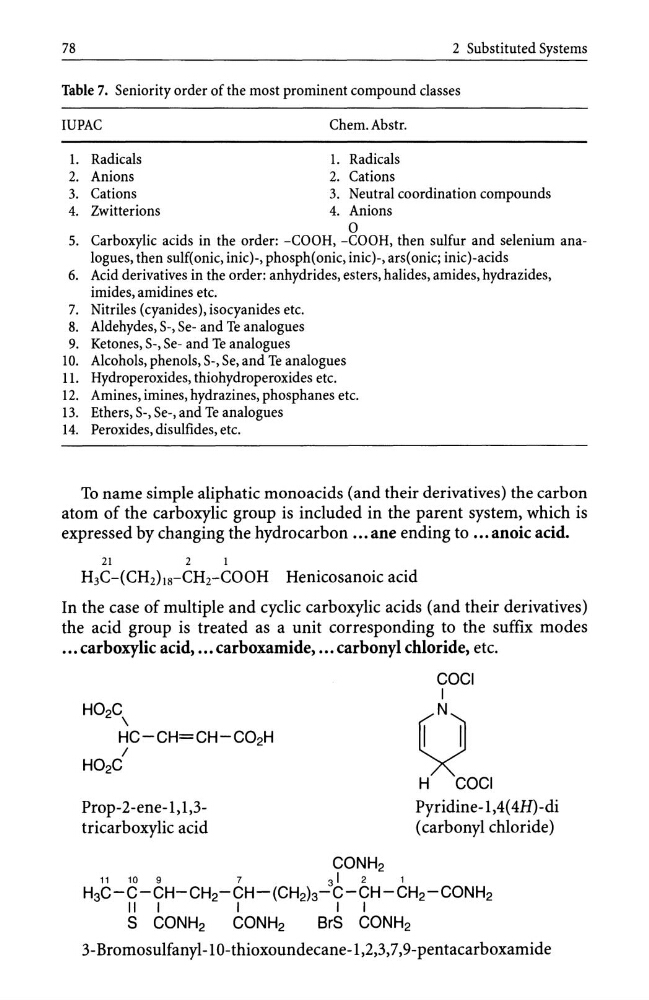
In the case of multiple and cyclic carboxylic acids (and their derivatives)
the acid group is treated as a unit corresponding to the suffix modes
... carboxylic acid, ... carboxamide, ... carbonyl chloride, etc.
Prop-2-ene-l,1,3tricarboxylic acid
CONH2
COCI
I
N
Q
H
COCI
Pyridine-l ,4( 4H)-di
(carbonyl chloride)
11
10
9
7
3 I 2
1
H3C-C-CH-CH2-CH-(CH2h-C-CH-CH2-CONH2
II I
I
I
I
S CONH2
CONH2
BrS CONH2
3-Bromosulfanyl-l 0-thioxoundecane-l ,2,3,7,9-pentacarboxamide
2 Substituted Systems
Table 7. Seniority order of the most prominent compound classes
IUPAC
Chern. Abstr.
1. Radicals
1. Radicals
2. Anions
2. Cations
3. Cations
3. Neutral coordination compounds
4. Zwitterions
4. Anions
o
5. Carboxylic acids in the order: -COOH, -COOH, then sulfur and selenium analogues, then sulf(onic, inic)-, phosph(onic, inic)-, ars(onic; inic)-acids
6. Acid derivatives in the order: anhydrides, esters, halides, amides, hydrazides,
imides, ami dines etc.
7. Nitriles (cyanides), isocyanides etc.
8. Aldehydes, S-, Se- and Te analogues
9. Ketones, S-, Se- and Te analogues
10. Alcohols, phenols, S-, Se, and Te analogues
11. Hydroperoxides, thiohydroperoxides etc.
12. Amines, imines, hydrazines, phosphanes etc.
13. Ethers, S-, Se-, and Te analogues
14. Peroxides, disulfides, etc.
To name simple aliphatic mono acids (and their derivatives) the carbon
atom of the carboxylic group is included in the parent system, which is
expressed by changing the hydrocarbon ... ane ending to •.. anoie acid.
21
2
1
H3C-(CH2hs-CHz-COOH Henicosanoic acid
In the case of multiple and cyclic carboxylic acids (and their derivatives)
the acid group is treated as a unit corresponding to the suffix modes
... carboxylic acid, ... carboxamide, ... carbonyl chloride, etc.
Prop-2-ene-l,1,3tricarboxylic acid
CONH2
COCI
I
N
Q
H
COCI
Pyridine-l ,4( 4H)-di
(carbonyl chloride)
11
10
9
7
3 I 2
1
H3C-C-CH-CH2-CH-(CH2h-C-CH-CH2-CONH2
II I
I
I
I
S CONH2
CONH2
BrS CONH2
3-Bromosulfanyl-l 0-thioxoundecane-l ,2,3,7,9-pentacarboxamide