

1.3 Phane Nomenclature
69
replacement terms which are arranged in compliance with a complexity
order similar to that valid for fused systems. The six main criteria of this hitherto non -finalized priority order are to be checked sequentially as follows:
a) heterocycles are always senior to carbocycles,
b) a ring system with the larger number of rings has precedence,
c) hetero atom priority follows the order laid down in the tables of "a"
terms,
d) a ring system containing the largest individual ring is preferred,
e) a ring system with the larger number ofhetero atoms of any kind ranks
first,
f) the least hydrogenated ring system is preferred.
In constructing the cyclophane name, locant numbers and, in parentheses,
attachment positions are placed in front of the cycla terms. The cyclophane character is expressed by a composite designator at the end of the
name that consists of the morphemes cyclo and phane enclosing a numerator for the members of the superring. Final numbering then assigns lowest locants possible to the most senior superatoms in accordance with the
predetermined numbering scheme.
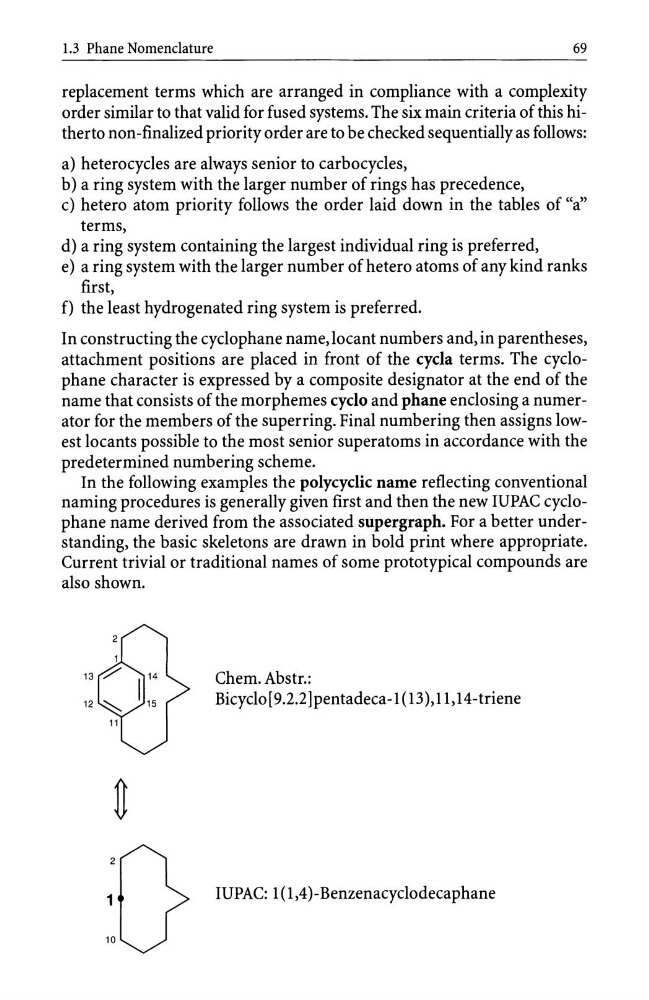
In the following examples the polycyclic name reflecting conventional
naming procedures is generally given first and then the new IUPAC cyclophane name derived from the associated supergraph. For a better understanding, the basic skeletons are drawn in bold print where appropriate.
Current trivial or traditional names of some prototypical compounds are
also shown.
Chern. Abstr.:
Bicyclo[9.2.2]pentadeca-l (13), 11,14-triene
1
IUPAC: 1 (1,4)-Benzenacyclodecaphane
10
69
replacement terms which are arranged in compliance with a complexity
order similar to that valid for fused systems. The six main criteria of this hitherto non -finalized priority order are to be checked sequentially as follows:
a) heterocycles are always senior to carbocycles,
b) a ring system with the larger number of rings has precedence,
c) hetero atom priority follows the order laid down in the tables of "a"
terms,
d) a ring system containing the largest individual ring is preferred,
e) a ring system with the larger number ofhetero atoms of any kind ranks
first,
f) the least hydrogenated ring system is preferred.
In constructing the cyclophane name, locant numbers and, in parentheses,
attachment positions are placed in front of the cycla terms. The cyclophane character is expressed by a composite designator at the end of the
name that consists of the morphemes cyclo and phane enclosing a numerator for the members of the superring. Final numbering then assigns lowest locants possible to the most senior superatoms in accordance with the
predetermined numbering scheme.
In the following examples the polycyclic name reflecting conventional
naming procedures is generally given first and then the new IUPAC cyclophane name derived from the associated supergraph. For a better understanding, the basic skeletons are drawn in bold print where appropriate.
Current trivial or traditional names of some prototypical compounds are
also shown.
Chern. Abstr.:
Bicyclo[9.2.2]pentadeca-l (13), 11,14-triene
1
IUPAC: 1 (1,4)-Benzenacyclodecaphane
10