

32
16
1
7
HC=C-(CH2}5- CH2
I
CH17
II
CH18
I
HC=C-(CH2}5- CH2
15
14
8
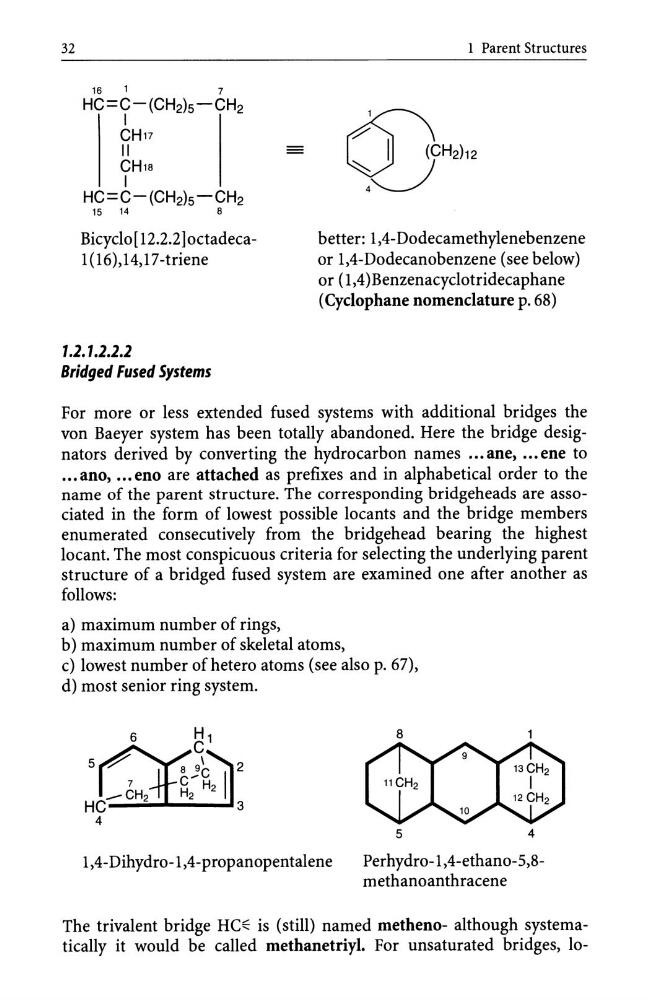
Bicyclo [12.2.2] octadeca1 (I6},14,17-triene
1.2.1.2.2.2
Bridged Fused Systems
1 Parent Structures
better: 1,4-Dodecamethylenebenzene
or l,4-Dodecanobenzene (see below)
or (I,4}Benzenacyclotridecaphane
(Cyclophane nomenclature p. 68)
For more or less extended fused systems with additional bridges the
von Baeyer system has been totally abandoned. Here the bridge designators derived by converting the hydrocarbon names ... ane, ... ene to
... ano, ... eno are attached as prefixes and in alphabetical order to the
name of the parent structure. The corresponding bridgeheads are associated in the form of lowest possible locants and the bridge members
enumerated consecutively from the bridgehead bearing the highest
locant. The most conspicuous criteria for selecting the underlying parent
structure of a bridged fused system are examined one after another as
follows:
a) maximum number of rings,
b) maximum number of skeletal atoms,
c) lowest number ofhetero atoms (see also p. 67),
d) most senior ring system.
6
-......;;, ..... - -....... 3
1,4-Dihydro-l,4-propanopentalene
8
5
4
Perhydro-l,4-ethano-S,8methanoanthracene
The trivalent bridge HeE is (still) named metheno- although systematically it would be called methanetriyl. For unsaturated bridges, 10-
16
1
7
HC=C-(CH2}5- CH2
I
CH17
II
CH18
I
HC=C-(CH2}5- CH2
15
14
8
Bicyclo [12.2.2] octadeca1 (I6},14,17-triene
1.2.1.2.2.2
Bridged Fused Systems
1 Parent Structures
better: 1,4-Dodecamethylenebenzene
or l,4-Dodecanobenzene (see below)
or (I,4}Benzenacyclotridecaphane
(Cyclophane nomenclature p. 68)
For more or less extended fused systems with additional bridges the
von Baeyer system has been totally abandoned. Here the bridge designators derived by converting the hydrocarbon names ... ane, ... ene to
... ano, ... eno are attached as prefixes and in alphabetical order to the
name of the parent structure. The corresponding bridgeheads are associated in the form of lowest possible locants and the bridge members
enumerated consecutively from the bridgehead bearing the highest
locant. The most conspicuous criteria for selecting the underlying parent
structure of a bridged fused system are examined one after another as
follows:
a) maximum number of rings,
b) maximum number of skeletal atoms,
c) lowest number ofhetero atoms (see also p. 67),
d) most senior ring system.
6
-......;;, ..... - -....... 3
1,4-Dihydro-l,4-propanopentalene
8
5
4
Perhydro-l,4-ethano-S,8methanoanthracene
The trivalent bridge HeE is (still) named metheno- although systematically it would be called methanetriyl. For unsaturated bridges, 10-