

1.2 Cyclic Systems
29
1.1.1.1.1
Bridged Polycyclic Hydrocarbons
1.1.1.2.2.1
von Baeyer System
Saturated cyclic hydrocarbons containing two or more rings in which at
least two rings have at least two common C-atoms are specified as bi-, tri-,
tetra-, etc. -cycoalkanes. The total number of rings present evidently
equals the number of C-C cleavages necessary to obtain an open chain
compound.
The names of such compounds are constructed stepwise in the followingmanner:
a) the actual tridimensional structure is transformed into an appropriate
planar representation,
b) that ring is selected as main ring which includes as many skeletal atoms
as possible,
c) the largest possible carbon chain that connects two C-atoms of the
main ring (consisting itself of two branches) is defined as the main
bridge. The corresponding points of connection are called bridgeheads,
d) to assemble the full name the numbers of C atoms of both branches of
the main ring, the main bridge and the secondary bridges, if present,
are cited in descending order, separated by full stops, and placed in
square brackets after the term cydo.
e) the numbering begins at the first bridgehead, tracing first the largest
branch of the main ring up to the second bridgehead and then the next
largest branch back to the first bridgehead. Next comes the (longest
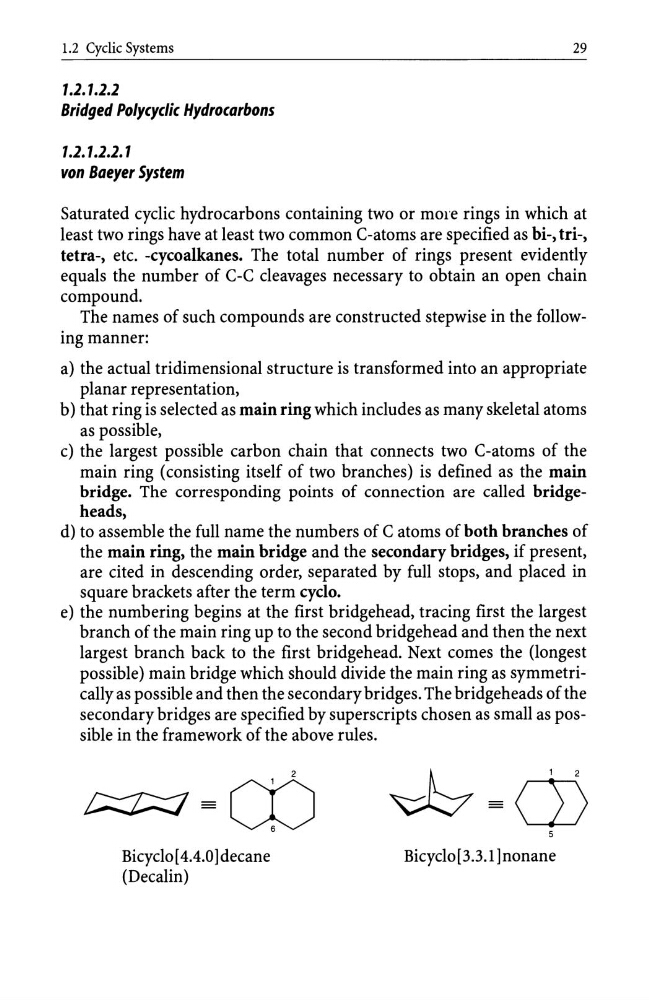
possible) main bridge which should divide the main ring as symmetrically as possible and then the secondary bridges. The bridgeheads of the
secondary bridges are specified by superscripts chosen as small as possible in the framework of the above rules.
Bicyclo [4.4.01 decane
(Decalin)
Bicyclo[3.3.11nonane
29
1.1.1.1.1
Bridged Polycyclic Hydrocarbons
1.1.1.2.2.1
von Baeyer System
Saturated cyclic hydrocarbons containing two or more rings in which at
least two rings have at least two common C-atoms are specified as bi-, tri-,
tetra-, etc. -cycoalkanes. The total number of rings present evidently
equals the number of C-C cleavages necessary to obtain an open chain
compound.
The names of such compounds are constructed stepwise in the followingmanner:
a) the actual tridimensional structure is transformed into an appropriate
planar representation,
b) that ring is selected as main ring which includes as many skeletal atoms
as possible,
c) the largest possible carbon chain that connects two C-atoms of the
main ring (consisting itself of two branches) is defined as the main
bridge. The corresponding points of connection are called bridgeheads,
d) to assemble the full name the numbers of C atoms of both branches of
the main ring, the main bridge and the secondary bridges, if present,
are cited in descending order, separated by full stops, and placed in
square brackets after the term cydo.
e) the numbering begins at the first bridgehead, tracing first the largest
branch of the main ring up to the second bridgehead and then the next
largest branch back to the first bridgehead. Next comes the (longest
possible) main bridge which should divide the main ring as symmetrically as possible and then the secondary bridges. The bridgeheads of the
secondary bridges are specified by superscripts chosen as small as possible in the framework of the above rules.
Bicyclo [4.4.01 decane
(Decalin)
Bicyclo[3.3.11nonane