

1.1 Acyclic Hydrocarbon Systems
11
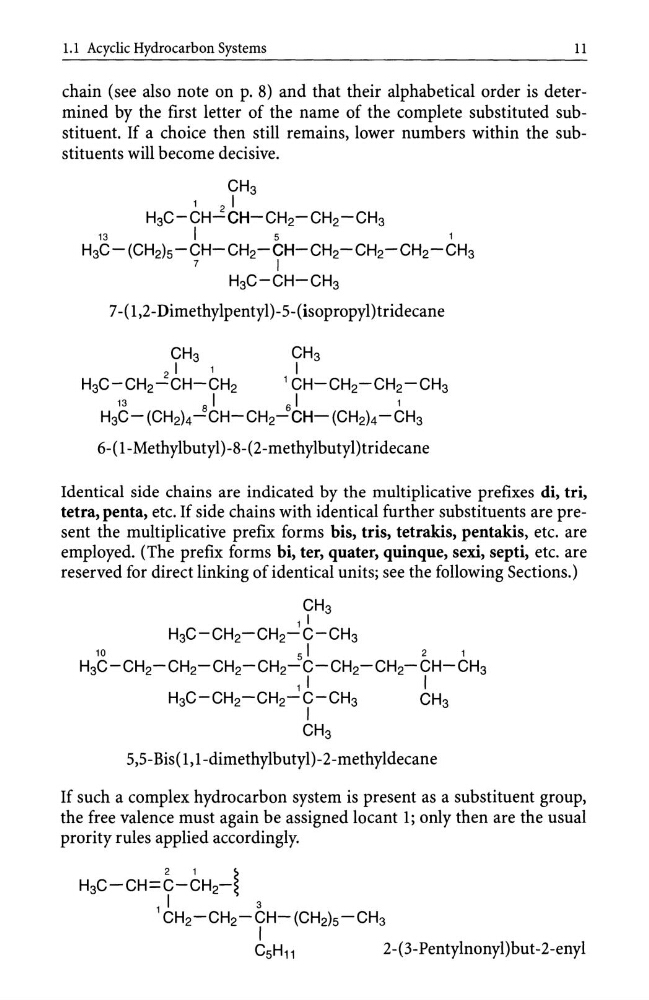
chain (see also note on p. 8) and that their alphabetical order is determined by the first letter of the name of the complete substituted substituent. If a choice then still remains, lower numbers within the substituents will become decisive.
CH3
1
2 I
H3C- CH- CH- CH2- CH 2 - CH 3
13
\
5
1
H3C-(CH2)5-CH-CH2-CH-CH2-CH2-CH2-CH3
7
I
H 3 C-CH-CH 3
7 -( 1 ,2-Dimethylpentyl)-5- (isopropyl)tridecane
CH3
CH3
2 I
1
I
H 3 C-CH 2 -CH-CH 2
1 CH-CH 2 -CH 2 -CH 3
13
a \
6\
1
H3C - (CH2)4 - CH- CH2- CH- (CH2)4 - CH3
6-( 1-Methylbutyl)-8-(2-methylbutyl)tridecane
Identical side chains are indicated hy the multiplicative prefixes di, tri,
tetra, penta, etc. If side chains with identical further substituents are present the multiplicative prefix forms his, tris, tetrakis, pentakis, etc. are
employed. (The prefix forms hi, ter, quater, quinque, sexi, septi, etc. are
reserved for direct linking of identical units; see the following Sections.)
CH3
1 I
H 3 C-CH 2 -CH 2 -C-CH 3
10
5\
2
1
H3C-CH2-CH2-CH2-CH2-C-CH2-CH2-CH-CH3
1 I
\
H 3 C-CH 2 -CH 2 -C-CH 3
CH 3
\
CH3
5,5-Bis( 1, I-dimethylbutyl)-2-methyldecane
If such a complex hydrocarbon system is present as a substituent group,
the free valence must again be assigned locant 1; only then are the usual
prority rules applied accordingly.
2
1
~
H3C-CH=C-CH2-~
1 \
3
CH2 - CH2 - CH- (CH 2 )5 - CH3
\
C S H11
2-(3-Pentylnonyl)but-2-enyl
11
chain (see also note on p. 8) and that their alphabetical order is determined by the first letter of the name of the complete substituted substituent. If a choice then still remains, lower numbers within the substituents will become decisive.
CH3
1
2 I
H3C- CH- CH- CH2- CH 2 - CH 3
13
\
5
1
H3C-(CH2)5-CH-CH2-CH-CH2-CH2-CH2-CH3
7
I
H 3 C-CH-CH 3
7 -( 1 ,2-Dimethylpentyl)-5- (isopropyl)tridecane
CH3
CH3
2 I
1
I
H 3 C-CH 2 -CH-CH 2
1 CH-CH 2 -CH 2 -CH 3
13
a \
6\
1
H3C - (CH2)4 - CH- CH2- CH- (CH2)4 - CH3
6-( 1-Methylbutyl)-8-(2-methylbutyl)tridecane
Identical side chains are indicated hy the multiplicative prefixes di, tri,
tetra, penta, etc. If side chains with identical further substituents are present the multiplicative prefix forms his, tris, tetrakis, pentakis, etc. are
employed. (The prefix forms hi, ter, quater, quinque, sexi, septi, etc. are
reserved for direct linking of identical units; see the following Sections.)
CH3
1 I
H 3 C-CH 2 -CH 2 -C-CH 3
10
5\
2
1
H3C-CH2-CH2-CH2-CH2-C-CH2-CH2-CH-CH3
1 I
\
H 3 C-CH 2 -CH 2 -C-CH 3
CH 3
\
CH3
5,5-Bis( 1, I-dimethylbutyl)-2-methyldecane
If such a complex hydrocarbon system is present as a substituent group,
the free valence must again be assigned locant 1; only then are the usual
prority rules applied accordingly.
2
1
~
H3C-CH=C-CH2-~
1 \
3
CH2 - CH2 - CH- (CH 2 )5 - CH3
\
C S H11
2-(3-Pentylnonyl)but-2-enyl