

180
6 Construction of the Names of Complex Compounds
g) lowest numerals for fusion or linking positions, e. g.:
naphtho[1,2-flquinoline> naptho[2,1-flquinoline > ... [2,3-f) ...
tricyclo[5.3.1.0 2 ,4)undecane > tricyclo[5.3.1.0 3 ,S]undecane
spiro [cyclopentane-l,l' -indene 1 > spiro [cyclopentane-l ,2' -indene]
2,3' -bipyridine > 3,3' -bipyridine
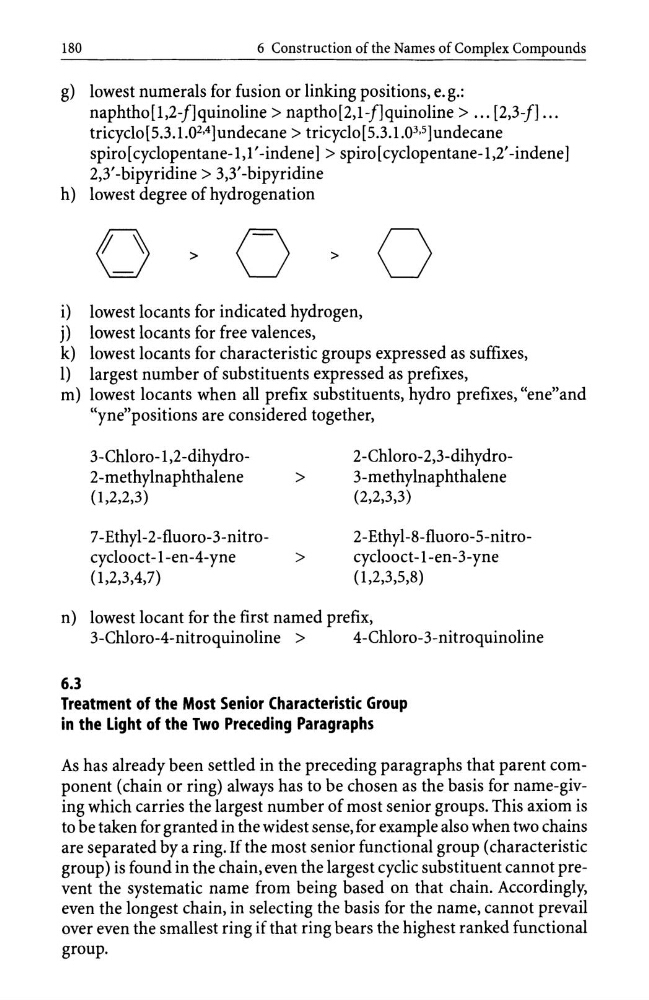
h) lowest degree of hydrogenation
o
>
o
>
o
i) lowest locants for indicated hydrogen,
j) lowest locants for free valences,
k) lowest locants for characteristic groups expressed as suffixes,
1) largest number of substituents expressed as prefixes,
m) lowest locants when all prefix substituents, hydro prefixes, "ene"and
"yne"positions are considered together,
3-Chloro-l,2-dihydro2-methylnaphthalene
>
(1,2,2,3)
7 -Ethyl-2-fluoro-3-nitrocyclooct-l-en-4-yne
>
(1,2,3,4,7)
2-Chloro-2,3-dihydro3-methylnaphthalene
(2,2,3,3)
2-Ethyl-8-fluoro- 5-nitrocyclooct-l-en-3-yne
( 1,2,3,5,8)
n) lowest locant for the first named prefix,
3-Chloro-4-nitroquinoline >
4-Chloro-3-nitroquinoline
6.3
Treatment of the Most Senior Characteristic Group
in the Light of the Two Preceding Paragraphs
As has already been settled in the preceding paragraphs that parent component (chain or ring) always has to be chosen as the basis for name-giving which carries the largest number of most senior groups. This axiom is
to be taken for granted in the widest sense, for example also when two chains
are separated by a ring. If the most senior functional group (characteristic
group) is found in the chain, even the largest cyclic substituent cannot prevent the systematic name from being based on that chain. Accordingly,
even the longest chain, in selecting the basis for the name, cannot prevail
over even the smallest ring if that ring bears the highest ranked functional
group.
6 Construction of the Names of Complex Compounds
g) lowest numerals for fusion or linking positions, e. g.:
naphtho[1,2-flquinoline> naptho[2,1-flquinoline > ... [2,3-f) ...
tricyclo[5.3.1.0 2 ,4)undecane > tricyclo[5.3.1.0 3 ,S]undecane
spiro [cyclopentane-l,l' -indene 1 > spiro [cyclopentane-l ,2' -indene]
2,3' -bipyridine > 3,3' -bipyridine
h) lowest degree of hydrogenation
o
>
o
>
o
i) lowest locants for indicated hydrogen,
j) lowest locants for free valences,
k) lowest locants for characteristic groups expressed as suffixes,
1) largest number of substituents expressed as prefixes,
m) lowest locants when all prefix substituents, hydro prefixes, "ene"and
"yne"positions are considered together,
3-Chloro-l,2-dihydro2-methylnaphthalene
>
(1,2,2,3)
7 -Ethyl-2-fluoro-3-nitrocyclooct-l-en-4-yne
>
(1,2,3,4,7)
2-Chloro-2,3-dihydro3-methylnaphthalene
(2,2,3,3)
2-Ethyl-8-fluoro- 5-nitrocyclooct-l-en-3-yne
( 1,2,3,5,8)
n) lowest locant for the first named prefix,
3-Chloro-4-nitroquinoline >
4-Chloro-3-nitroquinoline
6.3
Treatment of the Most Senior Characteristic Group
in the Light of the Two Preceding Paragraphs
As has already been settled in the preceding paragraphs that parent component (chain or ring) always has to be chosen as the basis for name-giving which carries the largest number of most senior groups. This axiom is
to be taken for granted in the widest sense, for example also when two chains
are separated by a ring. If the most senior functional group (characteristic
group) is found in the chain, even the largest cyclic substituent cannot prevent the systematic name from being based on that chain. Accordingly,
even the longest chain, in selecting the basis for the name, cannot prevail
over even the smallest ring if that ring bears the highest ranked functional
group.