

4.5 "ate" Complexes
(F3ChHg
(C3H7)2TiCb
Iodomethylzinc iodide
Iodomethyliodozinc
Dimethylcadmium
Phenylmercury acetate
Acetato(phenyl)mercury
Bis( trifluormethyl)mercury
Dichlorodipropyltitanium
Dipropyltitanium dichloride
153
[(H3ChH CbZr[ OCH( CH3hb Diisopropylzirkonium diisopropoxide
Diisopropyldiisopropanolatozirkonium
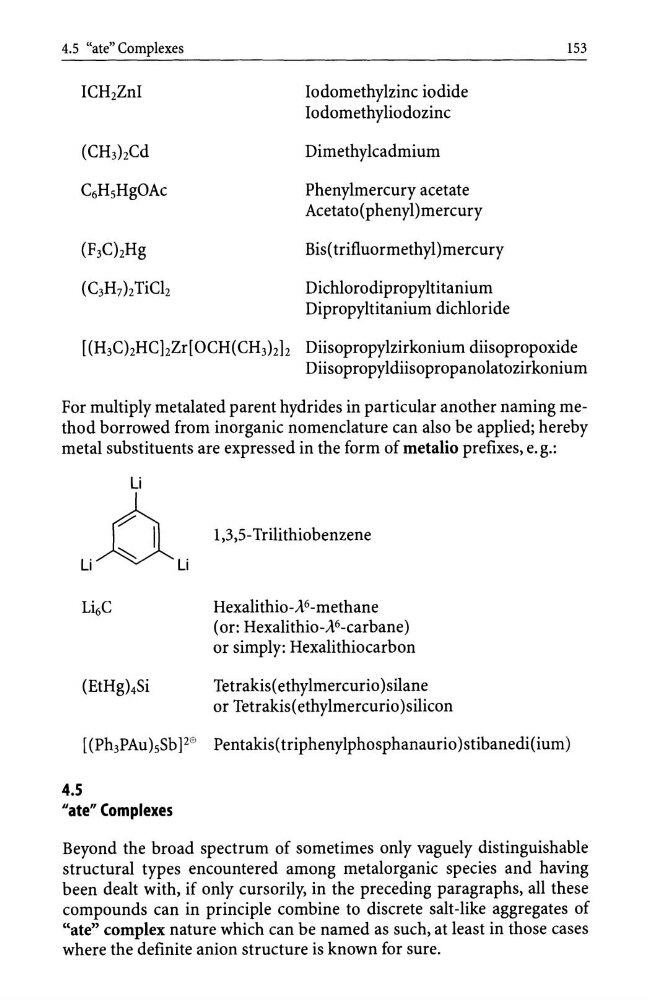
For multiply metalated parent hydrides in particular another naming method borrowed from inorganic nomenclature can also be applied; hereby
metal substituents are expressed in the form of metalio prefixes, e. g.:
Li
Jr 1,3,5-T'ilithiohenzene
L i A A L i
4.5
Li6C
Hexalithio-,t6-methane
(or: Hexalithio-,t6-carbane)
or simply: Hexalithiocarbon
(EtHg)4Si
Tetrakis( ethylmercurio )silane
or Tetrakis( ethylmercurio ) silicon
[(Ph3PAu)sSb Fe Pentakis( triphenylphosphanaurio )stibanedi(ium)
"ate" Complexes
Beyond the broad spectrum of sometimes only vaguely distinguishable
structural types encountered among metalorganic species and having
been dealt with, if only cursorily, in the preceding paragraphs, all these
compounds can in principle combine to discrete salt-like aggregates of
"ate" complex nature which can be named as such, at least in those cases
where the definite anion structure is known for sure.
(F3ChHg
(C3H7)2TiCb
Iodomethylzinc iodide
Iodomethyliodozinc
Dimethylcadmium
Phenylmercury acetate
Acetato(phenyl)mercury
Bis( trifluormethyl)mercury
Dichlorodipropyltitanium
Dipropyltitanium dichloride
153
[(H3ChH CbZr[ OCH( CH3hb Diisopropylzirkonium diisopropoxide
Diisopropyldiisopropanolatozirkonium
For multiply metalated parent hydrides in particular another naming method borrowed from inorganic nomenclature can also be applied; hereby
metal substituents are expressed in the form of metalio prefixes, e. g.:
Li
Jr 1,3,5-T'ilithiohenzene
L i A A L i
4.5
Li6C
Hexalithio-,t6-methane
(or: Hexalithio-,t6-carbane)
or simply: Hexalithiocarbon
(EtHg)4Si
Tetrakis( ethylmercurio )silane
or Tetrakis( ethylmercurio ) silicon
[(Ph3PAu)sSb Fe Pentakis( triphenylphosphanaurio )stibanedi(ium)
"ate" Complexes
Beyond the broad spectrum of sometimes only vaguely distinguishable
structural types encountered among metalorganic species and having
been dealt with, if only cursorily, in the preceding paragraphs, all these
compounds can in principle combine to discrete salt-like aggregates of
"ate" complex nature which can be named as such, at least in those cases
where the definite anion structure is known for sure.