

3.3 Aldehydes and Ketones
121
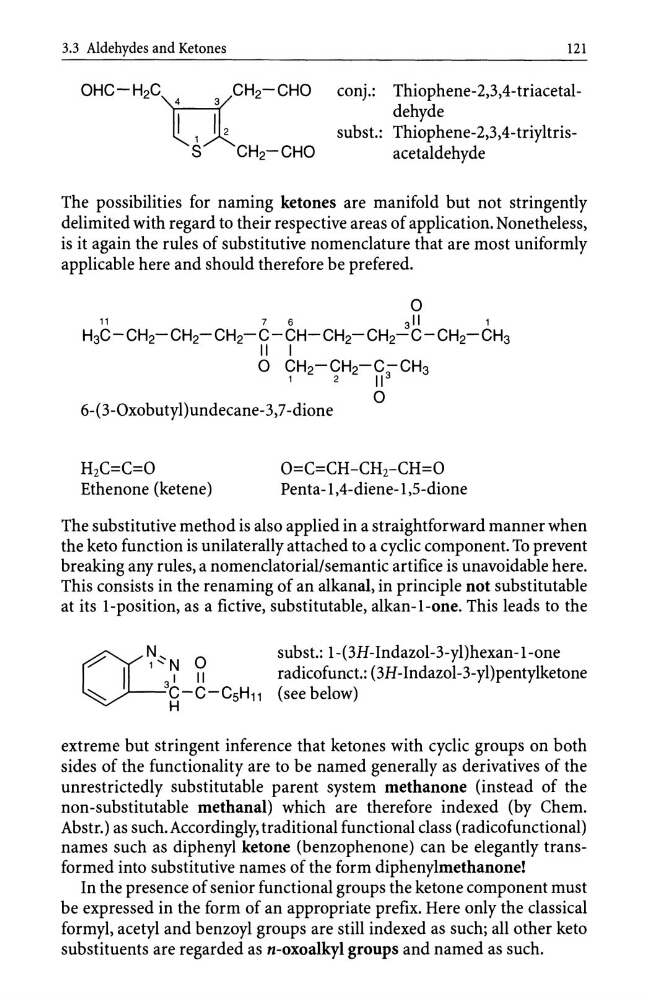
conj.: Thiophene-2,3,4-triacetaldehyde
subst.: Thiophene-2,3,4-triyltrisacetaldehyde
The possibilities for naming ketones are manifold but not stringently
delimited with regard to their respective areas of application. Nonetheless,
is it again the rules of substitutive nomenclature that are most uniformly
applicable here and should therefore be prefered.
o
11
7
6
311
1
H3C - CH 2 - CH 2 - CH 2 - C - CH- CH 2 - CH 2 -C - CH 2 - CH 3
II I
o CH2-CH2-C;-CH3
1
2
II
6-(3-0xobutyl)undecane-3,7-dione
o
HzC=C=O
Ethenone (ketene)
O=C=CH-CHz-CH=O
Penta-I,4-diene-I,5-dione
The substitutive method is also applied in a straightforward manner when
the keto function is unilaterally attached to a cyclic component. To prevent
breaking any rules, a nomenclatoriallsemantic artifice is unavoidable here.
This consists in the renaming of an alkanal, in principle not substitutable
at its I-position, as a fictive, substitutable, alkan-I-one. This leads to the
oc
~~
0
subst.: 1-(3H-Indazol-3-yl)hexan-I-one
I 3~ II
radicofunct.: (3H-Indazol-3-yl)pentylketone
~
C-C-C5H11 (see below)
H
extreme but stringent inference that ketones with cyclic groups on both
sides of the functionality are to be named generally as derivatives of the
unrestrictedly substitutable parent system methanone (instead of the
non-substitutable methanal) which are therefore indexed (by Chern.
Abstr.) as such. Accordingly, traditional functional class (radicofunctional)
names such as diphenyl ketone (benzophenone) can be elegantly transformed into substitutive names of the form diphenylmethanone!
In the presence of senior functional groups the ketone component must
be expressed in the form of an appropriate prefix. Here only the classical
formyl, acetyl and benzoyl groups are still indexed as such; all other keto
substituents are regarded as n-oxoalkyl groups and named as such.
121
conj.: Thiophene-2,3,4-triacetaldehyde
subst.: Thiophene-2,3,4-triyltrisacetaldehyde
The possibilities for naming ketones are manifold but not stringently
delimited with regard to their respective areas of application. Nonetheless,
is it again the rules of substitutive nomenclature that are most uniformly
applicable here and should therefore be prefered.
o
11
7
6
311
1
H3C - CH 2 - CH 2 - CH 2 - C - CH- CH 2 - CH 2 -C - CH 2 - CH 3
II I
o CH2-CH2-C;-CH3
1
2
II
6-(3-0xobutyl)undecane-3,7-dione
o
HzC=C=O
Ethenone (ketene)
O=C=CH-CHz-CH=O
Penta-I,4-diene-I,5-dione
The substitutive method is also applied in a straightforward manner when
the keto function is unilaterally attached to a cyclic component. To prevent
breaking any rules, a nomenclatoriallsemantic artifice is unavoidable here.
This consists in the renaming of an alkanal, in principle not substitutable
at its I-position, as a fictive, substitutable, alkan-I-one. This leads to the
oc
~~
0
subst.: 1-(3H-Indazol-3-yl)hexan-I-one
I 3~ II
radicofunct.: (3H-Indazol-3-yl)pentylketone
~
C-C-C5H11 (see below)
H
extreme but stringent inference that ketones with cyclic groups on both
sides of the functionality are to be named generally as derivatives of the
unrestrictedly substitutable parent system methanone (instead of the
non-substitutable methanal) which are therefore indexed (by Chern.
Abstr.) as such. Accordingly, traditional functional class (radicofunctional)
names such as diphenyl ketone (benzophenone) can be elegantly transformed into substitutive names of the form diphenylmethanone!
In the presence of senior functional groups the ketone component must
be expressed in the form of an appropriate prefix. Here only the classical
formyl, acetyl and benzoyl groups are still indexed as such; all other keto
substituents are regarded as n-oxoalkyl groups and named as such.