

3 Brief Demonstration
of the General Nomenclature Rules
for the Most Important Traditional Compound
Classes (Functional Parents)
Because the use of different kinds of nomenclature for one and the same
compound class is still widespread, it is necessary to bring into focus
which principles are to be applied in general. However, only those compound classes will be discussed individually whose naming does not
axiomatically follow from Table 8. As a rule, frequently occurring trivial
names are compiled in tables in the appendix. The remaining compound
classes are mentioned in the examples. Incidentally, it should be noted
once again that in the context of substitutive nomenclature certain class
names no longer appear at all in the names of the pertinent individual
compounds, as in the case of alcohols, ethers, ketones, etc.
3.1
Carboxylic Acids, Sulfonic Acids, etc. and their Derivatives
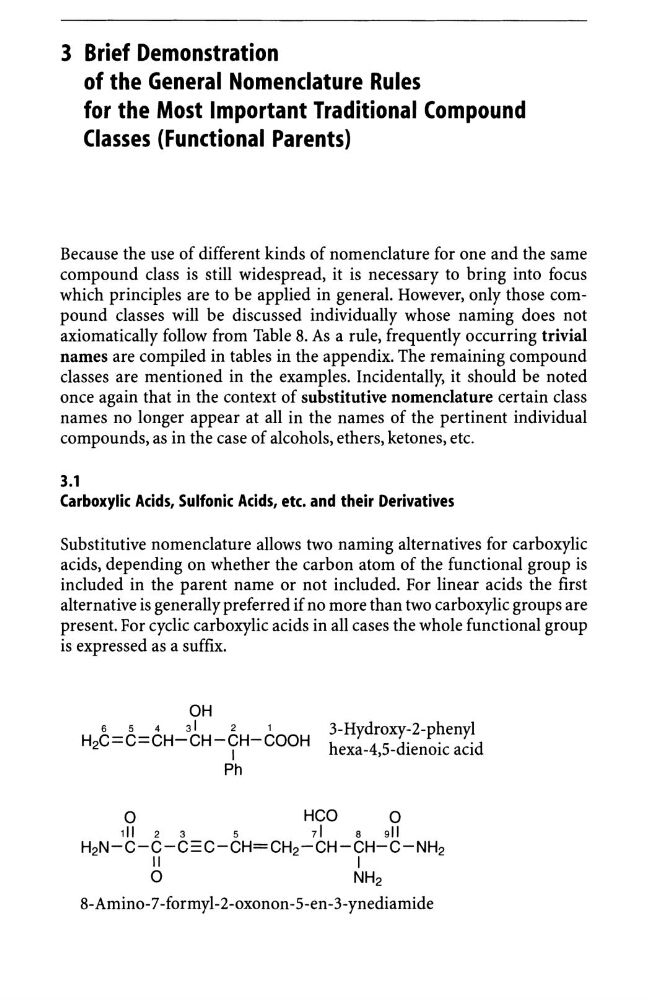
Substitutive nomenclature allows two naming alternatives for carboxylic
acids, depending on whether the carbon atom of the functional group is
included in the parent name or not included. For linear acids the first
alternative is generally preferred if no more than two carboxylic groups are
present. For cyclic carboxylic acids in all cases the whole functional group
is expressed as a suffix.
OH
6
5
4
31
2
1
H2C = C = CH- CH - CH- COOH
I
Ph
3-Hydroxy-2-phenyl
hexa-4,5-dienoic acid
o
HCO
0
111 2 3
5
71
8
911
~N-C-C-C~C-CH=C~-CH-CH-C-N~
II
I
o
NH2
8-Amino-7 -formyl- 2-oxonon-5-en -3-ynediamide
of the General Nomenclature Rules
for the Most Important Traditional Compound
Classes (Functional Parents)
Because the use of different kinds of nomenclature for one and the same
compound class is still widespread, it is necessary to bring into focus
which principles are to be applied in general. However, only those compound classes will be discussed individually whose naming does not
axiomatically follow from Table 8. As a rule, frequently occurring trivial
names are compiled in tables in the appendix. The remaining compound
classes are mentioned in the examples. Incidentally, it should be noted
once again that in the context of substitutive nomenclature certain class
names no longer appear at all in the names of the pertinent individual
compounds, as in the case of alcohols, ethers, ketones, etc.
3.1
Carboxylic Acids, Sulfonic Acids, etc. and their Derivatives
Substitutive nomenclature allows two naming alternatives for carboxylic
acids, depending on whether the carbon atom of the functional group is
included in the parent name or not included. For linear acids the first
alternative is generally preferred if no more than two carboxylic groups are
present. For cyclic carboxylic acids in all cases the whole functional group
is expressed as a suffix.
OH
6
5
4
31
2
1
H2C = C = CH- CH - CH- COOH
I
Ph
3-Hydroxy-2-phenyl
hexa-4,5-dienoic acid
o
HCO
0
111 2 3
5
71
8
911
~N-C-C-C~C-CH=C~-CH-CH-C-N~
II
I
o
NH2
8-Amino-7 -formyl- 2-oxonon-5-en -3-ynediamide