

96
Table 10 (continued)
Traditional
Sulfonyldioxy .. .
Tetramethylene .. .
Thio ...
Thiocarbonyl .. .
Trimethylene .. .
Trimethylenedioxy ...
Ureylene ...
2.2.7
Formula
-O-SOz-O-CHz(
-NH-CO-NHNaming of Radical and Ionic Species
2 Substituted Systems
Systematic
Butane-l,4-diyl
Sulfanediyl
Propane-l,3-diyl
Propane-l,3-diylbis( oxy)
In principle, all radicals and ions can nowadays be named in a uniform and
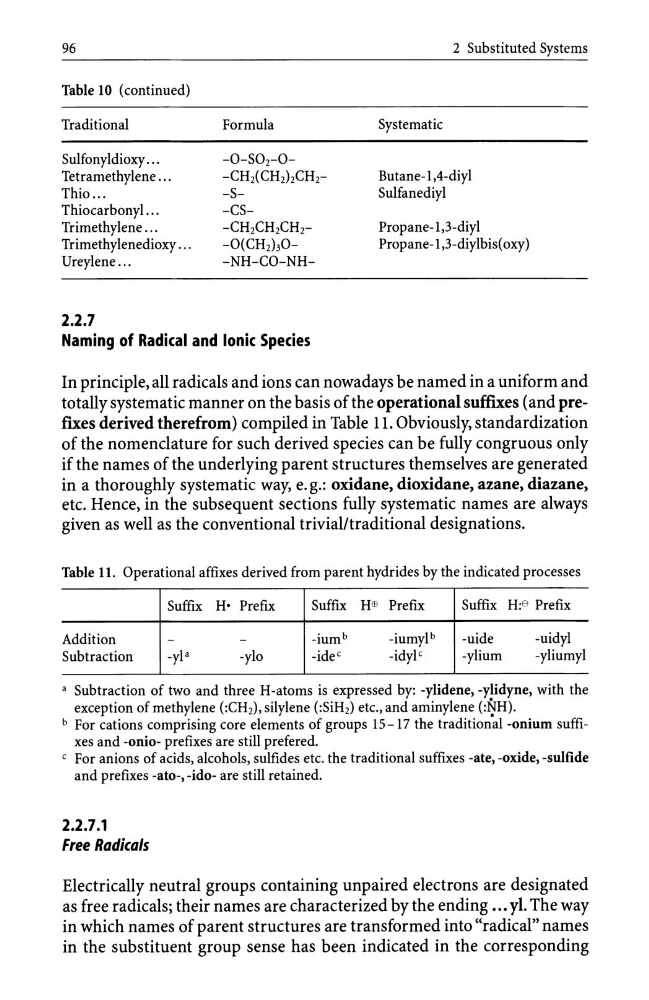
totally systematic manner on the basis of the operational suffixes (and prefIxes derived therefrom) compiled in Table 11. Obviously, standardization
of the nomenclature for such derived species can be fully congruous only
if the names of the underlying parent structures themselves are generated
in a thoroughly systematic way, e. g.: oxidane, dioxidane, azane, diazane,
etc. Hence, in the subsequent sections fully systematic names are always
given as well as the conventional trivial/traditional designations.
Table 11. Operational affixes derived from parent hydrides by the indicated processes
Suffix H' PrefIx
Suffix HEB PrefIx
SuffIx H:8 PrefIx
Addition
-
-
-ium b
-iumylb
-uide
-uidyl
Subtraction
-yla
-ylo
-ide'
-idyl'
-ylium
-yliumyl
a Subtraction of two and three H-atoms is expressed by: -ylidene, -ylidyne, with the
exception of methylene (:CH2), silylene (:SiH2) etc., and aminylene (:BH).
b For cations comprising core elements of groups 15 -17 the traditional -onium suffIxes and -onio- prefIxes are still prefered.
C For anions of acids, alcohols, sulfIdes etc. the traditional suffIxes -ate, -oxide, -sulfide
and prefIxes -ato-, -ido- are still retained.
2.2.7.1
Free Radicals
Electrically neutral groups containing unpaired electrons are designated
as free radicals; their names are characterized by the ending •.. yl. The way
in which names of parent structures are transformed into "radical" names
in the substituent group sense has been indicated in the corresponding
Table 10 (continued)
Traditional
Sulfonyldioxy .. .
Tetramethylene .. .
Thio ...
Thiocarbonyl .. .
Trimethylene .. .
Trimethylenedioxy ...
Ureylene ...
2.2.7
Formula
-O-SOz-O-CHz(
-NH-CO-NHNaming of Radical and Ionic Species
2 Substituted Systems
Systematic
Butane-l,4-diyl
Sulfanediyl
Propane-l,3-diyl
Propane-l,3-diylbis( oxy)
In principle, all radicals and ions can nowadays be named in a uniform and
totally systematic manner on the basis of the operational suffixes (and prefIxes derived therefrom) compiled in Table 11. Obviously, standardization
of the nomenclature for such derived species can be fully congruous only
if the names of the underlying parent structures themselves are generated
in a thoroughly systematic way, e. g.: oxidane, dioxidane, azane, diazane,
etc. Hence, in the subsequent sections fully systematic names are always
given as well as the conventional trivial/traditional designations.
Table 11. Operational affixes derived from parent hydrides by the indicated processes
Suffix H' PrefIx
Suffix HEB PrefIx
SuffIx H:8 PrefIx
Addition
-
-
-ium b
-iumylb
-uide
-uidyl
Subtraction
-yla
-ylo
-ide'
-idyl'
-ylium
-yliumyl
a Subtraction of two and three H-atoms is expressed by: -ylidene, -ylidyne, with the
exception of methylene (:CH2), silylene (:SiH2) etc., and aminylene (:BH).
b For cations comprising core elements of groups 15 -17 the traditional -onium suffIxes and -onio- prefIxes are still prefered.
C For anions of acids, alcohols, sulfIdes etc. the traditional suffIxes -ate, -oxide, -sulfide
and prefIxes -ato-, -ido- are still retained.
2.2.7.1
Free Radicals
Electrically neutral groups containing unpaired electrons are designated
as free radicals; their names are characterized by the ending •.. yl. The way
in which names of parent structures are transformed into "radical" names
in the substituent group sense has been indicated in the corresponding