

2.2 Nomenclature Types for Substituted Systems
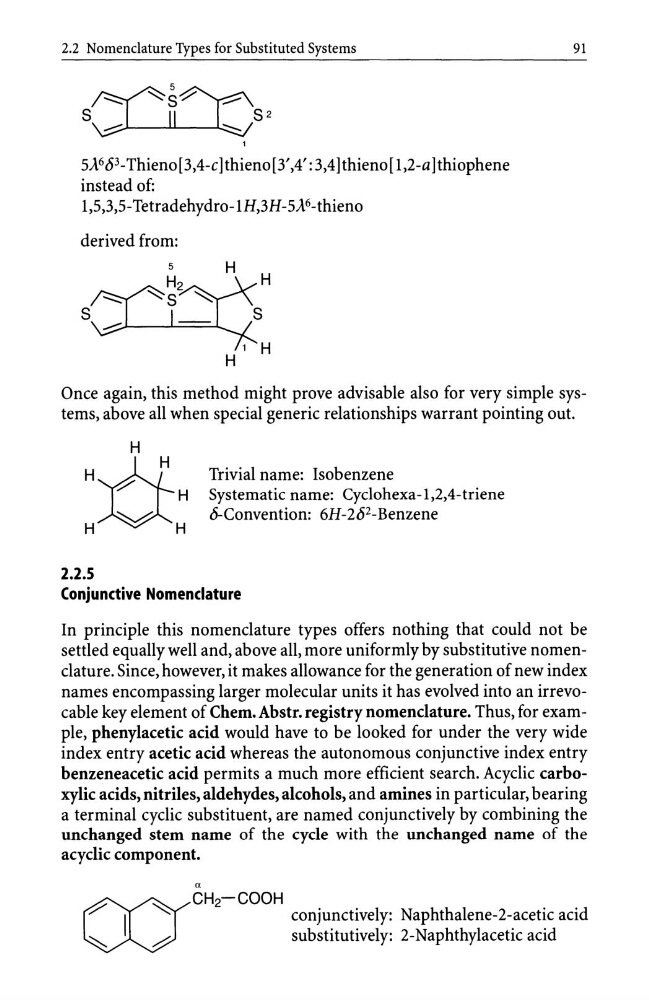
5..\6(53-Thieno[3,4-clthieno[3',4': 3,41thieno[I,2-althiophene
instead of:
1,5,3,5-Tetradehydro-1H,3H-5..\6-thieno
derived from:
H
H
s
1
H
H
91
Once again, this method might prove advisable also for very simple systems, above all when special generic relationships warrant pointing out.
2.2.5
Trivial name: Isobenzene
Systematic name: Cyclohexa -1,2,4-triene
8-Convention: 6H-28 2 -Benzene
Conjunctive Nomenclature
In principle this nomenclature types offers nothing that could not be
settled equally well and, above all, more uniformly by substitutive nomenclature. Since, however, it makes allowance for the generation of new index
names encompassing larger molecular units it has evolved into an irrevocable key element of Chern. Abstr. registry nomenclature. Thus, for example, phenylacetic acid would have to be looked for under the very wide
index entry acetic acid whereas the autonomous conjunctive index entry
benzeneacetic acid permits a much more efficient search. Acyclic carboxylic acids, nitrHes, aldehydes, alcohols, and amines in particular, bearing
a terminal cyclic substituent, are named conjunctively by combining the
unchanged stem name of the cycle with the unchanged name of the
acyclic component.
a
-:?' I ~
conjunctively: Naphthalene-2-acetic acid
ro
CH2-COOH
~
~
substitutively: 2-Naphthylacetic acid
5..\6(53-Thieno[3,4-clthieno[3',4': 3,41thieno[I,2-althiophene
instead of:
1,5,3,5-Tetradehydro-1H,3H-5..\6-thieno
derived from:
H
H
s
1
H
H
91
Once again, this method might prove advisable also for very simple systems, above all when special generic relationships warrant pointing out.
2.2.5
Trivial name: Isobenzene
Systematic name: Cyclohexa -1,2,4-triene
8-Convention: 6H-28 2 -Benzene
Conjunctive Nomenclature
In principle this nomenclature types offers nothing that could not be
settled equally well and, above all, more uniformly by substitutive nomenclature. Since, however, it makes allowance for the generation of new index
names encompassing larger molecular units it has evolved into an irrevocable key element of Chern. Abstr. registry nomenclature. Thus, for example, phenylacetic acid would have to be looked for under the very wide
index entry acetic acid whereas the autonomous conjunctive index entry
benzeneacetic acid permits a much more efficient search. Acyclic carboxylic acids, nitrHes, aldehydes, alcohols, and amines in particular, bearing
a terminal cyclic substituent, are named conjunctively by combining the
unchanged stem name of the cycle with the unchanged name of the
acyclic component.
a
-:?' I ~
conjunctively: Naphthalene-2-acetic acid
ro
CH2-COOH
~
~
substitutively: 2-Naphthylacetic acid