

2.2 Nomenclature Types for Substituted Systems
89
Also restricted mainly to complex and/ or trivially named natural products
(e. g.: alkaloids) remains a method for indicating replacement of N-methyl
groups by hydrogen with the prefix de ...
De-N-methyl ...
Similar limitations apply for the specification of an analogous replacement of hydroxy groups by hydrogen, as occurs frequently in carbohydrate
chemistry.
-CH20H ~ -CH3, -CHOH- ~ -CHr etc.
Deoxy ...
Several compound classes obtainable by dehydration of appropriate precursors have subtractive class names: anhydrides, lactones, sultams, etc.
The prefix anhydro for indicating removal of water from two hydroxy
groups is again mainly used for carbohydrates (see Chapter 5).
I
HC~OH
I y
HO-CH
I
HCz-OH
I
I
HC
HO-?~O x,z-Anhydro ...
HC
I
Special conventions apply for the use of the prefix nor ... , another manifestation of subtractive terminology. In the terpene series, nor-compounds are those which have undergone replacement of all methyl groups
on a ring by hydrogen atoms (see Appendix, Table 21). For steroids
(Appendix, Table 22) nor ... means first of all loss of a CHz group from a
chain and, in a second sense, ring contraction with the expulsion of one
CHz unit, i. e. the opposite of homo ....
Out of the specific necessities of steroid nomenclature another highly
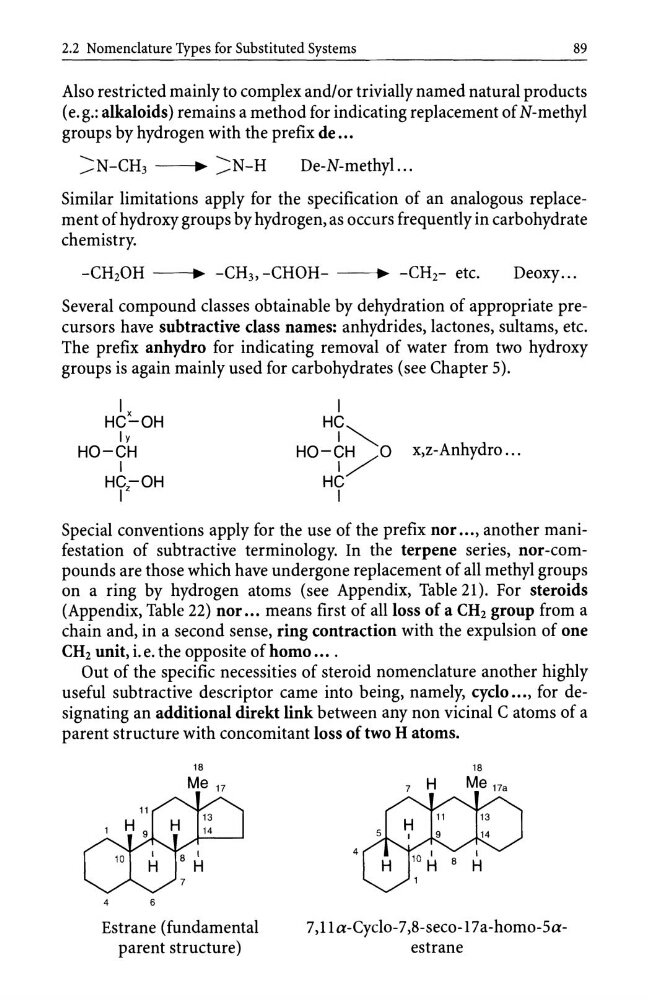
useful subtractive descriptor came into being, namely, cyclo ... , for designating an additional direkt link between any non vicinal C atoms of a
parent structure with concomitant loss of two H atoms.
18
Me 17
Estrane (fundamental
parent structure)
18
7
H Me 17a
4
7,11a-Cyclo-7,8-seco-17a-homo-5aestrane
89
Also restricted mainly to complex and/ or trivially named natural products
(e. g.: alkaloids) remains a method for indicating replacement of N-methyl
groups by hydrogen with the prefix de ...
De-N-methyl ...
Similar limitations apply for the specification of an analogous replacement of hydroxy groups by hydrogen, as occurs frequently in carbohydrate
chemistry.
-CH20H ~ -CH3, -CHOH- ~ -CHr etc.
Deoxy ...
Several compound classes obtainable by dehydration of appropriate precursors have subtractive class names: anhydrides, lactones, sultams, etc.
The prefix anhydro for indicating removal of water from two hydroxy
groups is again mainly used for carbohydrates (see Chapter 5).
I
HC~OH
I y
HO-CH
I
HCz-OH
I
I
HC
HO-?~O x,z-Anhydro ...
HC
I
Special conventions apply for the use of the prefix nor ... , another manifestation of subtractive terminology. In the terpene series, nor-compounds are those which have undergone replacement of all methyl groups
on a ring by hydrogen atoms (see Appendix, Table 21). For steroids
(Appendix, Table 22) nor ... means first of all loss of a CHz group from a
chain and, in a second sense, ring contraction with the expulsion of one
CHz unit, i. e. the opposite of homo ....
Out of the specific necessities of steroid nomenclature another highly
useful subtractive descriptor came into being, namely, cyclo ... , for designating an additional direkt link between any non vicinal C atoms of a
parent structure with concomitant loss of two H atoms.
18
Me 17
Estrane (fundamental
parent structure)
18
7
H Me 17a
4
7,11a-Cyclo-7,8-seco-17a-homo-5aestrane