

Addition of Hydroxylamines to DE-Unsaturated Esters 53
Answer to the Question
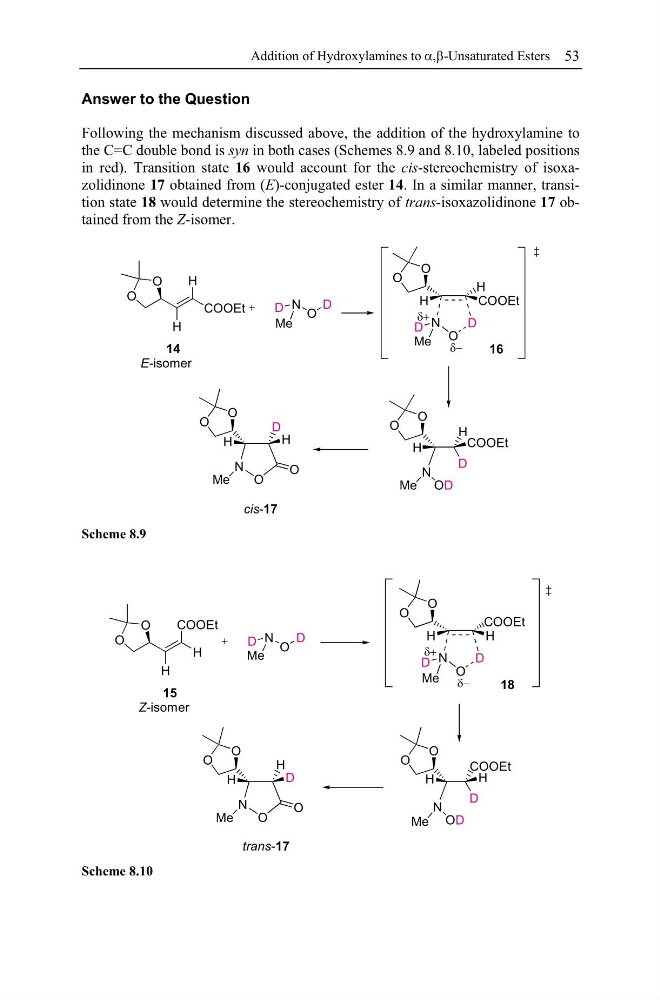
Following the mechanism discussed above, the addition of the hydroxylamine to
the C=C double bond is syn in both cases (Schemes 8.9 and 8.10, labeled positions
in red). Transition state 16 would account for the cis-stereochemistry of isoxazolidinone 17 obtained from (E)-conjugated ester 14. In a similar manner, transition state 18 would determine the stereochemistry of trans-isoxazolidinone 17 obtained from the Z-isomer. Z Z
COOEt
N
O
D
H
H
Me
D
O
O
D
N
OD
O
O
H
COOEt
Me
H
D
N
O
Me
D
N
O
Me
D
H
O
O
O
H
COOEt
O
O
H
H
E-isomer E E
14
G
G
cis-17
16
Scheme 8.9
N
Me
D
O
D
H
COOEt
O
O
H
O
D
N
COOEt
H
OD
Me
H
O
D N
O
D
Me
N
O
O
Me
H
D
O
O
H
H
O
O
COOEt
H
18
Z-isomer
15
G
G
trans-17
Scheme 8.10
Answer to the Question
Following the mechanism discussed above, the addition of the hydroxylamine to
the C=C double bond is syn in both cases (Schemes 8.9 and 8.10, labeled positions
in red). Transition state 16 would account for the cis-stereochemistry of isoxazolidinone 17 obtained from (E)-conjugated ester 14. In a similar manner, transition state 18 would determine the stereochemistry of trans-isoxazolidinone 17 obtained from the Z-isomer. Z Z
COOEt
N
O
D
H
H
Me
D
O
O
D
N
OD
O
O
H
COOEt
Me
H
D
N
O
Me
D
N
O
Me
D
H
O
O
O
H
COOEt
O
O
H
H
E-isomer E E
14
G
G
cis-17
16
Scheme 8.9
N
Me
D
O
D
H
COOEt
O
O
H
O
D
N
COOEt
H
OD
Me
H
O
D N
O
D
Me
N
O
O
Me
H
D
O
O
H
H
O
O
COOEt
H
18
Z-isomer
15
G
G
trans-17
Scheme 8.10