

Rearrangements from Tetrahydropyran Derivatives
29
H
H
O
O
C 6 H 5
O
C 6 H 5
H
H
O
SnCl 4
cis i i -11
DCM
-30
o C
tr t t an
r r s-12
Scheme 5.3
E Ex E Ex E Ex
Ex E E p
x xp xp xp p
x xpe er ri ri ri r ri ri r rim i im im im i i e en nt t 2 2
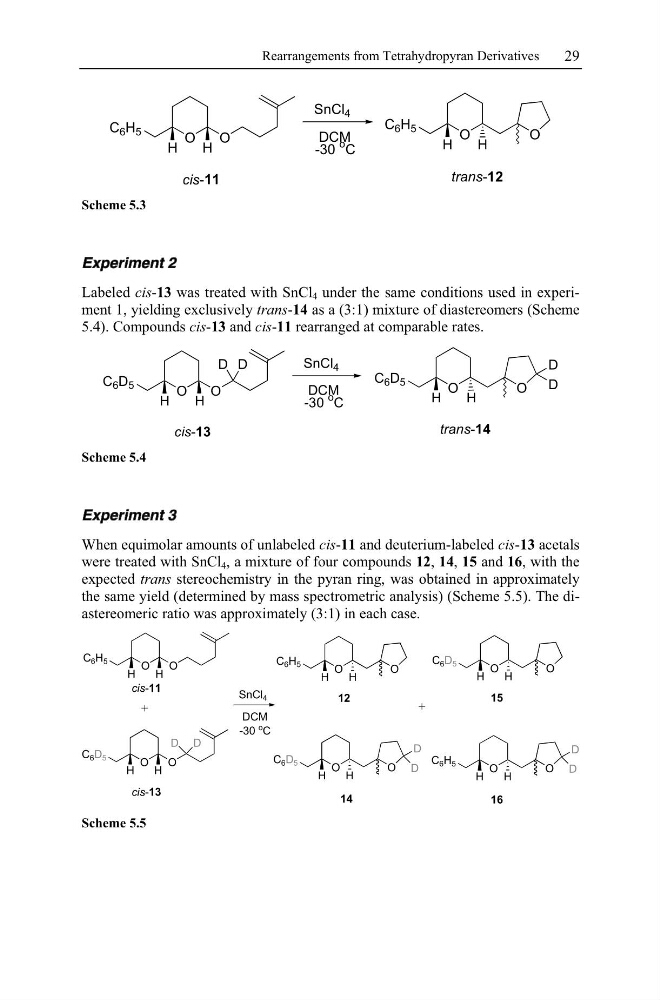
Labeled cis i i -13 was treated with SnCl 4 under the same conditions used in experiment 1, yielding exclusively trans-14 as a (3:1) mixture of diastereomers (Scheme
5.4). Comp m m ounds cis i i -13 and cis i i -11 rearranged at comp m arable rates.
O
O
C 6 D 5
H
H
O
D D
SnCl 4
O
C 6 D 5
H
H
O
O
D
D
cis i i -13
DCM
-30
o C
trans-14
Scheme 5.4
E Ex E Ex E Ex Ex E E p
x xp xp xp p
x xpe er ri ri ri r ri ri r rim i im im im i i e en nt t 3 3
When equ q imolar amounts of unlabe a led cis i i -11 and deuterium-labe a led cis i i -13 acetals
were tr t eated with SnCl 4 , a mixtu t re of fou f f r compo m unds 12, 14, 15 and 16, with the
expected trans stereochemistry in the pyran ring, was obtained in ap a proximately
the same yield (determined by mass spectrometric analysis) (Scheme 5.5). The diastereomeric ratio was approximately (3:1) in each case.
O
O
C 6 H 5
H
H
SnCl 4
O
O
C 6 D 5
D D
H
H
O
O
O
C 6 H 5
H
H
O
O
D
C 6 D 5
H
H
O
O D
H
H
O
O
C 6 D 5
O
C 6 H 5
H
H
O
O
D
D
DCM
-30
o
C
12
14
15
16
cis-11
cis-13
Scheme 5.5
29
H
H
O
O
C 6 H 5
O
C 6 H 5
H
H
O
SnCl 4
cis i i -11
DCM
-30
o C
tr t t an
r r s-12
Scheme 5.3
E Ex E Ex E Ex
Ex E E p
x xp xp xp p
x xpe er ri ri ri r ri ri r rim i im im im i i e en nt t 2 2
Labeled cis i i -13 was treated with SnCl 4 under the same conditions used in experiment 1, yielding exclusively trans-14 as a (3:1) mixture of diastereomers (Scheme
5.4). Comp m m ounds cis i i -13 and cis i i -11 rearranged at comp m arable rates.
O
O
C 6 D 5
H
H
O
D D
SnCl 4
O
C 6 D 5
H
H
O
O
D
D
cis i i -13
DCM
-30
o C
trans-14
Scheme 5.4
E Ex E Ex E Ex Ex E E p
x xp xp xp p
x xpe er ri ri ri r ri ri r rim i im im im i i e en nt t 3 3
When equ q imolar amounts of unlabe a led cis i i -11 and deuterium-labe a led cis i i -13 acetals
were tr t eated with SnCl 4 , a mixtu t re of fou f f r compo m unds 12, 14, 15 and 16, with the
expected trans stereochemistry in the pyran ring, was obtained in ap a proximately
the same yield (determined by mass spectrometric analysis) (Scheme 5.5). The diastereomeric ratio was approximately (3:1) in each case.
O
O
C 6 H 5
H
H
SnCl 4
O
O
C 6 D 5
D D
H
H
O
O
O
C 6 H 5
H
H
O
O
D
C 6 D 5
H
H
O
O D
H
H
O
O
C 6 D 5
O
C 6 H 5
H
H
O
O
D
D
DCM
-30
o
C
12
14
15
16
cis-11
cis-13
Scheme 5.5