

Level 3 – Case 39
266
the IBX-mediated cyclization of anilides 1, we should presume that the transformation of II into III (a radical cyclization) is not the slow step of the reaction.
Finally, the voltammetry measurements provide data that are in further support
of the SET step as rate-determining. If we study the values of the oxidation potentials of substituted anilides 8 we will realize that there exists a direct correlation
between their values and the observed relative rates of the reaction. Thus, the anilide with lower oxidation potential (0.82 V) proceeds rapidly, (this is the case of R
= MeO), while the anilides with higher oxidation potential (1.23 V, 1.48 V and
1.57 V) proceed only sluggishly (R = F, COMe) or not at all (R = CF 3 ).
Considering the kinetic data, the rate-determining step of the IBX-mediated cyclization of anilides 1 is the SET process (first step of the reaction). The variations of
the measured oxidation potentials with the reaction rates are in good agreement
with the initial SET proposed by the mechanism.
In Summary
The IBX-mediated cyclization of anilides can be interpreted through a stepwise
mechanism. The first (slow) step consists of a single electron transfer (SET) from
the anilide aromatic ring to the iodine reagent to form radical cation I. After loss
of a proton, I is transformed into amidyl radical II that cyclizes to carbon-centered
radical species III. Finally, III is quenched by the transfer of a hydrogen radical
from the THF present in the medium. The particular dependence of the THF can
be interpreted by considering a previous coordination between the solvent and the
iodine reagent (IBX), leading to an oxidant species that probably acts as electron
acceptor during the single electron transfer step.
Q Qu ue es st ti io on ns s
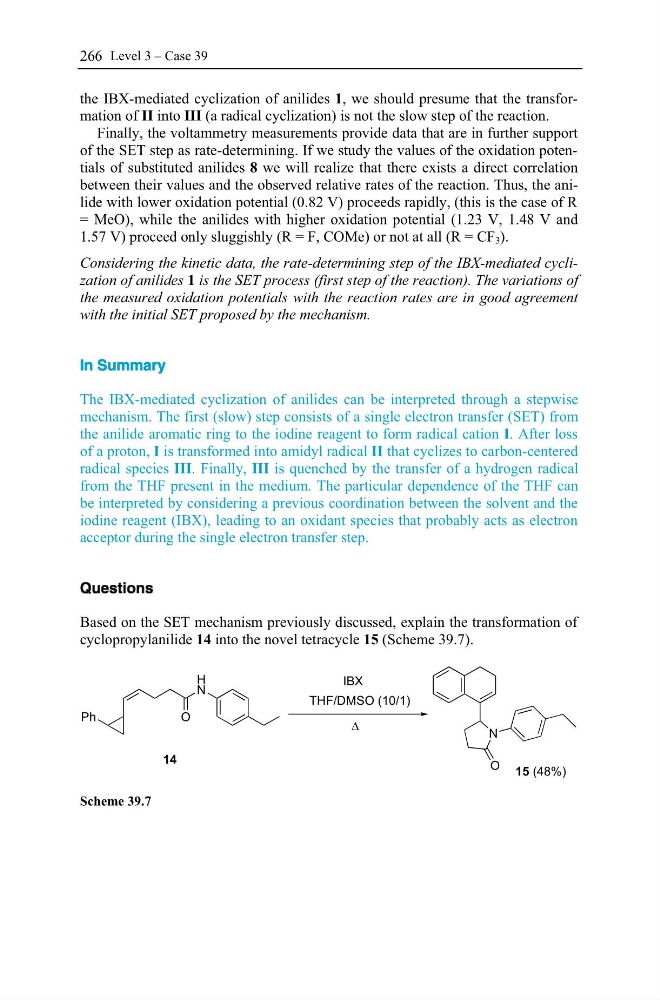
Based on the SET mechanism previously discussed, explain the transformation of
cyclopropylanilide 14 into the novel tetracycle 15 (Scheme 39.7).
H
N
O
Ph
IBX
'
N
O
THF/DMSO (10/1)
14
15 (48%)
Scheme 39.7
266
the IBX-mediated cyclization of anilides 1, we should presume that the transformation of II into III (a radical cyclization) is not the slow step of the reaction.
Finally, the voltammetry measurements provide data that are in further support
of the SET step as rate-determining. If we study the values of the oxidation potentials of substituted anilides 8 we will realize that there exists a direct correlation
between their values and the observed relative rates of the reaction. Thus, the anilide with lower oxidation potential (0.82 V) proceeds rapidly, (this is the case of R
= MeO), while the anilides with higher oxidation potential (1.23 V, 1.48 V and
1.57 V) proceed only sluggishly (R = F, COMe) or not at all (R = CF 3 ).
Considering the kinetic data, the rate-determining step of the IBX-mediated cyclization of anilides 1 is the SET process (first step of the reaction). The variations of
the measured oxidation potentials with the reaction rates are in good agreement
with the initial SET proposed by the mechanism.
In Summary
The IBX-mediated cyclization of anilides can be interpreted through a stepwise
mechanism. The first (slow) step consists of a single electron transfer (SET) from
the anilide aromatic ring to the iodine reagent to form radical cation I. After loss
of a proton, I is transformed into amidyl radical II that cyclizes to carbon-centered
radical species III. Finally, III is quenched by the transfer of a hydrogen radical
from the THF present in the medium. The particular dependence of the THF can
be interpreted by considering a previous coordination between the solvent and the
iodine reagent (IBX), leading to an oxidant species that probably acts as electron
acceptor during the single electron transfer step.
Q Qu ue es st ti io on ns s
Based on the SET mechanism previously discussed, explain the transformation of
cyclopropylanilide 14 into the novel tetracycle 15 (Scheme 39.7).
H
N
O
Ph
IBX
'
N
O
THF/DMSO (10/1)
14
15 (48%)
Scheme 39.7