

Periodinane-Mediated Cyclization of Anilides 263
D Di is sc cu us ss si io on n
As mentioned above, there are two key questions that have to be discussed in detail to confirm the validity of the stepwise radical mechanism proposed for the periodinane-mediated cyclizations of anilides 1.
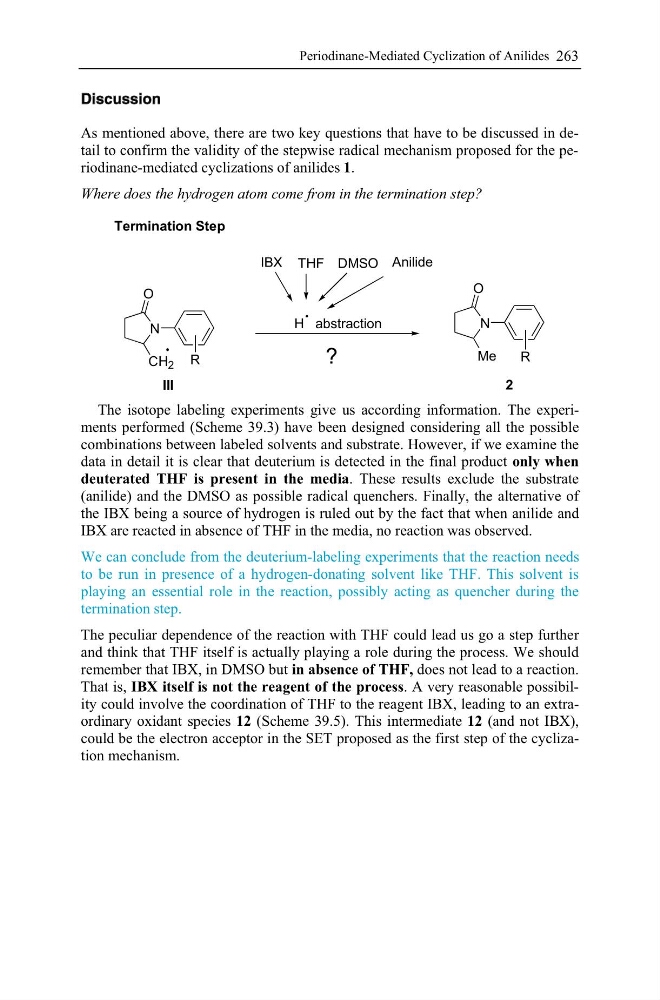
Where does the hydrogen atom come from in the termination step?
N
O
CH 2
THF DMSO
R
III
N
O
Me
R
H abstraction
Anilide
?
Termination Step
2
The isotope labeling experiments give us according information. The experiments performed (Scheme 39.3) have been designed considering all the possible
combinations between labeled solvents and substrate. However, if we examine the
data in detail it is clear that deuterium is detected in the final product only when
deuterated THF is present in the media. These results exclude the substrate
(anilide) and the DMSO as possible radical quenchers. Finally, the alternative of
the IBX being a source of hydrogen is ruled out by the fact that when anilide and
IBX are reacted in absence of THF in the media, no reaction was observed.
We can conclude from the deuterium-labeling experiments that the reaction needs
to be run in presence of a hydrogen-donating solvent like THF. This solvent is
playing an essential role in the reaction, possibly acting as quencher during the
termination step.
The peculiar dependence of the reaction with THF could lead us go a step further
and think that THF itself is actually playing a role during the process. We should
remember that IBX, in DMSO but in absence of THF, does not lead to a reaction.
That is, IBX itself is not the reagent of the process. A very reasonable possibility could involve the coordination of THF to the reagent IBX, leading to an extraordinary oxidant species 12 (Scheme 39.5). This intermediate 12 (and not IBX),
could be the electron acceptor in the SET proposed as the first step of the cyclization mechanism.
D Di is sc cu us ss si io on n
As mentioned above, there are two key questions that have to be discussed in detail to confirm the validity of the stepwise radical mechanism proposed for the periodinane-mediated cyclizations of anilides 1.
Where does the hydrogen atom come from in the termination step?
N
O
CH 2
THF DMSO
R
III
N
O
Me
R
H abstraction
Anilide
?
Termination Step
2
The isotope labeling experiments give us according information. The experiments performed (Scheme 39.3) have been designed considering all the possible
combinations between labeled solvents and substrate. However, if we examine the
data in detail it is clear that deuterium is detected in the final product only when
deuterated THF is present in the media. These results exclude the substrate
(anilide) and the DMSO as possible radical quenchers. Finally, the alternative of
the IBX being a source of hydrogen is ruled out by the fact that when anilide and
IBX are reacted in absence of THF in the media, no reaction was observed.
We can conclude from the deuterium-labeling experiments that the reaction needs
to be run in presence of a hydrogen-donating solvent like THF. This solvent is
playing an essential role in the reaction, possibly acting as quencher during the
termination step.
The peculiar dependence of the reaction with THF could lead us go a step further
and think that THF itself is actually playing a role during the process. We should
remember that IBX, in DMSO but in absence of THF, does not lead to a reaction.
That is, IBX itself is not the reagent of the process. A very reasonable possibility could involve the coordination of THF to the reagent IBX, leading to an extraordinary oxidant species 12 (Scheme 39.5). This intermediate 12 (and not IBX),
could be the electron acceptor in the SET proposed as the first step of the cyclization mechanism.