

Level 3 – Case 38
258
H
H
Ph
Br
MeS
H
H
Ph
Br
SMe
H
H
Ph
SMe
Z-1
slow
steric hindrance
more reactive
- Br
Z-2 Z Z
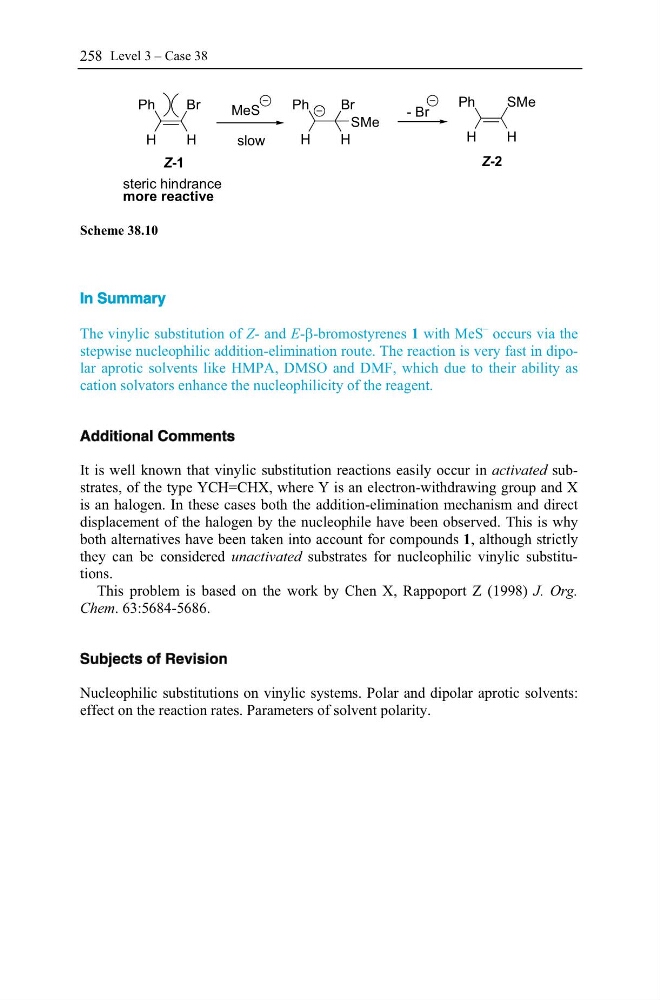
Scheme 38.10
In Summary
The vinylic substitution of Z- and E-E-bromostyrenes 1 with MeS
– occurs via the
stepwise nucleophilic addition-elimination route. The reaction is very fast in dipolar aprotic solvents like HMPA, DMSO and DMF, which due to their ability as
cation solvators enhance the nucleophilicity of the reagent.
A Ad dd di it ti io on na al l C Co om mm me en nt ts s
It is well known that vinylic substitution reactions easily occur in
u
activated subd
strates, of the type YCH=CHX, where Y is an electron-withdrawing group and X
is an halogen. In these cases both the addition-elimination mechanism and direct
displacement of the halogen by the nucleophile have been observed. This is why
both alternatives have been taken into account for compounds 1, although strictly
they can be considered unactivated substrates for nucleophilic vinylic substitud
tions.
This problem is based on the work by Chen X, Rappoport Z (1998) J. Org.
Chem. 63:5684-5686.
S Su ub bj je ec ct ts s o of f R Re ev vi is si io on n
Nucleophilic substitutions on vinylic systems. Polar and dipolar aprotic solvents:
effect on the reaction rates. Parameters of solvent polarity.
258
H
H
Ph
Br
MeS
H
H
Ph
Br
SMe
H
H
Ph
SMe
Z-1
slow
steric hindrance
more reactive
- Br
Z-2 Z Z
Scheme 38.10
In Summary
The vinylic substitution of Z- and E-E-bromostyrenes 1 with MeS
– occurs via the
stepwise nucleophilic addition-elimination route. The reaction is very fast in dipolar aprotic solvents like HMPA, DMSO and DMF, which due to their ability as
cation solvators enhance the nucleophilicity of the reagent.
A Ad dd di it ti io on na al l C Co om mm me en nt ts s
It is well known that vinylic substitution reactions easily occur in
u
activated subd
strates, of the type YCH=CHX, where Y is an electron-withdrawing group and X
is an halogen. In these cases both the addition-elimination mechanism and direct
displacement of the halogen by the nucleophile have been observed. This is why
both alternatives have been taken into account for compounds 1, although strictly
they can be considered unactivated substrates for nucleophilic vinylic substitud
tions.
This problem is based on the work by Chen X, Rappoport Z (1998) J. Org.
Chem. 63:5684-5686.
S Su ub bj je ec ct ts s o of f R Re ev vi is si io on n
Nucleophilic substitutions on vinylic systems. Polar and dipolar aprotic solvents:
effect on the reaction rates. Parameters of solvent polarity.