

L Le ev ve el l 3 3 C Ca as se e 3 37 7
B Ba as se e- -p pr ro om mo ot te ed d H HF F E El li im mi in na at ti io on n f fr ro om m
4 4- -F Fl lu uo or ro o- -4 4- -( (4 4 - -n ni it tr ro op ph he en ny yl l) )b bu ut ta an n- -2 2- -o on ne e
K Ke ey y p po oi in nt t: : K KI K KI KI K KI K K E
IE I IE I I s
Es E Es Es Es E E . . E El E El El E El E E i
li li l li li l lim i im im im i i i in i in in in i i a at ti ti ti t ti ti t tio io io io i ion n r re re r re re re re r rea ac ct ti ti ti t ti ti t tio io io io i ion ns s
O
F
O 2 N
O
O 2 N
F
base
B Ba as se e- -p pr ro om mo ot te ed d H HF F E El li im mi in na at ti io on n f fr ro om m
4 4- -F Fl lu uo or ro o- -4 4- -( (4 4 - -n ni it tr ro op ph he en ny yl l) )b bu ut ta an n- -2 2- -o on ne e. .
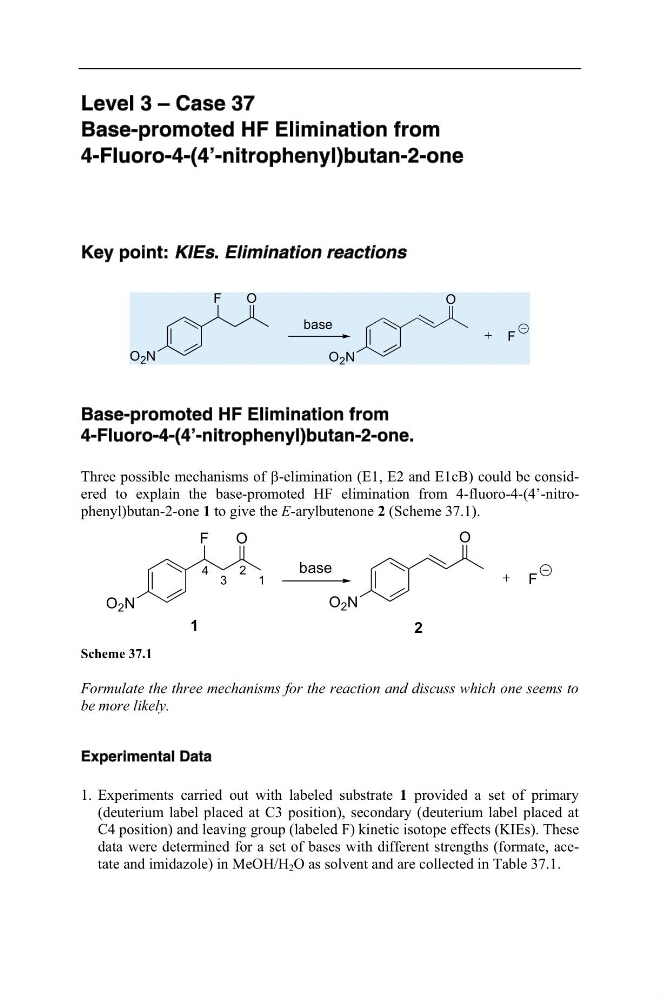
Three possible mechanisms of E-elimination (E1, E2 and E1cB) could be considered to explain the base-promoted HF elimination from 4-fluoro-4-(4’-nitrophenyl)butan-2-one 1 to give the E-arylbutenone 2 (Scheme 37.1).
O
F
O 2 N
O 2 N
O
F
1
3
4
base
2
2
1
Scheme 37.1
Formulate the three mechanisms for the reaction and discuss which one seems to
be more likely.
E Ex xp pe er ri im me en nt ta al l D Da at ta a
1. Experiments carried out with labeled substrate 1 provided a set of primary
(deuterium label placed at C3 position), secondary (deuterium label placed at
C4 position) and leaving group (labeled F) kinetic isotope effects (KIEs). These
data were determined for a set of bases with different strengths (formate, acetate and imidazole) in MeOH/H 2 O as solvent and are collected in Table 37.1.
B Ba as se e- -p pr ro om mo ot te ed d H HF F E El li im mi in na at ti io on n f fr ro om m
4 4- -F Fl lu uo or ro o- -4 4- -( (4 4 - -n ni it tr ro op ph he en ny yl l) )b bu ut ta an n- -2 2- -o on ne e
K Ke ey y p po oi in nt t: : K KI K KI KI K KI K K E
IE I IE I I s
Es E Es Es Es E E . . E El E El El E El E E i
li li l li li l lim i im im im i i i in i in in in i i a at ti ti ti t ti ti t tio io io io i ion n r re re r re re re re r rea ac ct ti ti ti t ti ti t tio io io io i ion ns s
O
F
O 2 N
O
O 2 N
F
base
B Ba as se e- -p pr ro om mo ot te ed d H HF F E El li im mi in na at ti io on n f fr ro om m
4 4- -F Fl lu uo or ro o- -4 4- -( (4 4 - -n ni it tr ro op ph he en ny yl l) )b bu ut ta an n- -2 2- -o on ne e. .
Three possible mechanisms of E-elimination (E1, E2 and E1cB) could be considered to explain the base-promoted HF elimination from 4-fluoro-4-(4’-nitrophenyl)butan-2-one 1 to give the E-arylbutenone 2 (Scheme 37.1).
O
F
O 2 N
O 2 N
O
F
1
3
4
base
2
2
1
Scheme 37.1
Formulate the three mechanisms for the reaction and discuss which one seems to
be more likely.
E Ex xp pe er ri im me en nt ta al l D Da at ta a
1. Experiments carried out with labeled substrate 1 provided a set of primary
(deuterium label placed at C3 position), secondary (deuterium label placed at
C4 position) and leaving group (labeled F) kinetic isotope effects (KIEs). These
data were determined for a set of bases with different strengths (formate, acetate and imidazole) in MeOH/H 2 O as solvent and are collected in Table 37.1.