

Level 1 – Case 3
14
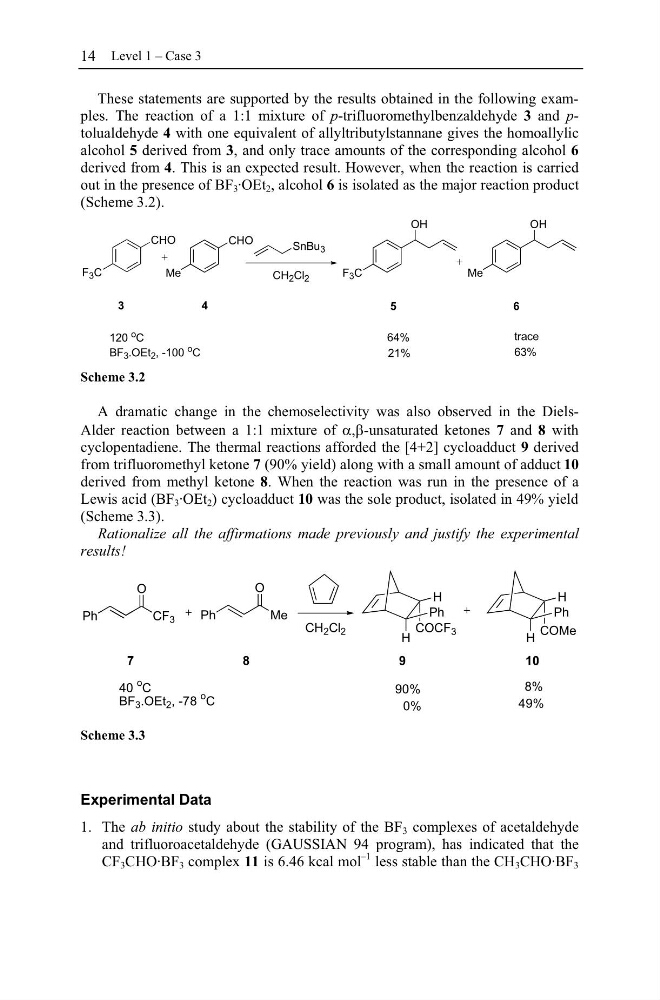
These statements are supported by the results obtained in the following examples. The reaction of a 1:1 mixture of p-trifluoromethylbenzaldehyde 3 and ptolualdehyde 4 with one equivalent of allyltributylstannane gives the homoallylic
alcohol 5 derived from 3, and only trace amounts of the corresponding alcohol 6
derived from 4. This is an expected result. However, when the reaction is carried
out in the presence of BF 3 ·OEt 2 , alcohol 6 is isolated as the major reaction product
(Scheme 3.2).
CHO
F 3 C
CHO
Me
SnBu 3
CH 2 Cl 2
F 3 C
OH
Me
OH
3
5
6
120 o C
BF 3 .OEt 2 , -100 o C
4
trace
64%
63%
21%
Scheme 3.2
A dramatic change in the chemoselectivity was also observed in the DielsAlder reaction between a 1:1 mixture of DE-unsaturated ketones 7 and 8 with
cyclopentadiene. The thermal reactions afforded the [4+2] cycloadduct 9 derived
from trifluoromethyl ketone 7 (90% yield) along with a small amount of adduct 10
derived from methyl ketone 8. When the reaction was run in the presence of a
Lewis acid (BF 3 ·OEt 2 ) cycloadduct 10 was the sole product, isolated in 49% yield
(Scheme 3.3).
Rationalize all the affirmations made previously and justify the experimental
results!
3
O
Me
O
Ph
CH 2 Cl 2
COCF 3
Ph
H
H
COMe
Ph
H
H
7
8
1 0
40
o
C
BF 3 .OEt 2 , -78
o C
8%
90%
49%
0%
Scheme 3.3
Experimental Data
1. The ab initio study about the stability of the BF 3 complexes of acetaldehyde
and trifluoroacetaldehyde (GAUSSIAN 94 program), has indicated that the
CF 3 CHO·BF 3 complex 11 is 6.46 kcal mol
–1 less stable than the CH 3 CHO·BF 3
14
These statements are supported by the results obtained in the following examples. The reaction of a 1:1 mixture of p-trifluoromethylbenzaldehyde 3 and ptolualdehyde 4 with one equivalent of allyltributylstannane gives the homoallylic
alcohol 5 derived from 3, and only trace amounts of the corresponding alcohol 6
derived from 4. This is an expected result. However, when the reaction is carried
out in the presence of BF 3 ·OEt 2 , alcohol 6 is isolated as the major reaction product
(Scheme 3.2).
CHO
F 3 C
CHO
Me
SnBu 3
CH 2 Cl 2
F 3 C
OH
Me
OH
3
5
6
120 o C
BF 3 .OEt 2 , -100 o C
4
trace
64%
63%
21%
Scheme 3.2
A dramatic change in the chemoselectivity was also observed in the DielsAlder reaction between a 1:1 mixture of DE-unsaturated ketones 7 and 8 with
cyclopentadiene. The thermal reactions afforded the [4+2] cycloadduct 9 derived
from trifluoromethyl ketone 7 (90% yield) along with a small amount of adduct 10
derived from methyl ketone 8. When the reaction was run in the presence of a
Lewis acid (BF 3 ·OEt 2 ) cycloadduct 10 was the sole product, isolated in 49% yield
(Scheme 3.3).
Rationalize all the affirmations made previously and justify the experimental
results!
3
O
Me
O
Ph
CH 2 Cl 2
COCF 3
Ph
H
H
COMe
Ph
H
H
7
8
1 0
40
o
C
BF 3 .OEt 2 , -78
o C
8%
90%
49%
0%
Scheme 3.3
Experimental Data
1. The ab initio study about the stability of the BF 3 complexes of acetaldehyde
and trifluoroacetaldehyde (GAUSSIAN 94 program), has indicated that the
CF 3 CHO·BF 3 complex 11 is 6.46 kcal mol
–1 less stable than the CH 3 CHO·BF 3