

Level 3 – Case 36
238
Determine which is the slow step of the reaction with the help of the following kinetic data.
E Ex xp pe er ri im me en nt ta al l D Da at ta a
1. The reaction proceeds with a variety of nucleophiles such as carbanions containing halogen, alkoxy, thioalkoxy, and other leaving groups. Among the bases,
KOH, NaOH, t-BuOK or NaH in DMSO have been used.
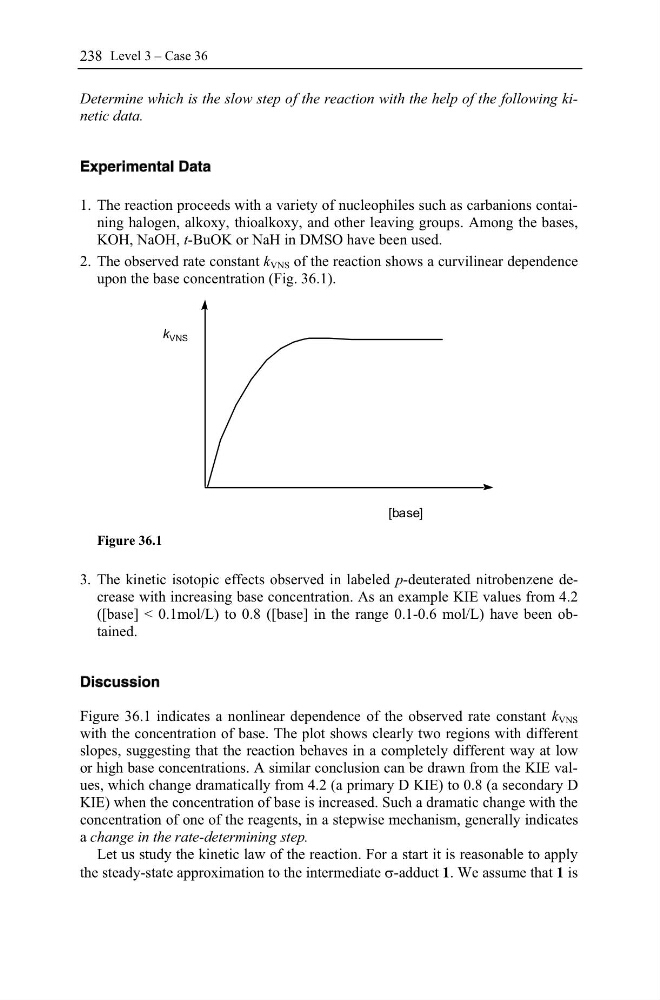
2. The observed rate constant k VNS
k k
of the reaction shows a curvilinear dependence
upon the base concentration (Fig. 36.1).
[base]
k VNS
k k
Figure 36.1
3. The kinetic isotopic effects observed in labeled p-deuterated nitrobenzene decrease with increasing base concentration. As an example KIE values from 4.2
([base] < 0.1mol/L) to 0.8 ([base] in the range 0.1-0.6 mol/L) have been obtained.
D Di is sc cu us ss si io on n
Figure 36.1 indicates a nonlinear dependence of the observed rate constant k VNS
k k
with the concentration of base. The plot shows clearly two regions with different
slopes, suggesting that the reaction behaves in a completely different way at low
or high base concentrations. A similar conclusion can be drawn from the KIE values, which change dramatically from 4.2 (a primary D KIE) to 0.8 (a secondary D
KIE) when the concentration of base is increased. Such a dramatic change with the
concentration of one of the reagents, in a stepwise mechanism, generally indicates
a change in the rate-determining step.
Let us study the kinetic law of the reaction. For a start it is reasonable to apply
the steady-state approximation to the intermediate V-adduct 1. We assume that 1 is
238
Determine which is the slow step of the reaction with the help of the following kinetic data.
E Ex xp pe er ri im me en nt ta al l D Da at ta a
1. The reaction proceeds with a variety of nucleophiles such as carbanions containing halogen, alkoxy, thioalkoxy, and other leaving groups. Among the bases,
KOH, NaOH, t-BuOK or NaH in DMSO have been used.
2. The observed rate constant k VNS
k k
of the reaction shows a curvilinear dependence
upon the base concentration (Fig. 36.1).
[base]
k VNS
k k
Figure 36.1
3. The kinetic isotopic effects observed in labeled p-deuterated nitrobenzene decrease with increasing base concentration. As an example KIE values from 4.2
([base] < 0.1mol/L) to 0.8 ([base] in the range 0.1-0.6 mol/L) have been obtained.
D Di is sc cu us ss si io on n
Figure 36.1 indicates a nonlinear dependence of the observed rate constant k VNS
k k
with the concentration of base. The plot shows clearly two regions with different
slopes, suggesting that the reaction behaves in a completely different way at low
or high base concentrations. A similar conclusion can be drawn from the KIE values, which change dramatically from 4.2 (a primary D KIE) to 0.8 (a secondary D
KIE) when the concentration of base is increased. Such a dramatic change with the
concentration of one of the reagents, in a stepwise mechanism, generally indicates
a change in the rate-determining step.
Let us study the kinetic law of the reaction. For a start it is reasonable to apply
the steady-state approximation to the intermediate V-adduct 1. We assume that 1 is