

Sulfenylation of Indole
11
Question
How could we get evidence in support of the proposed quaternization of the nitrogen atom in 3,3-bis(phenylthio)-3H-indole H H
6?
Answer
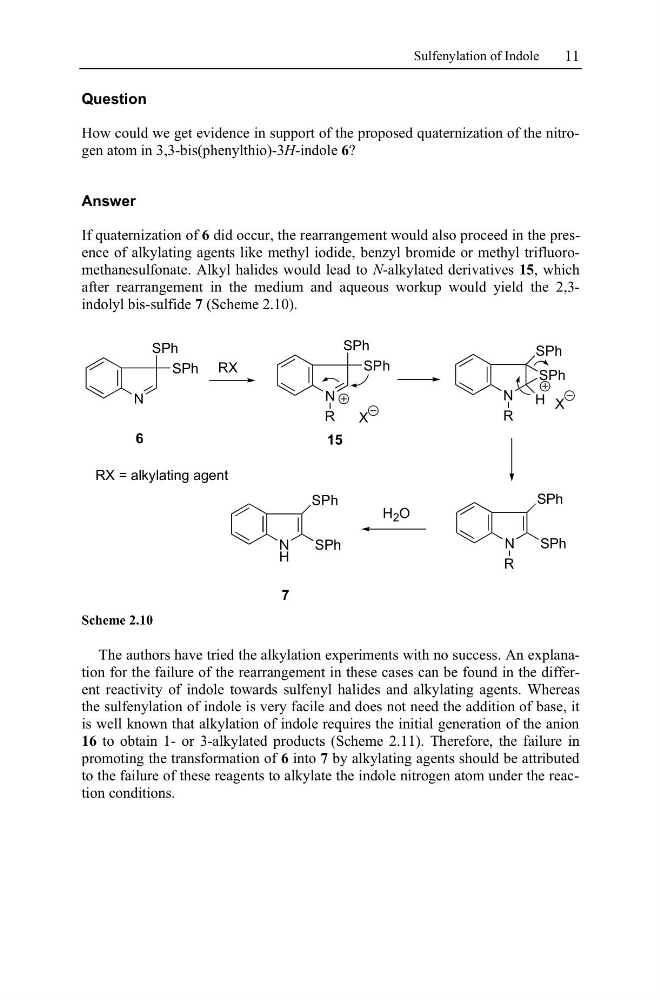
If quaternization of 6 did occur, the rearrangement would also proceed in the presence of alkylating agents like methyl iodide, benzyl bromide or methyl trifluoromethanesulfonate. Alkyl halides would lead to N-alkylated derivatives
N N
15, which
after rearrangement in the medium and aqueous workup would yield the 2,3indolyl bis-sulfide 7 (Scheme 2.10).
N
SPh
SPh RX
6
N
SPh
SPh
R
X
15
N
SPh
H
SPh
R
X
N
H
SPh
SPh
H 2 O
N
SPh
SPh
R
7
RX = alkylating agent
Scheme 2.10
The authors have tried the alkylation experiments with no success. An explanax
tion for the failure of the rearrangement in these cases can be found in the different reactivity of indole towards sulfenyl halides and alkylating agents. Whereas
the sulfenylation of indole is very facile and does not need the addition of base, it
is well known that alkylation of indole requires the initial generation of the anion
16 to obtain 1- or 3-alkylated products (Scheme 2.11). Therefore, the failure in
f f
promoting the transformation of 6 into 7 by alkylating agents should be attributed
to the failure of these reagents to alkylate the indole nitrogen atom under the reaction conditions.
11
Question
How could we get evidence in support of the proposed quaternization of the nitrogen atom in 3,3-bis(phenylthio)-3H-indole H H
6?
Answer
If quaternization of 6 did occur, the rearrangement would also proceed in the presence of alkylating agents like methyl iodide, benzyl bromide or methyl trifluoromethanesulfonate. Alkyl halides would lead to N-alkylated derivatives
N N
15, which
after rearrangement in the medium and aqueous workup would yield the 2,3indolyl bis-sulfide 7 (Scheme 2.10).
N
SPh
SPh RX
6
N
SPh
SPh
R
X
15
N
SPh
H
SPh
R
X
N
H
SPh
SPh
H 2 O
N
SPh
SPh
R
7
RX = alkylating agent
Scheme 2.10
The authors have tried the alkylation experiments with no success. An explanax
tion for the failure of the rearrangement in these cases can be found in the different reactivity of indole towards sulfenyl halides and alkylating agents. Whereas
the sulfenylation of indole is very facile and does not need the addition of base, it
is well known that alkylation of indole requires the initial generation of the anion
16 to obtain 1- or 3-alkylated products (Scheme 2.11). Therefore, the failure in
f f
promoting the transformation of 6 into 7 by alkylating agents should be attributed
to the failure of these reagents to alkylate the indole nitrogen atom under the reaction conditions.