

Dicls-Aldcr Rcactions of N-Acyl-1,2.4,5-tctrazincs 199
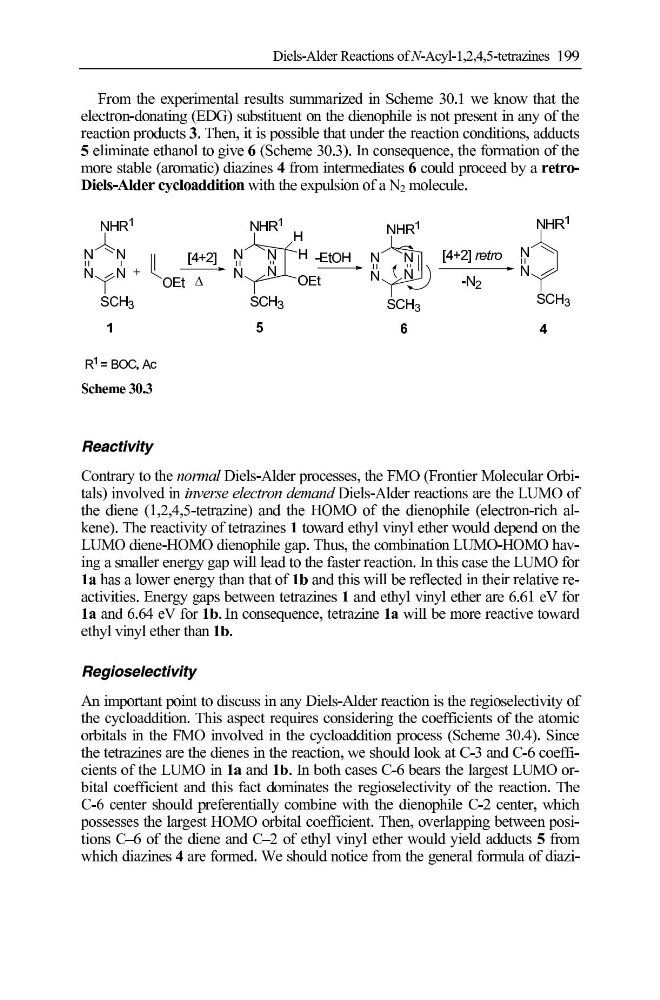
From the experimental results summarized in Scheme 30.1 we know that the
electron-donating (EDG) substituent on the dienophile is not present in any of the
reaction products 3. Then, it is possible that under the reaction conditions, adducts
5 eliminate ethanol to give 6 (Scheme 30.3). ln consequence, the fonnation of the
more slable (aromatic) diazines 4 from intennediales 6 could proceed by a retroDiels-Alder cycloaddition with lhe expulsion of a N 2 molecule.
NHR 1
NHR 1
NHR
1
NHR
1
N~N
lOEt
[4+2] N~H -EtOH
~~
[4+2] retro
N?
11
1
11
11
11
NYN +
N
N
OEt
N .&
~
-Nz
SCH3
SCH3
SCH3
SCH3
1
5
6
4
R
1 = BOC, Ac
Scheme30.3
Reactlvlty
Contrary to the normal Diels-Alder processes, the FMO (Frontier Molecular Orbitais) involved in inverse e!ectron demand Diels-Alder reactions are the LUMO of
the diene (1,2,4,5-lelrazine) and the HOMO of lhe dienophile (electron-rich alkene). The reaclivily oftetrazines 1 loward elhyl vinyl elher would depend on lhe
LUMO diene-HOMO dienophile gap. Thus, Lhe combination LUMO-HOMO ha ving a smaller energy gap willlead to lhe fasler reaction. In lhis case lhe LUMO for
la has a lower energy than that of 1 b and this will be reflected in their relative reactivities. Energy gaps between tetrazines 1 and ethyl vinyl ether are 6.61 eV for
la and 6.64 eV for lb.ln consequence, tetrazine la will be more reactive toward
ethyl vinyl ether than 1 b.
Regioselectivity
An important point to discuss in any Diels-Alder reaction is the regioselectivity of
the cycloaddition. This aspect requires considering lhe coefficienls of the atomic
orbitals in lhe FMO involved in the cycloaddition process (Scheme 30.4). Since
the tetrazines are the dienes in lhe reaclion, we should look at C-3 and C-6 coefficienls of the LUMO in 1 a and 1 b. ln bolh cases C-6 bears lhe largesl LUMO orbita! coefficient and lhis fact dominales lhe regioselectivity of the reaclion. The
C-6 center should preferenlially combine wilh lhe dienophile C-2 center, which
possesses the largest HOMO orbita! coefticient. Then, overlapping between positions C-6 of the diene and C-2 of ethyl vinyl ether would yield adducts 5 from
which diazines 4 are formed. We should notice trom the general fonnula of diazi-
From the experimental results summarized in Scheme 30.1 we know that the
electron-donating (EDG) substituent on the dienophile is not present in any of the
reaction products 3. Then, it is possible that under the reaction conditions, adducts
5 eliminate ethanol to give 6 (Scheme 30.3). ln consequence, the fonnation of the
more slable (aromatic) diazines 4 from intennediales 6 could proceed by a retroDiels-Alder cycloaddition with lhe expulsion of a N 2 molecule.
NHR 1
NHR 1
NHR
1
NHR
1
N~N
lOEt
[4+2] N~H -EtOH
~~
[4+2] retro
N?
11
1
11
11
11
NYN +
N
N
OEt
N .&
~
-Nz
SCH3
SCH3
SCH3
SCH3
1
5
6
4
R
1 = BOC, Ac
Scheme30.3
Reactlvlty
Contrary to the normal Diels-Alder processes, the FMO (Frontier Molecular Orbitais) involved in inverse e!ectron demand Diels-Alder reactions are the LUMO of
the diene (1,2,4,5-lelrazine) and the HOMO of lhe dienophile (electron-rich alkene). The reaclivily oftetrazines 1 loward elhyl vinyl elher would depend on lhe
LUMO diene-HOMO dienophile gap. Thus, Lhe combination LUMO-HOMO ha ving a smaller energy gap willlead to lhe fasler reaction. In lhis case lhe LUMO for
la has a lower energy than that of 1 b and this will be reflected in their relative reactivities. Energy gaps between tetrazines 1 and ethyl vinyl ether are 6.61 eV for
la and 6.64 eV for lb.ln consequence, tetrazine la will be more reactive toward
ethyl vinyl ether than 1 b.
Regioselectivity
An important point to discuss in any Diels-Alder reaction is the regioselectivity of
the cycloaddition. This aspect requires considering lhe coefficienls of the atomic
orbitals in lhe FMO involved in the cycloaddition process (Scheme 30.4). Since
the tetrazines are the dienes in lhe reaclion, we should look at C-3 and C-6 coefficienls of the LUMO in 1 a and 1 b. ln bolh cases C-6 bears lhe largesl LUMO orbita! coefficient and lhis fact dominales lhe regioselectivity of the reaclion. The
C-6 center should preferenlially combine wilh lhe dienophile C-2 center, which
possesses the largest HOMO orbita! coefticient. Then, overlapping between positions C-6 of the diene and C-2 of ethyl vinyl ether would yield adducts 5 from
which diazines 4 are formed. We should notice trom the general fonnula of diazi-