

Sulfenylation of Indole
9
N
H
SPh
MeSCl
N
H
SPh
SMe
3
4
Cl
N
H
H
SMe
SPh
Scheme 2.6
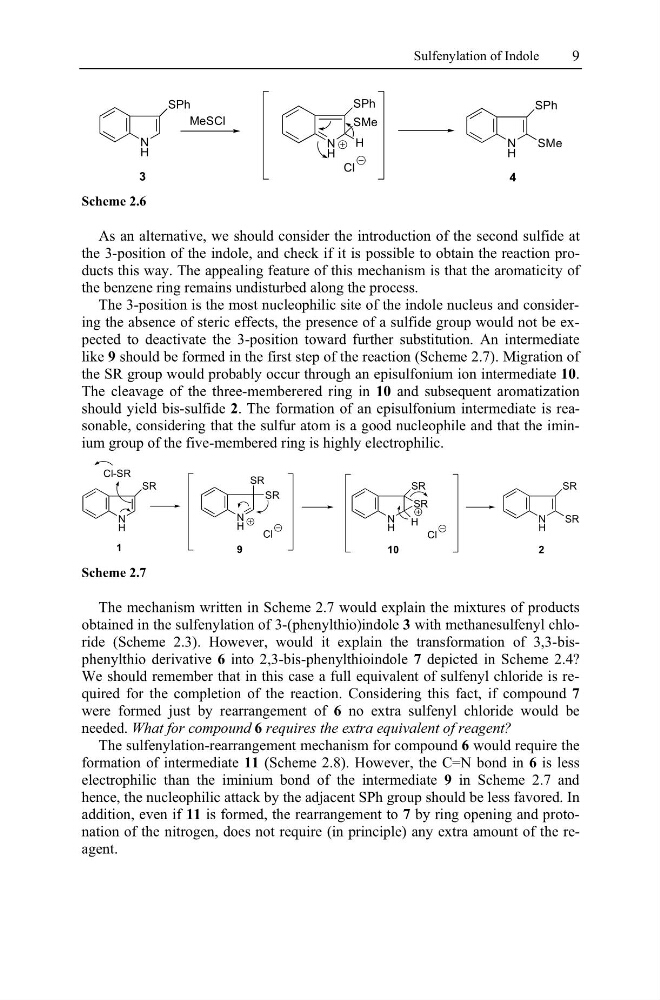
As an alternative, we should consider the introduction of the second sulfide at
the 3-position of the indole, and check if it is possible to obtain the reaction products this way. The appealing feature of this mechanism is that the aromaticity of
the benzene ring remains undisturbed along the process.
The 3-position is the most nucleophilic site of the indole nucleus and considering the absence of steric effects, the presence of a sulfide group would not be expected to deactivate the 3-position toward further substitution. An intermediate
d
like 9 should be formed in the first step of the reaction (Scheme 2.7). Migration of
the SR group would probably occur through an episulfonium ion intermediate 10.
The cleavage of the three-memberered ring in 10 and subsequent aromatization
should yield bis-sulfide 2. The formation of an episulfonium intermediate is reasonable, considering that the sulfur atom is a good nucleophile and that the iminium group of the five-membered ring is highly electrophilic.
N
H
SR
Cl-SR
N
H
SR
SR
Cl
N
H
SR
H
SR
Cl
N
H
SR
SR
1
9
10
2
Scheme 2.7
The mechanism written in Scheme 2.7 would explain the mixtures of products
obtained in the sulfenylation of 3-(phenylthio)indole 3 with methanesulfenyl chloride (Scheme 2.3). However, would it explain the transformation of 3,3-bisphenylthio derivative 6 into 2,3-bis-phenylthioindole 7 depicted in Scheme 2.4?
We should remember that in this case a full equivalent of sulfenyl chloride is required for the completion of the reaction. Considering this fact, if compound 7
were formed just by rearrangement of 6 no extra sulfenyl chloride would be
needed. What for compound 6 requires the extra equivalent of reagent?
The sulfenylation-rearrangement mechanism for compound 6 would require the
formation of intermediate 11 (Scheme 2.8). However, the C=N bond in 6 is less
electrophilic than the iminium bond of the intermediate 9 in Scheme 2.7 and
hence, the nucleophilic attack by the adjacent SPh group should be less favored. In
addition, even if 11 is formed, the rearrangement to 7 by ring opening and protonation of the nitrogen, does not require (in principle) any extra amount of the reagent.
9
N
H
SPh
MeSCl
N
H
SPh
SMe
3
4
Cl
N
H
H
SMe
SPh
Scheme 2.6
As an alternative, we should consider the introduction of the second sulfide at
the 3-position of the indole, and check if it is possible to obtain the reaction products this way. The appealing feature of this mechanism is that the aromaticity of
the benzene ring remains undisturbed along the process.
The 3-position is the most nucleophilic site of the indole nucleus and considering the absence of steric effects, the presence of a sulfide group would not be expected to deactivate the 3-position toward further substitution. An intermediate
d
like 9 should be formed in the first step of the reaction (Scheme 2.7). Migration of
the SR group would probably occur through an episulfonium ion intermediate 10.
The cleavage of the three-memberered ring in 10 and subsequent aromatization
should yield bis-sulfide 2. The formation of an episulfonium intermediate is reasonable, considering that the sulfur atom is a good nucleophile and that the iminium group of the five-membered ring is highly electrophilic.
N
H
SR
Cl-SR
N
H
SR
SR
Cl
N
H
SR
H
SR
Cl
N
H
SR
SR
1
9
10
2
Scheme 2.7
The mechanism written in Scheme 2.7 would explain the mixtures of products
obtained in the sulfenylation of 3-(phenylthio)indole 3 with methanesulfenyl chloride (Scheme 2.3). However, would it explain the transformation of 3,3-bisphenylthio derivative 6 into 2,3-bis-phenylthioindole 7 depicted in Scheme 2.4?
We should remember that in this case a full equivalent of sulfenyl chloride is required for the completion of the reaction. Considering this fact, if compound 7
were formed just by rearrangement of 6 no extra sulfenyl chloride would be
needed. What for compound 6 requires the extra equivalent of reagent?
The sulfenylation-rearrangement mechanism for compound 6 would require the
formation of intermediate 11 (Scheme 2.8). However, the C=N bond in 6 is less
electrophilic than the iminium bond of the intermediate 9 in Scheme 2.7 and
hence, the nucleophilic attack by the adjacent SPh group should be less favored. In
addition, even if 11 is formed, the rearrangement to 7 by ring opening and protonation of the nitrogen, does not require (in principle) any extra amount of the reagent.