

L Le ev ve el l 2 2 C Ca as se e 2 28 8
A A D De ea ar ro om ma at ti iz zi in ng g D Di is sr ro ot ta at to or ry y E El le ec ct tr ro oc cy yc cl li ic c R Ri in ng g
C
Cl lo os su ur re e
K Ke ey y p po oi in nt t: : E El E El El E El E E e
le l le le le l lec ct tr t tr tr t tr t t o
ro r ro ro ro ro r roc cy cy cy yc yc y yc yc yc yc y y l li li li l li li l lic ic ic ic i i r re re r re re re re r rea ac ct ti ti ti t ti ti t tio io io io i ion ns s
N
O
Ar
t-Bu
R 2
R 1
R 2
R 1
N
OLi
t-Bu
H Ar
4 Cl
H
R 2
R 1
N
O
t-Bu
Ar
H
LDA
or t-BuLi
?
A A D De ea ar ro om ma at ti iz zi in ng g D Di is sr ro ot ta at to or ry y E El le ec ct tr ro oc cy yc cl li ic c R Ri in ng g C Cl lo os su ur re e
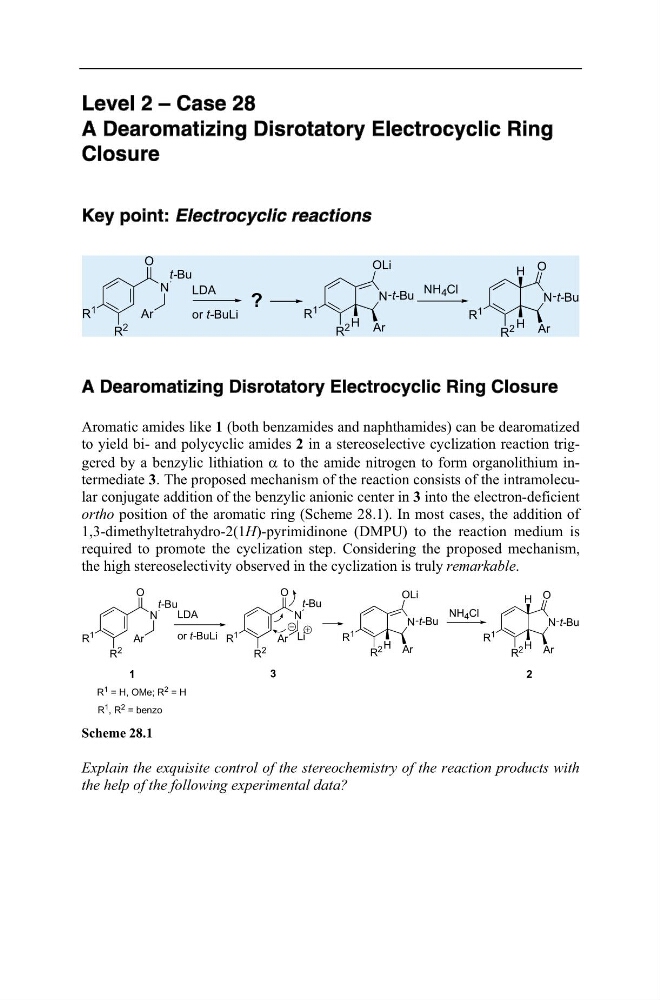
Aromatic amides like 1 (both benzamides and naphthamides) can be dearomatized
to yield bi- and polycyclic amides 2 in a stereoselective cyclization reaction triggered by a benzylic lithiation D to the amide nitrogen to form organolithium intermediate 3. The proposed mechanism of the reaction consists of the intramolecular conjugate addition of the benzylic anionic center in 3 into the electron-deficient
ortho position of the aromatic ring (Scheme 28.1). In most cases, the addition of
1,3-dimethyltetrahydro-2(1H)-pyrimidinone (DMPU) to the reaction medium is
H H
required to promote the cyclization step. Considering the proposed mechanism,
the high stereoselectivity observed in the cyclization is truly remarkable.
R 2
R 1
N
O
Ar
t-Bu
N
O
R 2
R 1
Ar
t-Bu
Li
N
R 2
R 1
OLi
t-Bu
H Ar
4 Cl
R 1 = H, OMe; R 2 = H
R
1
, R
2 = benzo
R 2
R 1
N
O
t-Bu
H Ar
H
LDA
or t-BuLi
1
2
3
Scheme 28.1
Explain the exquisite control of the stereochemistry of the reaction products with
the help of the following experimental data?
A A D De ea ar ro om ma at ti iz zi in ng g D Di is sr ro ot ta at to or ry y E El le ec ct tr ro oc cy yc cl li ic c R Ri in ng g
C
Cl lo os su ur re e
K Ke ey y p po oi in nt t: : E El E El El E El E E e
le l le le le l lec ct tr t tr tr t tr t t o
ro r ro ro ro ro r roc cy cy cy yc yc y yc yc yc yc y y l li li li l li li l lic ic ic ic i i r re re r re re re re r rea ac ct ti ti ti t ti ti t tio io io io i ion ns s
N
O
Ar
t-Bu
R 2
R 1
R 2
R 1
N
OLi
t-Bu
H Ar
4 Cl
H
R 2
R 1
N
O
t-Bu
Ar
H
LDA
or t-BuLi
?
A A D De ea ar ro om ma at ti iz zi in ng g D Di is sr ro ot ta at to or ry y E El le ec ct tr ro oc cy yc cl li ic c R Ri in ng g C Cl lo os su ur re e
Aromatic amides like 1 (both benzamides and naphthamides) can be dearomatized
to yield bi- and polycyclic amides 2 in a stereoselective cyclization reaction triggered by a benzylic lithiation D to the amide nitrogen to form organolithium intermediate 3. The proposed mechanism of the reaction consists of the intramolecular conjugate addition of the benzylic anionic center in 3 into the electron-deficient
ortho position of the aromatic ring (Scheme 28.1). In most cases, the addition of
1,3-dimethyltetrahydro-2(1H)-pyrimidinone (DMPU) to the reaction medium is
H H
required to promote the cyclization step. Considering the proposed mechanism,
the high stereoselectivity observed in the cyclization is truly remarkable.
R 2
R 1
N
O
Ar
t-Bu
N
O
R 2
R 1
Ar
t-Bu
Li
N
R 2
R 1
OLi
t-Bu
H Ar
4 Cl
R 1 = H, OMe; R 2 = H
R
1
, R
2 = benzo
R 2
R 1
N
O
t-Bu
H Ar
H
LDA
or t-BuLi
1
2
3
Scheme 28.1
Explain the exquisite control of the stereochemistry of the reaction products with
the help of the following experimental data?