

A Hammett Analysis in a Multistep Reaction 143
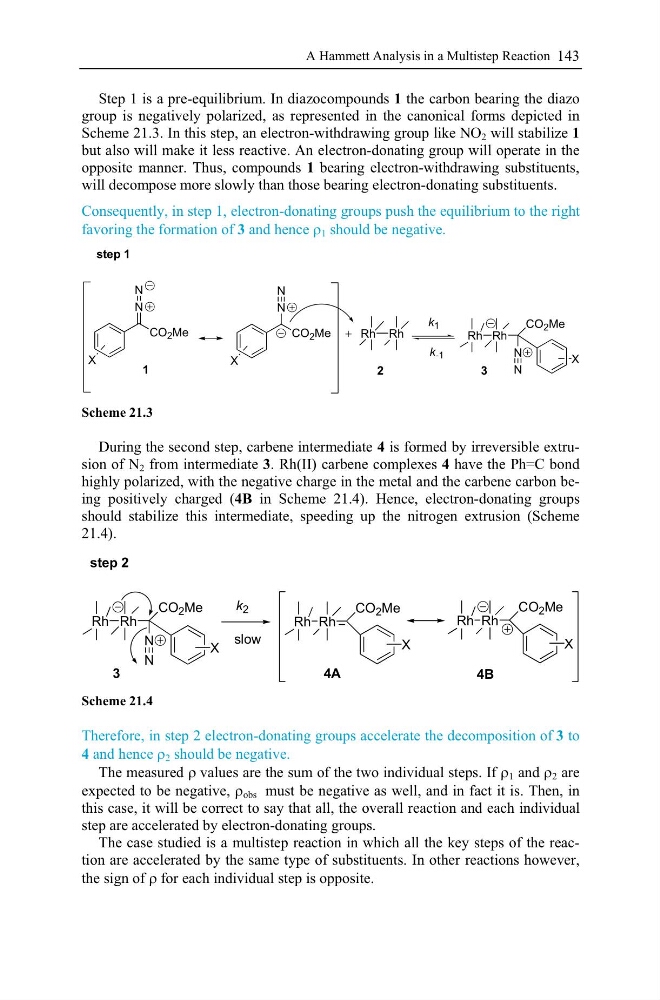
Step 1 is a pre-equilibrium. In diazocompounds 1 the carbon bearing the diazo
group is negatively polarized, as represented in the canonical forms depicted in
Scheme 21.3. In this step, an electron-withdrawing group like NO 2 will stabilize 1
but also will make it less reactive. An electron-donating group will operate in the
opposite manner. Thus, compounds 1 bearing electron-withdrawing substituents,
will decompose more slowly than those bearing electron-donating substituents.
Consequently, in step 1, electron-donating groups push the equilibrium to the right
favoring the formation of 3 and hence U 1 should be negative.
X
CO 2 Me
N
N
X
CO 2 Me
N
N
Rh Rh
CO 2 Me
N
N
X
2
1
k 1
k -
k k 1
3
step 1
Scheme 21.3
During the second step, carbene intermediate 4 is formed by irreversible extrusion of N 2 from intermediate 3. Rh(II) carbene complexes 4 have the Ph=C bond
highly polarized, with the negative charge in the metal and the carbene carbon being positively charged (4B in Scheme 21.4). Hence, electron-donating groups
should stabilize this intermediate, speeding up the nitrogen extrusion (Scheme
21.4).
Rh Rh
CO 2 Me
N
N
X
Rh Rh
CO 2 Me
X
4B
Rh Rh
CO 2 Me
X
3
k 2
k k
slow
step 2
4A
Scheme 21.4
Therefore, in step 2 electron-donating groups accelerate the decomposition of 3 to
4 and hence U 2 should be negative.
The measured U values are the sum of the two individual steps. If U 1 and U 2 are
expected to be negative, U obs must be negative as well, and in fact it is. Then, in
this case, it will be correct to say that all, the overall reaction and each individual
step are accelerated by electron-donating groups.
The case studied is a multistep reaction in which all the key steps of the reacn
tion are accelerated by the same type of substituents. In other reactions however,
the sign of U for each individual step is opposite.
Step 1 is a pre-equilibrium. In diazocompounds 1 the carbon bearing the diazo
group is negatively polarized, as represented in the canonical forms depicted in
Scheme 21.3. In this step, an electron-withdrawing group like NO 2 will stabilize 1
but also will make it less reactive. An electron-donating group will operate in the
opposite manner. Thus, compounds 1 bearing electron-withdrawing substituents,
will decompose more slowly than those bearing electron-donating substituents.
Consequently, in step 1, electron-donating groups push the equilibrium to the right
favoring the formation of 3 and hence U 1 should be negative.
X
CO 2 Me
N
N
X
CO 2 Me
N
N
Rh Rh
CO 2 Me
N
N
X
2
1
k 1
k -
k k 1
3
step 1
Scheme 21.3
During the second step, carbene intermediate 4 is formed by irreversible extrusion of N 2 from intermediate 3. Rh(II) carbene complexes 4 have the Ph=C bond
highly polarized, with the negative charge in the metal and the carbene carbon being positively charged (4B in Scheme 21.4). Hence, electron-donating groups
should stabilize this intermediate, speeding up the nitrogen extrusion (Scheme
21.4).
Rh Rh
CO 2 Me
N
N
X
Rh Rh
CO 2 Me
X
4B
Rh Rh
CO 2 Me
X
3
k 2
k k
slow
step 2
4A
Scheme 21.4
Therefore, in step 2 electron-donating groups accelerate the decomposition of 3 to
4 and hence U 2 should be negative.
The measured U values are the sum of the two individual steps. If U 1 and U 2 are
expected to be negative, U obs must be negative as well, and in fact it is. Then, in
this case, it will be correct to say that all, the overall reaction and each individual
step are accelerated by electron-donating groups.
The case studied is a multistep reaction in which all the key steps of the reacn
tion are accelerated by the same type of substituents. In other reactions however,
the sign of U for each individual step is opposite.