

132 Level 2 - Case 20
o
+ H3C, 0 Ă 0
... CH3
Ba se
DMC
2
Scheme20.2
Why does the reaction work with DB U and nof with the rest of the amines studied?
This question was a subject of de bate and led to different speculations about the
role of DBU during the process. The following mechanistic proposals were raised:
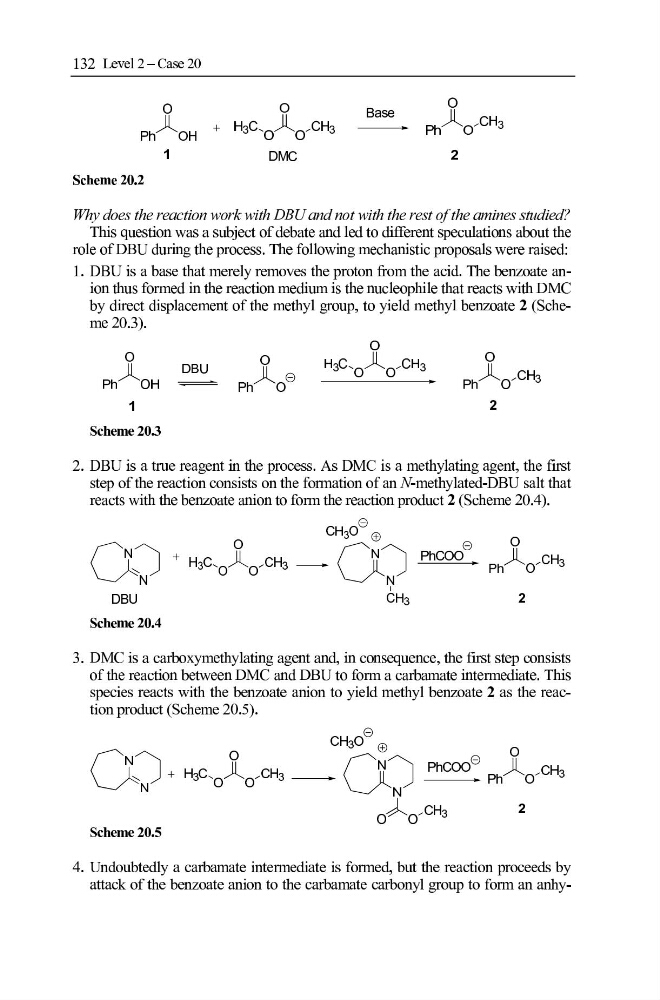
1. DBU is a base that merely removes the proton from the acid. The benzoate anion thus fonned in the reaction medimn is the nucleophile that reacts with DMC
by direct displacement of the methy 1 group, to yield methy 1 benzoate 2 (Scheme 20.3).
DBU
o
11 8
Ph/'...0
Scheme20.3
2. DBU is a true reagent in the process. As DMC is a methylating agent, the first
step of the reaction consists on the formation of an N-methylated-DBU salt that
reacts with the benzoate anion to form the reaction product 2 (Scheme 20.4).
e
_
0
0) Phcoo
8
1
DBU
CH3
2
Scheme 20.4
3. DMC is a carboxymethylating agent and, in consequence, the first step consists
ofthe reaction between DMC and DBU to fonn a carbamate intermediate. This
species reacts with the benzoate anion to yield methyl benzoate 2 as the reaction product (Scheme 20.5).
Scheme20.5
4. Undoubtedly a carbamate intennediate is formed, but the reaction proceeds by
attack of the benzoate anion to the carbamate carbonyl group to fonn an anhy-
o
+ H3C, 0 Ă 0
... CH3
Ba se
DMC
2
Scheme20.2
Why does the reaction work with DB U and nof with the rest of the amines studied?
This question was a subject of de bate and led to different speculations about the
role of DBU during the process. The following mechanistic proposals were raised:
1. DBU is a base that merely removes the proton from the acid. The benzoate anion thus fonned in the reaction medimn is the nucleophile that reacts with DMC
by direct displacement of the methy 1 group, to yield methy 1 benzoate 2 (Scheme 20.3).
DBU
o
11 8
Ph/'...0
Scheme20.3
2. DBU is a true reagent in the process. As DMC is a methylating agent, the first
step of the reaction consists on the formation of an N-methylated-DBU salt that
reacts with the benzoate anion to form the reaction product 2 (Scheme 20.4).
e
_
0
0) Phcoo
8
1
DBU
CH3
2
Scheme 20.4
3. DMC is a carboxymethylating agent and, in consequence, the first step consists
ofthe reaction between DMC and DBU to fonn a carbamate intermediate. This
species reacts with the benzoate anion to yield methyl benzoate 2 as the reaction product (Scheme 20.5).
Scheme20.5
4. Undoubtedly a carbamate intennediate is formed, but the reaction proceeds by
attack of the benzoate anion to the carbamate carbonyl group to fonn an anhy-