

Level 2 – Case 17
116
PhCH 2 N SO 2
2
PhCH 2 N
O
N O
SO 2
2
NO 2
O
PhCH 2 N SO 2
2
PhCH 2 N
O
N O
SO 2
2
NO 2
O
SO 2
PhCH 2 N
NPBS
NR
1 R
2
SO 2
PhCH 2 NH
R
1 R
2
NH
k 1
k -1
k k
R
1 R
2
NH 2
k 2
k k
R
1 R
2
NH
2
step 1
step 2
step 3
7
7
8
8
Scheme 17.3
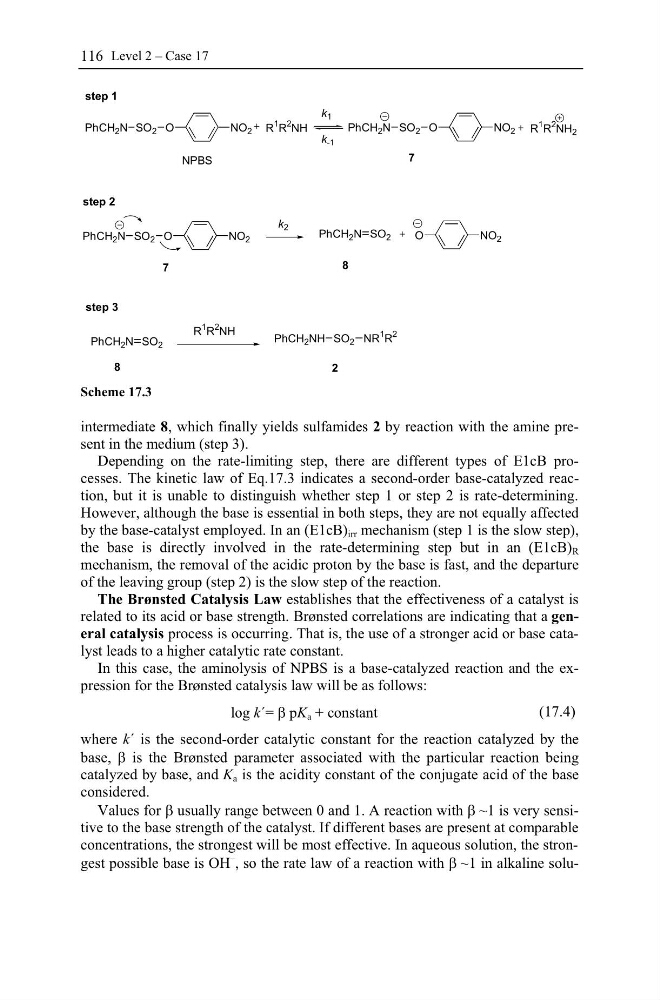
intermediate 8, which finally yields sulfamides 2 by reaction with the amine present in the medium (step 3).
Depending on the rate-limiting step, there are different types of E1cB processes. The kinetic law of Eq.17.3 indicates a second-order base-catalyzed reaction, but it is unable to distinguish whether step 1 or step 2 is rate-determining.
However, although the base is essential in both steps, they are not equally affected
by the base-catalyst employed. In an (E1cB) irr mechanism (step 1 is the slow step),
r
the base is directly involved in the rate-determining step but in an (E1cB) R
mechanism, the removal of the acidic proton by the base is fast, and the departure
of the leaving group (step 2) is the slow step of the reaction.
The Brønsted Catalysis Law establishes that the effectiveness of a catalyst is
f f
related to its acid or base strength. Brønsted correlations are indicating that a general catalysis process is occurring. That is, the use of a stronger acid or base catalyst leads to a higher catalytic rate constant.
In this case, the aminolysis of NPBS is a base-catalyzed reaction and the expression for the Brønsted catalysis law will be as follows:
log k´= E pK a
K K + constant
(17.4)
where k´ is the second-order catalytic constant for the reaction catalyzed by the
base, E is the Brønsted parameter associated with the particular reaction being
d
catalyzed by base, and K a
K K is the acidity constant of the conjugate acid of the base
considered.
Values for E usually range between 0 and 1. A reaction with E~1 is very sensitive to the base strength of the catalyst. If different bases are present at comparable
concentrations, the strongest will be most effective. In aqueous solution, the strongest possible base is OH
– , so the rate law of a reaction with E~1 in alkaline solu-
116
PhCH 2 N SO 2
2
PhCH 2 N
O
N O
SO 2
2
NO 2
O
PhCH 2 N SO 2
2
PhCH 2 N
O
N O
SO 2
2
NO 2
O
SO 2
PhCH 2 N
NPBS
NR
1 R
2
SO 2
PhCH 2 NH
R
1 R
2
NH
k 1
k -1
k k
R
1 R
2
NH 2
k 2
k k
R
1 R
2
NH
2
step 1
step 2
step 3
7
7
8
8
Scheme 17.3
intermediate 8, which finally yields sulfamides 2 by reaction with the amine present in the medium (step 3).
Depending on the rate-limiting step, there are different types of E1cB processes. The kinetic law of Eq.17.3 indicates a second-order base-catalyzed reaction, but it is unable to distinguish whether step 1 or step 2 is rate-determining.
However, although the base is essential in both steps, they are not equally affected
by the base-catalyst employed. In an (E1cB) irr mechanism (step 1 is the slow step),
r
the base is directly involved in the rate-determining step but in an (E1cB) R
mechanism, the removal of the acidic proton by the base is fast, and the departure
of the leaving group (step 2) is the slow step of the reaction.
The Brønsted Catalysis Law establishes that the effectiveness of a catalyst is
f f
related to its acid or base strength. Brønsted correlations are indicating that a general catalysis process is occurring. That is, the use of a stronger acid or base catalyst leads to a higher catalytic rate constant.
In this case, the aminolysis of NPBS is a base-catalyzed reaction and the expression for the Brønsted catalysis law will be as follows:
log k´= E pK a
K K + constant
(17.4)
where k´ is the second-order catalytic constant for the reaction catalyzed by the
base, E is the Brønsted parameter associated with the particular reaction being
d
catalyzed by base, and K a
K K is the acidity constant of the conjugate acid of the base
considered.
Values for E usually range between 0 and 1. A reaction with E~1 is very sensitive to the base strength of the catalyst. If different bases are present at comparable
concentrations, the strongest will be most effective. In aqueous solution, the strongest possible base is OH
– , so the rate law of a reaction with E~1 in alkaline solu-