

2.7 Relationships among Analytical Properties
,Preconcentration
~
SENSITIVITY
SENSITIVITY
PRECISION
PRECISION
Precision
Selectivity - , , , ,
, ,
,
Interfel' ence
removal
,
•
SELECTIVITY
SELECTIVITY
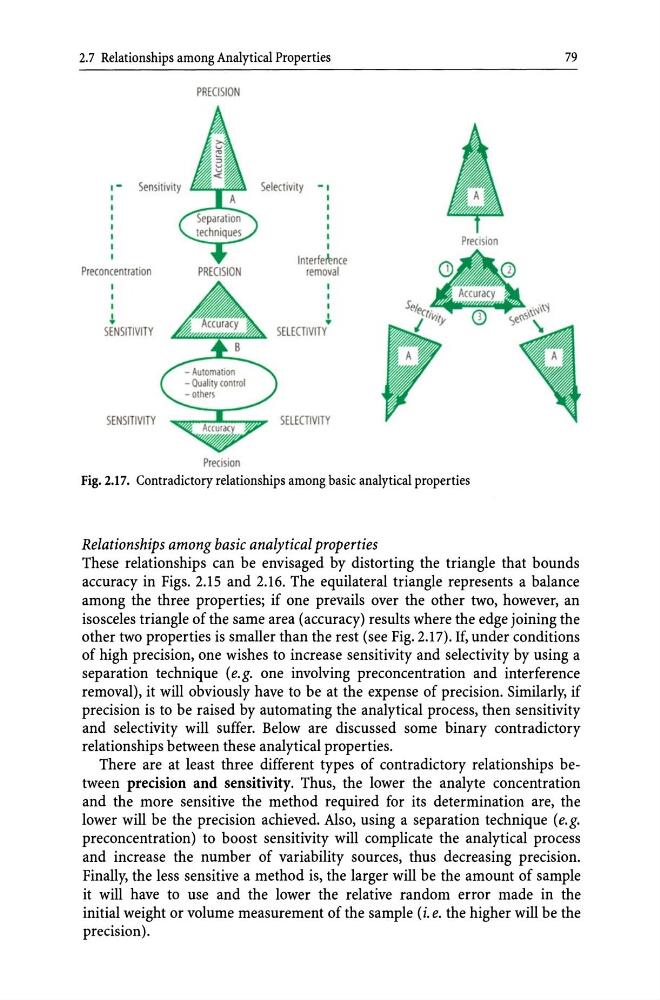
Fig. 2.17. Contradictory relationships among basic analytical properties
Relationships among basic analytical properties
79
These relationships can be envisaged by distorting the triangle that bounds
accuracy in Figs. 2.15 and 2.16. The equilateral triangle represents a balance
among the three properties; if one prevails over the other two, however, an
isosceles triangle of the same area (accuracy) results where the edge joining the
other two properties is smaller than the rest (see Fig. 2.17). If, under conditions
of high precision, one wishes to increase sensitivity and selectivity by using a
separation technique (e.g. one involving preconcentration and interference
removal), it will obviously have to be at the expense of precision. Similarly, if
precision is to be raised by automating the analytical process, then sensitivity
and selectivity will suffer. Below are discussed some binary contradictory
relationships between these analytical properties.
There are at least three different types of contradictory relationships between precision and sensitivity. Thus, the lower the analyte concentration
and the more sensitive the method required for its determination are, the
lower will be the precision achieved. Also, using a separation technique (e. g.
preconcentration) to boost sensitivity will complicate the analytical process
and increase the number of variability sources, thus decreasing precision.
Finally, the less sensitive a method is, the larger will be the amount of sample
it will have to use and the lower the relative random error made in the
initial weight or volume measurement of the sample (i. e. the higher will be the
precision).
,Preconcentration
~
SENSITIVITY
SENSITIVITY
PRECISION
PRECISION
Precision
Selectivity - , , , ,
, ,
,
Interfel' ence
removal
,
•
SELECTIVITY
SELECTIVITY
Fig. 2.17. Contradictory relationships among basic analytical properties
Relationships among basic analytical properties
79
These relationships can be envisaged by distorting the triangle that bounds
accuracy in Figs. 2.15 and 2.16. The equilateral triangle represents a balance
among the three properties; if one prevails over the other two, however, an
isosceles triangle of the same area (accuracy) results where the edge joining the
other two properties is smaller than the rest (see Fig. 2.17). If, under conditions
of high precision, one wishes to increase sensitivity and selectivity by using a
separation technique (e.g. one involving preconcentration and interference
removal), it will obviously have to be at the expense of precision. Similarly, if
precision is to be raised by automating the analytical process, then sensitivity
and selectivity will suffer. Below are discussed some binary contradictory
relationships between these analytical properties.
There are at least three different types of contradictory relationships between precision and sensitivity. Thus, the lower the analyte concentration
and the more sensitive the method required for its determination are, the
lower will be the precision achieved. Also, using a separation technique (e. g.
preconcentration) to boost sensitivity will complicate the analytical process
and increase the number of variability sources, thus decreasing precision.
Finally, the less sensitive a method is, the larger will be the amount of sample
it will have to use and the lower the relative random error made in the
initial weight or volume measurement of the sample (i. e. the higher will be the
precision).