

32
1 Introduction to Analytical Chemistry
Box 1.14
Here are some practical examples of the different possibilities illustrated in Fig.1.22 regarding
the nature of the sample and analytes:
Sample Analyte(s) Example
• Determination of gold in a mineral
0
• Determination of a pesticide in soil
b
• Determination of traces of biochemical molecules in a meteorite
(e. g. in search of evidence of life on other planets)
0
• Determination of metal traces in organic pharmaceutical preparations
0
0
• Determination of nitrogen-containing organic compounds in
petroleum crudes
0
b
• Determination of enzyme activity in an organic solvent
B
• Determination of calcium in biological fluids
B
0
• Determination of drugs and their metabolites in human urine
B
b
• Determination of protein content in milk
Two other possible classifications of Analytical Chemistry are based on the
nature of the sample analysed and analytes determined and were outlined in its
definition. Figure 1.22 shows both classifications and their multiple mutual
relationships. It should be noted that assignations in this context can rarely be
categorical. Thus, a metal may occur as such or in free ionic form as a part of a
complex or an organometallic compound; this last is difficult to place in the classification because it lies on the organic-inorganic boundary.
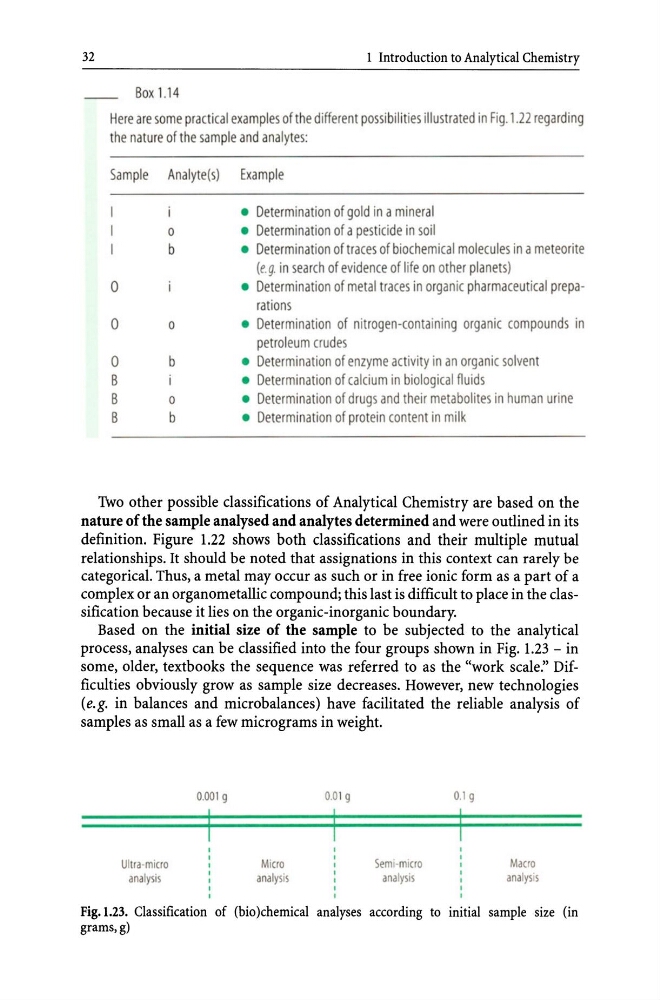
Based on the initial size of the sample to be subjected to the analytical
process, analyses can be classified into the four groups shown in Fig. 1.23 - in
some, older, textbooks the sequence was referred to as the "work scale." Difficulties obviously grow as sample size decreases. However, new technologies
(e. g. in balances and microbalances) have facilitated the reliable analysis of
samples as small as a few micrograms in weight.
0.001 9
0.01 9
0.1 9
I
I
Ultra-micro
Micro
Semi-micro
Macro
analysis
ana lysis
analysis
analysis
Fig. 1.23. Classification of (bio)chemical analyses according to initial sample size (in
grams, g)
1 Introduction to Analytical Chemistry
Box 1.14
Here are some practical examples of the different possibilities illustrated in Fig.1.22 regarding
the nature of the sample and analytes:
Sample Analyte(s) Example
• Determination of gold in a mineral
0
• Determination of a pesticide in soil
b
• Determination of traces of biochemical molecules in a meteorite
(e. g. in search of evidence of life on other planets)
0
• Determination of metal traces in organic pharmaceutical preparations
0
0
• Determination of nitrogen-containing organic compounds in
petroleum crudes
0
b
• Determination of enzyme activity in an organic solvent
B
• Determination of calcium in biological fluids
B
0
• Determination of drugs and their metabolites in human urine
B
b
• Determination of protein content in milk
Two other possible classifications of Analytical Chemistry are based on the
nature of the sample analysed and analytes determined and were outlined in its
definition. Figure 1.22 shows both classifications and their multiple mutual
relationships. It should be noted that assignations in this context can rarely be
categorical. Thus, a metal may occur as such or in free ionic form as a part of a
complex or an organometallic compound; this last is difficult to place in the classification because it lies on the organic-inorganic boundary.
Based on the initial size of the sample to be subjected to the analytical
process, analyses can be classified into the four groups shown in Fig. 1.23 - in
some, older, textbooks the sequence was referred to as the "work scale." Difficulties obviously grow as sample size decreases. However, new technologies
(e. g. in balances and microbalances) have facilitated the reliable analysis of
samples as small as a few micrograms in weight.
0.001 9
0.01 9
0.1 9
I
I
Ultra-micro
Micro
Semi-micro
Macro
analysis
ana lysis
analysis
analysis
Fig. 1.23. Classification of (bio)chemical analyses according to initial sample size (in
grams, g)