

8.4 Quality Systems in the Analytical Laboratory
325
(e) Accomplishing an accurately defined, low uncertainty (10 - 3 - 10- 4 % in relative terms) is
very difficult - and an arduous task as well. 5uch low uncertainty levels can be achieved
if every potential source of error is carefully examined and efficiently corrected; this
entails fulfilling the previous two requirements.
Box 8.8
Characterization of Analytical Quantitation Methods in the Context of Quality
I Reference I
'--v_ .:_ :: _ ,:_ r Y. . . , ; ~ + 0 2: . ; _5 _ :,_ ::_ :d---,
I Traceable I
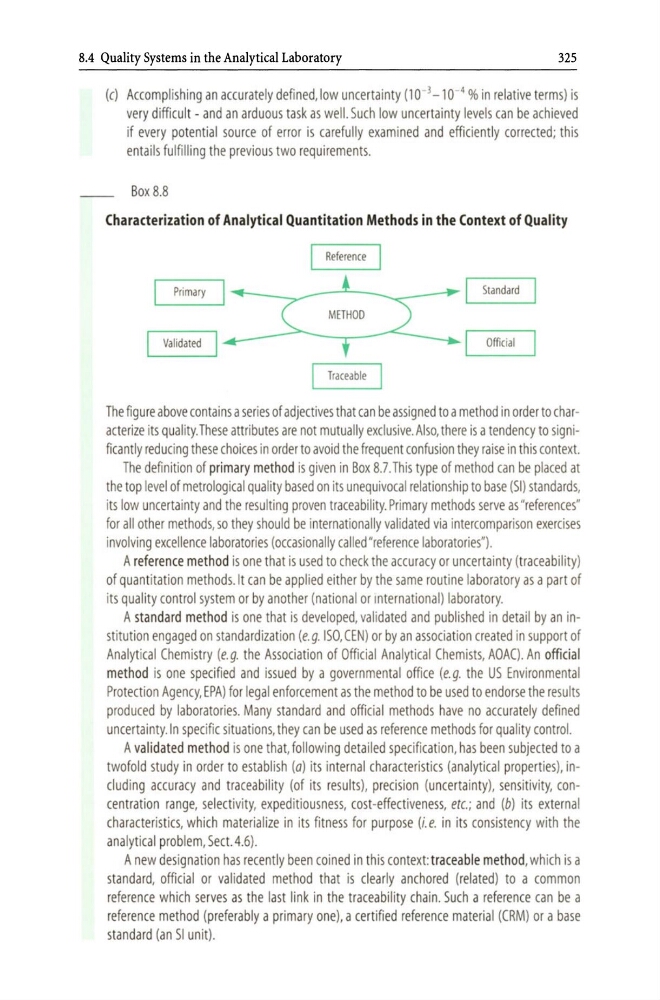
The figure above contains a series of adjectives that can be assigned to a method in order to characterize its qua lity.These attributes are not mutually exclusive. Also, there is a tendency to significantly reducing these choices in order to avoid the frequent confusion they raise in this context.
The definition of primary method is given in Box 8.7. This type of method can be placed at
the top level of metrological quality based on its unequivocal relationship to base (51) standards,
its low uncertainty and the resulting proven traceability. Primary methods serve as "references"
for all other methods, so they should be internationally validated via intercomparison exercises
involving excellence laboratories (occasionally called "reference laboratories").
A reference method is one that is used to check the accuracy or uncertainty (traceability)
of quantitation methods. It can be applied either by the same routine laboratory as a part of
its quality control system or by another (national or International) laboratory.
A standa rd method is one that is developed, validated and published in detail by an institution engaged on standardization (e.g. ISO, CEN) or by an association created in support of
Ana lytical Chemistry (e. g. the Association of Official Analytical Chemists, AOAC). An official
method is one specified and issued by a governmental office (e. g. the US Environmental
Protection Agency, EPA) for legal enforcement as the method to be used to endorse the results
produced by laboratories. Many standard and officia l methods have no accurately defined
uncertainty. In specific situations, they can be used as reference methods for quality control.
A validated method is one that, following detailed specification, has been subjected to a
twofold study in order to establish (a) its internal cha racteristics (analytical properties), including accuracy and traceabi lity (of its results), precision (uncertainty), sensitivity, concentration range, selectivity, expeditiousness, cost-effectiveness, etc.; and (b) its external
characteristics, which materialize in its fitness for purpose (i. e. in its consistency with the
analytical problem, Sect.4.6).
A new designation has recently been coined in this contexttraceable method, which is a
standard, official or validated method that is clearly anchored (related) to a common
reference wh ich serves as the last link in the traceability chain. Such a reference can be a
reference method (preferably a primary one), a certified reference material (CRM) or a base
standard (an 51 unit).
325
(e) Accomplishing an accurately defined, low uncertainty (10 - 3 - 10- 4 % in relative terms) is
very difficult - and an arduous task as well. 5uch low uncertainty levels can be achieved
if every potential source of error is carefully examined and efficiently corrected; this
entails fulfilling the previous two requirements.
Box 8.8
Characterization of Analytical Quantitation Methods in the Context of Quality
I Reference I
'--v_ .:_ :: _ ,:_ r Y. . . , ; ~ + 0 2: . ; _5 _ :,_ ::_ :d---,
I Traceable I
The figure above contains a series of adjectives that can be assigned to a method in order to characterize its qua lity.These attributes are not mutually exclusive. Also, there is a tendency to significantly reducing these choices in order to avoid the frequent confusion they raise in this context.
The definition of primary method is given in Box 8.7. This type of method can be placed at
the top level of metrological quality based on its unequivocal relationship to base (51) standards,
its low uncertainty and the resulting proven traceability. Primary methods serve as "references"
for all other methods, so they should be internationally validated via intercomparison exercises
involving excellence laboratories (occasionally called "reference laboratories").
A reference method is one that is used to check the accuracy or uncertainty (traceability)
of quantitation methods. It can be applied either by the same routine laboratory as a part of
its quality control system or by another (national or International) laboratory.
A standa rd method is one that is developed, validated and published in detail by an institution engaged on standardization (e.g. ISO, CEN) or by an association created in support of
Ana lytical Chemistry (e. g. the Association of Official Analytical Chemists, AOAC). An official
method is one specified and issued by a governmental office (e. g. the US Environmental
Protection Agency, EPA) for legal enforcement as the method to be used to endorse the results
produced by laboratories. Many standard and officia l methods have no accurately defined
uncertainty. In specific situations, they can be used as reference methods for quality control.
A validated method is one that, following detailed specification, has been subjected to a
twofold study in order to establish (a) its internal cha racteristics (analytical properties), including accuracy and traceabi lity (of its results), precision (uncertainty), sensitivity, concentration range, selectivity, expeditiousness, cost-effectiveness, etc.; and (b) its external
characteristics, which materialize in its fitness for purpose (i. e. in its consistency with the
analytical problem, Sect.4.6).
A new designation has recently been coined in this contexttraceable method, which is a
standard, official or validated method that is clearly anchored (related) to a common
reference wh ich serves as the last link in the traceability chain. Such a reference can be a
reference method (preferably a primary one), a certified reference material (CRM) or a base
standard (an 51 unit).