

316
QUALI TY POLICY
QUALITY SYSTEM
Entity
8 Analytical Chemistry and Quality
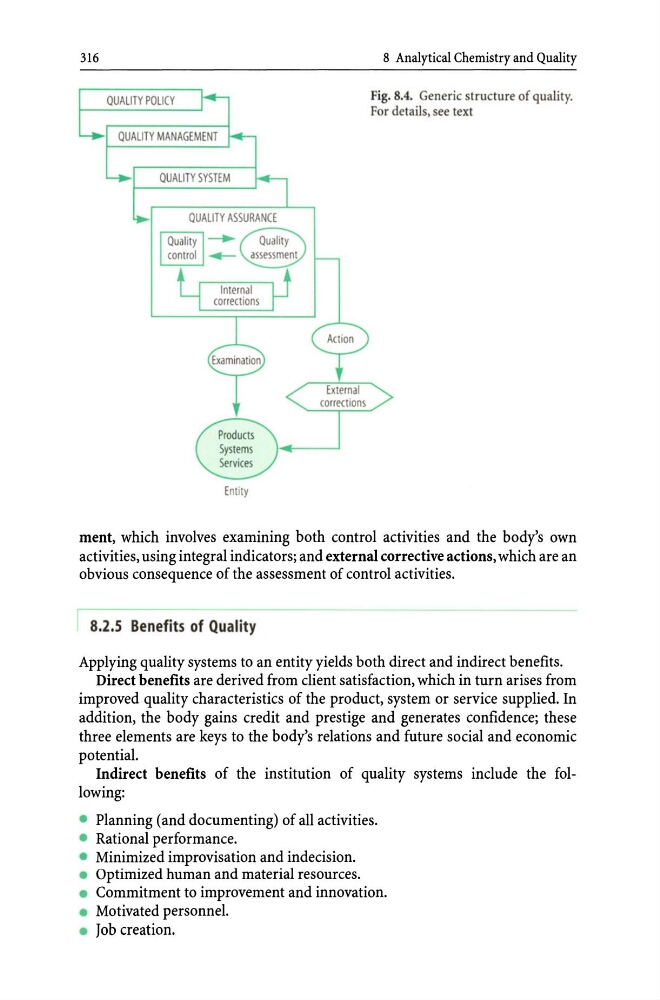
Fig. 8.4. Generic structure of quality.
For details, see text
ment, which involves examining both control activities and the body's own
activities, using integral indicators; and external corrective actions, which are an
obvious consequence of the assessment of control activities.
8.2.S Benefits of Quality
Applying quality systems to an entity yields both direct and indirect benefits.
Direct benefits are derived from client satisfaction, which in turn arises from
improved quality characteristics of the product, system or service supplied. In
addition, the body gains credit and prestige and generates confidence; these
three elements are keys to the body's relations and future social and economic
potential.
Indirect benefits of the institution of quality systems include the following:
• Planning (and documenting) of all activities.
• Rational performance.
• Minimized improvisation and indecision.
• Optimized human and material resources.
• Commitment to improvement and innovation.
• Motivated personnel.
• Job creation.
QUALI TY POLICY
QUALITY SYSTEM
Entity
8 Analytical Chemistry and Quality
Fig. 8.4. Generic structure of quality.
For details, see text
ment, which involves examining both control activities and the body's own
activities, using integral indicators; and external corrective actions, which are an
obvious consequence of the assessment of control activities.
8.2.S Benefits of Quality
Applying quality systems to an entity yields both direct and indirect benefits.
Direct benefits are derived from client satisfaction, which in turn arises from
improved quality characteristics of the product, system or service supplied. In
addition, the body gains credit and prestige and generates confidence; these
three elements are keys to the body's relations and future social and economic
potential.
Indirect benefits of the institution of quality systems include the following:
• Planning (and documenting) of all activities.
• Rational performance.
• Minimized improvisation and indecision.
• Optimized human and material resources.
• Commitment to improvement and innovation.
• Motivated personnel.
• Job creation.